Results by title
58 books match the query 'Margins' and 4 start with r
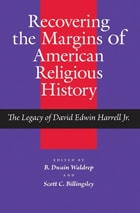
Recovering the Margins of American Religious History
The Legacy of David Edwin Harrell Jr.B. Dwain Waldrep
University of Alabama Press, 2012
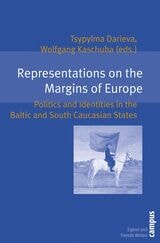
Representations on the Margins of Europe
Politics and Identities in the Baltic and South Caucasian StatesEdited by Tsypylma Darieva and Wolfgang Kaschuba
Campus Verlag, 2007
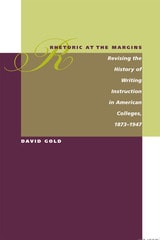
Rhetoric at the Margins
Revising the History of Writing Instruction in American Colleges, 1873-1947David Gold
Southern Illinois University Press, 2008
Rhetoric at the Margins: Revising the History of Writing Instruction in American Colleges, 1873-1947 examines the rhetorical education of African American, female, and working-class college students in the late nineteenth and early twentieth centuries. The rich case studies in this work encourage a reconceptualization of both the history of rhetoric and composition and the ways we make use of it.
Author David Gold uses archival materials to study three types of institutions historically underrepresented in disciplinary histories: a black liberal arts college in rural East Texas (Wiley College); a public women's college (Texas Woman's University); and an independent teacher training school (East Texas Normal College). The case studies complement and challenge previous disciplinary histories and suggest that the epistemological schema that have long applied to pedagogical practices may actually limit our understanding of those practices.
Gold argues that each of these schools championed intellectual and pedagogical traditions that differed from the Eastern liberal arts model—a model that often serves as the standard bearer for rhetorical education. He demonstrates that by emphasizing community uplift and civic participation and attending to local needs, these schools created contexts in which otherwise moribund curricular features of the era—such as strict classroom discipline and an emphasis on prescription—took on new possibilities.
Rhetoric at the Margins describes the recent revisionist turn in rhetoric and composition historiography, argues for the importance of diverse institutional microhistories, and argues that the nineteenth and early twentieth centuries offer rich lessons for contemporary classroom practice. The study brings alive the voices of black, female, rural, Southern, and first-generation college students and their instructors, effectively linking these histories to the history of rhetoric and writing. Appendices include excerpts of important and rarely seen primary source material, allowing readers to experience in fuller detail the voices captured in this work.
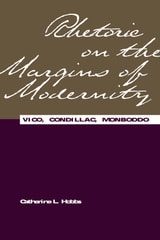
Rhetoric on the Margins of Modernity
Vico, Condillac, MonboddoCatherine L. Hobbs
Southern Illinois University Press, 2002
Changes in English studies today, particularly the rise of cultural studies, have forced reexaminations of historical genealogies. Three complex figures whose places are currently being reassessed include the Neapolitan Giambattista Vico (1668 –1744), the Frenchman Etienne de Condillac (1714 –1780), and the Scotsman James Burnet(t), Lord Monboddo (1714 –1799) in our histories of communication, linguistics, English studies, and now rhetoric.
In Rhetoric on the Margins of Modernity: Vico, Condillac, Monboddo, Catherine L. Hobbs focuses primarily on these three key figures in whose work rhetoric and linguistics intertwine as they respond to emerging attitudes and values of science and philosophy in the eighteenth century. Through her examination of works of Vico, Condillac, Monboddo and other marginal figures, Hobbs presents a different and more nuanced view of the transformation of rhetoric from classical to modern.
In order to redefine each figure’s position, Hobbs brings together the histories of linguistics, literature, rhetoric, and communication, rather than leaving them isolated in separate disciplines. She examines each figure’s theory of language origin and development as it has motivated their rhetorical theories. The result is Rhetoric on the Margins of Modernity: Vico, Condillac, Monboddo, an original and significant account of the formation of modern rhetoric.