Results by title
66 books match the query 'Masculinity in literature' and 2 start with r
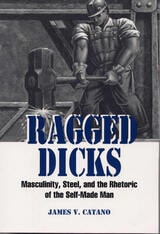
Ragged Dicks
Masculinity, Steel, and the Rhetoric of the Self-Made ManJames V. Catano
Southern Illinois University Press, 2001
Portraits of self-made men are rife in Western culture, as James V. Catano observes. Positive and negative, admittedly fictional and ostensibly factual, these portraits endure because the general rhetorical practice embodied in the myth of the self-made man enacts both the need and the very means for making oneself masculine: verbal power and prowess. The myth of the self-made man, in short, is part of ongoing rhetorical practices that constitute society, culture, and subjects.
To explain those practices and their effectiveness, Catano argues that the basic narrative achieves much of its effectiveness by engaging and enacting the traditional psychological dynamics of the family romance: preoedipal separation, oedipal conflict, and “proper” postoedipal self-definition and socialization.
To focus on the combined social, psychological, and rhetorical dynamics that constitute the ongoing activity he calls masculine self-making, Catano emphasizes a particular strand: masculinity and steelmaking. Pursuing that strand, he argues that these representations of masculine self-making are rhetorical enactments of cultural needs and desires, and that they are ongoing and formative arguments about what society and its individuals either are or should be.

Resisting Regionalism
Gender And Naturalism In American Fiction, 1885-1915Donna Campbell
Ohio University Press, 1997
When James Lane Allen defined the “Feminine Principle” and the “Masculine Principle” in American fiction for the Atlantic Monthly in 1897, he in effect described local color fiction and naturalism, two branches of realism often regarded as bearing little relationship to each other. In this award-winning study of both movements, Resisting Regionalism explores the effect the cultural dominance of women’s local color fiction in the 1890’s had on young male naturalist writers, who rebelled against the local colorists and their “teacup tragedies.”
An immensely popular genre, local color fiction reached its peak in the 1880s in such literary journals as Harper’s Monthly, Scribner’s, the Atlantic Monthly, and the Century. These short stories exhibited local “characters,” depicted marginal groups and vanishing folkways, and addressed issues of absence, loss, limitation, and the past. Despite such prickly themes, according to Donna Campbell, local color fiction “fulfilled some specific needs of the public – for nostalgia, for a retreat into mildly exotic locales, for a semblance of order preserved in ritual.”
By the turn of the century, however, local color fiction was fading from the scene, supplanted by writers of adventure fiction and historical romances, with whom local colorists increasingly merged, and opposed by the naturalists. In examining this historic shift, Resisting Regionalism shows that far from being distanced from local color fiction, nationalism emerged in part as a dissenting response to its popularity and to the era’s concerns about the dominance of feminine influence in American literature. The new generation of authors, including Crane, Norris, London, Frederic, Wharton, resisted the cultural myths and narrative strategies common to local colorists Sarah Orne Jewett, Rose Terry Cooke, Mary E. Wilkins Freeman, and Constance Fenimore Woolson. Yet, as Campbell underscores in her analysis of Stephan Crane’s The Monster, the naturalists could, and did, integrate local color conventions with the grotesque and horrifying to powerful effect.
In clear, accessible prose, Resisting Regionalism provides fresh readings of naturalistic works in the context of the dispute between local color and naturalism. In the process, this book shows the debt naturalism owes to local color fiction and illuminates a neglected but significant literary era.