Results by title
178 books match the query 'Media' and 12 start with r
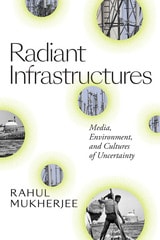
Radiant Infrastructures
Media, Environment, and Cultures of UncertaintyRahul Mukherjee
Duke University Press, 2020
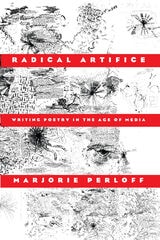
Radical Artifice
Writing Poetry in the Age of MediaMarjorie Perloff
University of Chicago Press, 1992
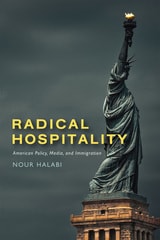
Radical Hospitality
American Policy, Media, and ImmigrationNour Halabi
Rutgers University Press, 2022
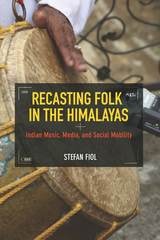
Recasting Folk in the Himalayas
Indian Music, Media, and Social MobilityStefan Fiol
University of Illinois Press, 2017

Reclaiming the Media
Communication Rights and Democratic Media RolesEdited by Bart Cammaerts and Nico Carpentier
Intellect Books, 1995
In the twentieth century, the media gave whistleblowers a voice, spearheaded the downfall of powerful politicians, and exposed widespread corporate corruption. How will the twenty-first-century media cope with its storied legacy as the watchdog of democratic society? Reclaiming the Media examines the sometimes tenuous, often fraught relationship between media organizations and civil rights in Europe. In sections devoted to citizenship, participation, contemporary journalism, and activist communication strategies, a panel of European media experts makes the case for deepening the media’s role in democracy.
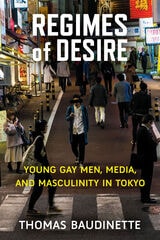
Regimes of Desire
Young Gay Men, Media, and Masculinity in TokyoThomas Baudinette
University of Michigan Press, 2021
Shinjuku Ni-chōme is a nightlife district in central Tokyo filled with bars and clubs targeting the city’s gay male community. Typically understood as a “safe space” where same-sex attracted men and women from across Japan’s largest city can gather to find support from a relentlessly heteronormative society, Regimes of Desire reveals that the neighborhood may not be as welcoming as previously depicted in prior literature. Through fieldwork observation and interviews with young men who regularly frequent the neighborhood’s many bars, the book reveals that the district is instead a space where only certain performances of gay identity are considered desirable. In fact, the district is highly stratified, with Shinjuku Ni-chōme’s bar culture privileging “hard” masculine identities as the only legitimate expression of gay desire and thus excluding all those men who supposedly “fail” to live up to these hegemonic gendered ideals.
Through careful analysis of media such as pornographic videos, manga comics, lifestyle magazines and online dating services, this book argues that the commercial imperatives of the Japanese gay media landscape and the bar culture of Shinjuku Ni-chōme act together to limit the agency of young gay men so as to better exploit them economically. Exploring the direct impacts of media consumption on the lives of four key informants who frequent the district’s gay bars in search of community, fun and romance, Regimes of Desire reveals the complexity of Tokyo’s most popular “gay town” and intervenes in debates over the changing nature of masculinity in contemporary Japan.
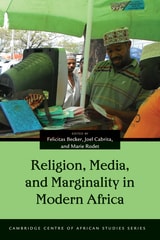
Religion, Media, and Marginality in Modern Africa
Felicitas Becker
Ohio University Press, 2018
In recent years, anthropologists, historians, and others have been drawn to study the profuse and creative usages of digital media by religious movements. At the same time, scholars of Christian Africa have long been concerned with the history of textual culture, the politics of Bible translation, and the status of the vernacular in Christianity. Students of Islam in Africa have similarly examined politics of knowledge, the transmission of learning in written form, and the influence of new media. Until now, however, these arenas—Christianity and Islam, digital media and “old” media—have been studied separately.
Religion, Media, and Marginality in Modern Africa is one of the first volumes to put new media and old media into significant conversation with one another, and also offers a rare comparison between Christianity and Islam in Africa. The contributors find many previously unacknowledged correspondences among different media and between the two faiths. In the process they challenge the technological determinism—the notion that certain types of media generate particular forms of religious expression—that haunts many studies. In evaluating how media usage and religious commitment intersect in the social, cultural, and political landscapes of modern Africa, this collection will contribute to the development of new paradigms for media and religious studies.
Contributors: Heike Behrend, Andre Chappatte, Maria Frahm-Arp, David Gordon, Liz Gunner, Bruce S. Hall, Sean Hanretta, Jorg Haustein, Katrien Pype, and Asonzeh Ukah.
Religion, Media, and the Marketplace
Clark, Lynn Schofield
Rutgers University Press, 2007
Religion is infiltrating the arena of consumer culture in increasingly visible ways. We see it in a myriad of forms-in movies, such as Mel Gibson's The Passion of the Christ, on Internet shrines and kitschy Web "altars," and in the recent advertising campaign that attacked fuel-guzzling SUVs by posing the question: What would Jesus drive?
In Religion, Media, and the Marketplace, scholars in history, media studies, and sociology explore this intersection of the secular and the sacred. Topics include how religious leaders negotiate between the competing aims of the mainstream and the devout in the commercial marketplace, how politics and religious beliefs combine to shape public policy initiatives, how the religious "other" is represented in the media, and how consumer products help define the practice of different faiths.
At a time when religious fundamentalism in the United States and throughout the world is inseparable from political aims, this interdisciplinary look at the mutual influences between religion and the media is essential reading for scholars from a wide variety of disciplines.

Renaissance Drama 34
Media, Technology, and PerformanceW. B. Worthen
Northwestern University Press, 2006
This issue of Renaissance Drama, devoted to the topic of "Media, Technology, and Performance" is co-edited by W.B. Worthen, Wendy Wall, and Jeffrey Masten. The various articles displayed here address the interface between drama and its various modes of production over the past four centuries. This volume explores the relationship of drama to other forms of early modern spectacle (pageantry, masques), to the specificities of typography and the economics of the book industry, to the intersection of drama with film and DVD production, and to the way that stage technologies and theatrical economies of the 16th, 17th and 20th centuries define plays and playing. Rather than thinking of the early modern text as something simply reconstituted in its different incarnations, these essays make clear that different media force a rethinking of the terms that we use to envision, conceptualize, and even to see the work of drama.
Rethinking Global Security
Media, Popular Culture, and the "War on Terror"Martin, Andrew
Rutgers University Press, 2006
Rewriting Crusoe
The Robinsonade across Languages, Cultures, and MediaJakub Lipski
Bucknell University Press, 2020
Published by Bucknell University Press. Distributed worldwide by Rutgers University Press.
Russia and the Media
The Makings of a New Cold WarGreg McLaughlin
Pluto Press, 2020
But recent propaganda images that define public debate around growing tensions with Russia are not new or arbitrary. Russia and the Media asks, what is the role of Western journalism in constructing a new kind of Cold War with Russia? Focusing on British and US media coverage of moments of crisis and of co-operation between the West and Russia, McLaughlin exposes how such a Cold War framework shapes public perceptions of a major, hostile power reasserting itself on the world stage.
Scrutinizing events such as the Ukraine/Crimea crisis, the Skripal Poisoning and Russia's military intervention in Syria - as well as analyzing media coverage of the 2018 Russian presidential election and build up to the 2018 World Cup - Russia and the Media makes a landmark intervention at the intersection of media studies and international relations.