Results by title
79 books match the query 'Media & Communications' and 5 start with r
Radio's Second Century
Past, Present, and Future PerspectivesJohn Allen Hendricks
Rutgers University Press, 2020
One of the first books to examine the status of broadcasting on its one hundredth anniversary, Radio’s Second Century investigates both vanguard and perennial topics relevant to radio’s past, present, and future. As the radio industry enters its second century of existence, it continues to be a dominant mass medium with almost total listenership saturation despite rapid technological advancements that provide alternatives for consumers. Lasting influences such as on-air personalities, audience behavior, fan relationships, and localism are analyzed as well as contemporary issues including social and digital media. Other essays examine the regulatory concerns that continue to exist for public radio, commercial radio, and community radio, and discuss the hindrances and challenges posed by government regulation with an emphasis on both American and international perspectives. Radio’s impact on cultural hegemony through creative programming content in the areas of religion, ethnic inclusivity, and gender parity is also explored. Taken together, this volume compromises a meaningful insight into the broadcast industry’s continuing power to inform and entertain listeners around the world via its oldest mass medium--radio.
Reality Squared
Televisual Discourse on the RealFriedman, James
Rutgers University Press, 2002
“Reality Squared develops the scholarly discussion of the aesthetic of realism, documentary conventions, and modes of television broadcasting, in sophisticated new directions. Friedman’s historical perspective is especially valuable since so much discussion of the new aesthetic of realism on television fails to take into account similar trends throughout television history.”—Ellen Seiter, professor of communication, University of California at San Diego
“Reality Squared offers a rich variety of insights into the way television and new media make us believe in the worlds they represent. Spanning across the decades of early live TV to contemporary digital culture, this volume is an important history, not only of media but alsoof our perception of reality itself.”—Lynn Spigel, University of Southern California and author of Welcome to the Dreamhouse
Through the 1980s and 1990s, the television industry and its critics have identified and promoted the re-emergence of “reality-based” television. During the past two decades, this type of programming has come to play a major role in both production decisions and network strategy. At the beginning of the twenty-first century, viewers’ desire for “reality TV” shows no signs of diminishing, as evidenced by the meteoric rise of shows such as Who Wants to be a Millionaire, Survivor, and MTV’s Real World.
Although debates concerning the relationship between representational media and reality have occupied scholars and artists for quite some time, a surprisingly small number of books have examined this subject. As the title suggests, Reality Squared examines the representation of reality within the squared televisual viewing frame, as
well as the exponential growth of these representational programs on broadcast, cable TV, and even beyond, to the worldwide web. The contributors approach the issues surrounding television and reality from a wide range of theoretical and methodological perspectives. Topics include: the internet, the impact of global news events, weather predictions on the Weather Channel, and the representation of criminality on America’s
Most Wanted. This diverse volume contributes to the ongoing conversation about reality and representation, history and fiction, text and context, and the “inside” and “outside” of that box we call television.
Renovating Value
HGTV and the Spectacle of GentrificationRobert Goldman
Temple University Press, 2021
HGTV has perfected stories about creating and capturing value in the housing market. But according to Robert Goldman, this lifestyle network’s beloved flagship programs, Flip or Flop, Property Brothers, and Fixer Upper—where people revitalize modern spaces and reinvent property values—offer “fairy tales” in the wake of the 2008 economic crisis. The cable channel’s seductive, bingeable programs may show how to find and extract value from properties, but, in fact, they insidiously ignore the realities of the real estate and mortgage markets, housing inequality, gentrification, economic insecurity, and even homelessness. In effect, HGTV has turned house flipping into a master narrative about getting ahead in America during an era of otherwise uneasy economic prospects.
HGTV pictures its insular moral economy as an alternative to a crisis-ridden neoliberal finance system that shaped landscapes of foreclosure and financial uncertainty for millions of households. Renovating Value explores the circuitry of consumer credit and debt, and a rent-gap model of gentrification that charts a path to the rehabilitation of Value. Goldman shrewdly critiques the aspirational myth of adding value to a home simply by using imagination, elbow grease, and aesthetic know-how.
Rereading Marx in the Age of Digital Capitalism
Christian Fuchs
Pluto Press, 2019
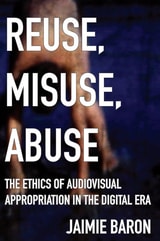
Reuse, Misuse, Abuse
The Ethics of Audiovisual Appropriation in the Digital EraJaimie Baron
Rutgers University Press, 2021