Results by title
308 books match the query 'Memory' and 23 start with r
Race, Politics, and Memory
A Documentary History of the Little Rock School CrisisCatherine M. Lewis
University of Arkansas Press, 2007
Recollecting Early Asian America
Essays In Cultural HistoryJosephine Lee
Temple University Press, 2002
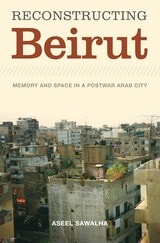
Reconstructing Beirut
Memory and Space in a Postwar Arab CityBy Aseel Sawalha
University of Texas Press, 2010
Once the cosmopolitan center of the Middle East, Beirut was devastated by the civil war that ran from 1975 to 1991, which dislocated many residents, disrupted normal municipal functions, and destroyed the vibrant downtown district. The aftermath of the war was an unstable situation Sawalha considers "a postwar state of emergency," even as the state strove to restore normalcy. This ethnography centers on various groups' responses to Beirut's large, privatized urban-renewal project that unfolded during this turbulent moment.
At the core of the study is the theme of remembering space. The official process of rebuilding the city as a node in the global economy collided with local day-to-day concerns, and all arguments invariably inspired narratives of what happened before and during the war. Sawalha explains how Beirutis invoked their past experiences of specific sites to vie for the power to shape those sites in the future. Rather than focus on a single site, the ethnography crosses multiple urban sites and social groups, to survey varied groups with interests in particular spaces. The book contextualizes these spatial conflicts within the discourses of the city's historical accounts and the much-debated concept of heritage, voiced in academic writing, politics, and journalism. In the afterword, Sawalha links these conflicts to the social and political crises of early twenty-first-century Beirut.

Recording Memories from Political Violence
A Film-maker's JourneyCahal McLaughlin
Intellect Books, 2010
Based on work the author has carried out with survivor groups in Northern Ireland and South Africa, Recording Memories from Political Violence draws on written and audiovisual texts to describe and analyze the use of documentary filmmaking in recording experiences of political conflict. A variety of issues relevant to the genre are addressed at length, including the importance of ethics in the collaboration between the filmmaker and the participant and the effect of location on the accounts of participants. Cahal McLaughlin draws on the diverse fields of film and cultural studies, as well as nearly twenty years of production experience, in this informed and instructive contribution to documentary filmmaking and post-conflict studies.
Recovered Roots
Collective Memory and the Making of Israeli National TraditionYael Zerubavel
University of Chicago Press, 1995
In the years leading to the birth of Israel, Zerubavel shows, Zionist settlers in Palestine consciously sought to rewrite Jewish history by reshaping Jewish memory. Zerubavel focuses on the nationalist reinterpretation of the defense of Masada against the Romans in 73 C.E. and the Bar Kokhba revolt of 133-135; and on the transformation of the 1920 defense of a new Jewish settlement in Tel Hai into a national myth. Zerubavel demonstrates how, in each case, Israeli memory transforms events that ended in death and defeat into heroic myths and symbols of national revival.
Drawing on a broad range of official and popular sources and original interviews, Zerubavel shows that the construction of a new national tradition is not necessarily the product of government policy but a creative collaboration between politicans, writers, and educators. Her discussion of the politics of commemoration demonstrates how rival groups can turn the past into an arena of conflict as they posit competing interpretations of history and opposing moral claims on the use of the past. Zerubavel analyzes the emergence of counter-memories within the reality of Israel's frequent wars, the ensuing debates about the future of the occupied territories, and the embattled relations with Palestinians.
A fascinating examination of the interplay between history and memory, this book will appeal to historians, sociologists, anthropologists, political scientists, and folklorists, as well as to scholars of cultural studies, literature, and communication.
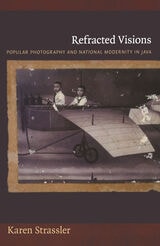
Refracted Visions
Popular Photography and National Modernity in JavaKaren Strassler
Duke University Press, 2010
Oriented to projects of selfhood, memory, and social affiliation, popular photographs recast national iconographies in an intimate register. They convey the longings of Indonesian national modernity: nostalgia for rural idylls and “tradition,” desires for the trappings of modernity and affluence, dreams of historical agency, and hopes for political authenticity. Yet photography also brings people into contact with ideas and images that transcend and at times undermine a strictly national frame. Photography’s primary practitioners in the postcolonial era have been Chinese Indonesians. Acting as cultural brokers who translate global and colonial imageries into national idioms, these members of a transnational minority have helped shape the visual contours of Indonesian belonging even as their own place within the nation remains tenuous. Refracted Visions illuminates the ways that everyday photographic practices generate visual habits that in turn give rise to political subjects and communities.
Religion as a Chain of Memory
Daniele Hervieu-Leger
Rutgers University Press, 2000
For most of the last twenty years, sociologists have studied the “decline” of religion in the modern world—a decline they saw as a defining feature of modernity, which promotes materialism over spirituality. The revival and political strength of varying religious traditions around the world, however, has forced sociologists to reconsider.
This paradox has led Hervieu-Léger to undertake a sociological redefinition and reexamination of religion. For religion to endure in the modern world, she finds, it must have deep roots in traditions and times in which it was not defined as irrelevant. This reasoning leads her to develop the concept of a “chain of memory”—a process by which individual believers become members of a community that links past, present, and future members. Thus, like cultural tradition, religion may be understood as a shared understanding with a collective memory that enables it to draw upon the deep well of its past for nourishment in the increasingly secular present.
Hervieu-Legér also argues that the modern secular societies of the West have not, as is commonly assumed, outgrown or found secular substitutes for religious traditions; nor are they more “rational” than past societies. Rather, modern societies have become “amnesiacs,” no longer able to maintain the chain of memory that binds them to their religious pasts. Ironically, however, even as the modern world is destroying and losing touch with its traditional religious bases, it is also creating the need for a spiritual life and is thus opening up a space that only religion can fill.
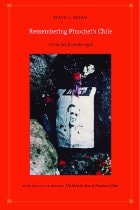
Remembering Pinochet's Chile
On the Eve of London 1998Steve J. Stern
Duke University Press, 2004
“A thoughtful, nuanced study of how Chileans remember the traumatic 1973 coup by Augusto Pinochet against Salvador Allende and the nearly two decades of military government that followed. . . . In light of the recent revelations of American human rights abuses of Iraqi prisoners, [Stern’s] insights into the legacies of torture and abuse in the Chilean prisons of the 1970s certainly have contemporary significance for any society that undergoes a national trauma.”—Publishers Weekly
“This outstanding work of scholarship sets a benchmark in the history of state terror, trauma, and memory in Latin America.”—Thomas Miller Klubock, American Historical Review
“This is a book of uncommon depth and introspection. . . . Steve J. Stern has not only advanced the memory of the horrors of the military dictatorship; he has assured the place of Pinochet’s legacy of atrocity in our collective conscience.”—Peter Kornbluh, author of The Pinochet File: A Declassified Dossier on Atrocity and Accountability
“Steve J. Stern’s book elegantly recounts the conflicted recent history of Chile. He has found a deft solution to the knotty problem of evenhandedness in representing points of view so divergent they defy even the most careful attempts to portray the facts of the Pinochet period. He weaves a tapestry of memory in which narratives of horror and rupture commingle with the sincere perceptions of Chileans who remember Pinochet’s rule as salvation. The facts are there, but more important is the understanding we gain by knowing how ordinary Chileans—Pinochet’s supporters and his victims—work through their unresolved past.”—John Dinges, author of The Condor Years: How Pinochet and His Allies Brought Terrorism to Three Continents
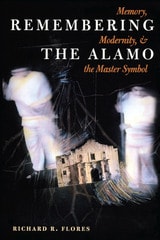
Remembering the Alamo
Memory, Modernity, and the Master SymbolBy Richard R. Flores
University of Texas Press, 2002
"Remember the Alamo!" reverberates through Texas history and culture, but what exactly are we remembering? Over nearly two centuries, the Mexican victory over an outnumbered band of Alamo defenders has been transformed into an American victory for the love of liberty. Why did the historical battle of 1836 undergo this metamorphosis in memory and mythology to become such a potent master symbol in Texan and American culture?
In this probing book, Richard Flores seeks to answer that question by examining how the Alamo's transformation into an American cultural icon helped to shape social, economic, and political relations between Anglo and Mexican Texans from the late nineteenth to the mid-twentieth centuries. In the first part of the book, he looks at how the attempts of heritage society members and political leaders to define the Alamo as a place have reflected struggles within Texas society over the place and status of Anglos and Mexicans. In the second part, he explores how Alamo movies and the transformation of Davy Crockett into an Alamo hero/martyr have advanced deeply racialized, ambiguous, and even invented understandings of the past.
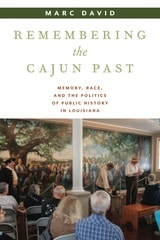
Remembering the Cajun Past
Memory, Race, and the Politics of Public History in LouisianaMarc David
University of Massachusetts Press, 2025
Exploring how public history creates collective memory of this white ethnic group through memorials
Cajuns arrived in southern Louisiana in the 18th century after the British exiled them from eastern Canada. Also known as Acadians, they retain a unique dialect of French, and their distinctive music, food, and other cultural traits characterized them as an ethnic group. Until the 1960s, authorities viewed them as a serious problem, allegedly blocking the state’s progress as they clung to their antiquated ways. Few Cajun residents in the region remembered the remote past of their ancestors, but by the 1970s, organizations ranging from local non-profits to the National Park Service created sites that commemorated their history, such as the Acadian Memorial in St. Martinville, allowing Cajuns to connect their lives to their past and claim it as their own.
In Remembering the Cajun Past, anthropologist Marc David studies the cultural and political dynamics that reconfigured Cajun memory and identity. Focusing on St. Martinville and the Acadian Memorial, he explores how authorities changed their minds about Cajuns and demonstrates how Cajuns’ historical memories took shape. Part ethnography and part history, David examines the racial aspects of the Memorial’s creation in the wake of the Civil Rights movement and the growth of a new Cajun history, one through which individual Cajuns rejected the label’s connotation of “white trash” and embraced belonging within a storied white ethnic group. Based on decades of fieldwork and deep engagement with public history practices, David explores how historical memory and the historic sites that foster it are intertwined with the politics of civic life.
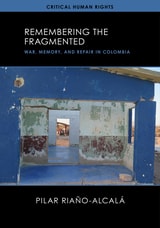
Remembering the Fragmented
War, Memory, and Repair in ColombiaPilar Riaño-Alcalá
University of Wisconsin Press, 2027
The South American nation of Colombia has experienced decades of violence involving state, guerrilla, and paramilitary actors, resulting in profound and enduring consequences. Scholars have examined both the violent events and the subsequent truth and reconciliation initiatives addressing this complex history. Pilar Riaño-Alcalá introduces a novel perspective by integrating Black, Indigenous, and memory studies in her analysis of two significant sites of mass violence: Bahia Portete, a Wayuu Indigenous territory in Upper Guajira, and Bojayá, a Black and Embera Indigenous territory in Chocó. By recognizing nonhuman and nonliving community members as actants and foregrounding Indigenous and Black ontologies in collective remembrance, Riaño-Alcalá reveals the processes through which these communities engage in social repair. She demonstrates how they interpret, restore, sustain, and reimagine their identities amid ongoing challenges posed by war and racial capitalism. This work advances scholarship in human rights studies, memory studies, Indigenous studies, Latin American studies, and the anthropology of social repair, offering significant new insights into a well-examined historical context.
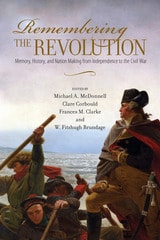
Remembering the Revolution
Memory, History, and Nation Making from Independence to the Civil WarMichael A. McDonnell
University of Massachusetts Press, 2013
In today's United States, the legacy of the American Revolution looms large. From presidential speeches to bestselling biographies, from conservative politics to school pageants, everybody knows something about the Revolution. Yet what was a messy, protracted, divisive, and destructive war has calcified into a glorified founding moment of the American nation. Disparate events with equally diverse participants have been reduced to a few key scenes and characters, presided over by well-meaning and wise old men.
Recollections of the Revolution did not always take today's form. In this lively collection of essays, historians and literary scholars consider how the first three generations of American citizens interpreted their nation's origins. The volume introduces readers to a host of individuals and groups both well known and obscure, from Molly Pitcher and “forgotten father” John Dickinson to African American Baptists in Georgia and antebellum pacifists. They show how the memory of the Revolution became politicized early in the nation's history, as different interests sought to harness its meaning for their own ends. No single faction succeeded, and at the outbreak of the Civil War the American people remained divided over how to remember the Revolution.
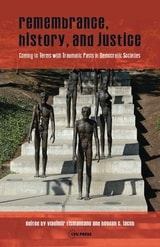
Remembrance, History, and Justice
Coming to terms with traumatic pasts in democratic societiesBogdan C. Iacob
Central European University Press, 2015
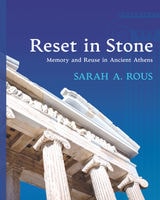
Reset in Stone
Memory and Reuse in Ancient AthensSarah A. Rous
University of Wisconsin Press, 2019
Sarah Rous develops the concept of upcycling to refer to this meaningful reclamation, the intentionality of reemploying each particular object for its specific new context. The upcycling approach drives innovative reinterpretations of diverse cases, including column drums built into fortification walls, recut inscriptions, monument renovations, and the wholesale relocation of buildings. Using archaeological, literary, and epigraphic evidence from more than eight centuries of Athenian history, Rous's investigation connects seemingly disparate instances of the reuse of building materials. She focuses on agency, offering an alternative to the traditional discourse on spolia. Reset in Stone illuminates a vital practice through which Athenians shaped social memory in the physical realm, literally building their past into their city.
Resonant Violence
Affect, Memory, and Activism in Post-Genocide SocietiesKerry Whigham
Rutgers University Press, 2022
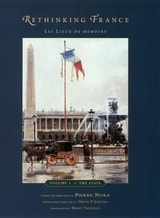
Rethinking France
Les Lieux de mémoire, Volume 1: The StateEdited by Pierre Nora. David P. Jordan, General Editor
University of Chicago Press, 2001
The first volume in the Chicago translation, Rethinking France, brings together works addressing the omnipresent role of the state in French life. As in the other volumes, the lieux de mémoire serve as entries into the French past, whether they are actual sites, political traditions, rituals, or even national pastimes and textbooks. Volume I: The State offers a sophisticated and engaging view of the French and their past through widely diverse essays on, for example, the château of Versailles and the French history of absolutism; the Code civil and its ordering of French life; memoirs written by French statesmen; and Charlemagne and his place in French history. Nora's authors constitute a who's who of French academia, yet they wear their erudition lightly. Taken as a whole, this extraordinary series documents how the French have come to see themselves and why.
Contributors:
Alain Guéry
Maurice Agulhon
Bernard Guenée
Daniel Nordman
Robert Morrissey
Alain Boureau
Anne-Marie Lecoq
Hélène Himelfarb
Jean Carbonnier
Hervé Le Bras
Pierre Nora
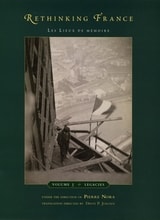
Rethinking France
Les Lieux de mémoire, Volume 3: LegaciesEdited by Pierre Nora. David P. Jordan, General Editor
University of Chicago Press, 2009
The third volume of Pierre Nora’s monumental work documenting the history and culture of France turns to French manners, mores, and society. While previous volumes focused on specific historical events, people, and institutions within France, the essays in Legacies are concerned with the kinds of things that make up the heart of French culture: conversation, cafés, songs, wine, gallantry, and places imbued with national symbolism such as Notre Dame and Sacré Coeur cathedrals. Linking these diverse topics together is the idea of patrimony—a term used by the French to designate the collective culture of the country or its national heritage—a concept that has undergone radical changes beginning with the Revolution and corresponding to other dramatic ruptures throughout France’s history.
As a whole, these twelve essays by leading French historians add up to an illuminating and well-rounded portrait of those cherished traditions that together form the basic foundation for the distinctive culture of the French.
Rethinking France
Les Lieux de mémoire, Volume 4: Histories and MemoriesEdited by Pierre Nora. David P. Jordan, Translation Editor
University of Chicago Press, 2010
Revolt of the Saints
Memory and Redemption in the Twilight of Brazilian Racial DemocracyJohn F. Collins
Duke University Press, 2015
Rhetorical Memory
A Study of Technical Communication and Information ManagementStewart Whittemore
University of Chicago Press, 2015
In Rhetorical Memory, Stewart Whittemore demonstrates that strategies we use to manage information—techniques often acquired through trial and error, rarely studied, and generally invisible to us—are as important to our success as the end products of our work. First, he situates information management within the larger field of rhetoric, showing that both are tied to purpose, audience, and situation. He then dives into an engaging and tightly focused workplace study, presenting three cases from a team of technical communicators making use of organizational memory during their everyday work. By examining which techniques succeed and which fail, Whittemore illuminates the challenges faced by technical communicators. He concludes with a number of practical strategies to better organize information, that will help employees, managers, and anyone else suffering from information overload.
Rhetorical Vectors of Memory in National and International Holocaust Trials
Marouf A. Hasian Jr.
Michigan State University Press, 2006
During the past several decades, the twentieth century Holocaust has become a defining event in many histories. This newfound respect for the Judeocide has been cathartic for both individuals and communities, in that it provides evidence that audiences around the world are rethinking the significance of the World War II narratives of bystanders, perpetrators, and victims. Given the complexities of these issues, scholars who are interested in studying Holocaust memory make choices about the questions on which they focus, the artifacts they select for analysis, and the perspectives they want to present.
Hasian reviews how national and international courts have used Holocaust trials as forums for debates about individuated justice, historical record keeping, and pedagogical memory work. He concludes that the trials involving Auschwitz, Demjanjuk, Eichmann, Finta, Nuremberg, Irving, Kastner, Keegstra, Sawoniuk, and Zündel are highly problematic. The author provides a rhetorical analysis of holocaust trials as a way of looking into the question of what role court proceedings play in the creation of Holocaust collective memories.

River of Tears
Country Music, Memory, and Modernity in BrazilAlexander Sebastian Dent
Duke University Press, 2009
Since 1998, Alexander Sebastian Dent has analyzed rural music in the state of São Paulo, interviewing and spending time with listeners, musicians, songwriters, journalists, record-company owners, and radio hosts. Dent not only describes the production and reception of this music, he also explains why the genre experienced such tremendous growth as Brazil transitioned from an era of dictatorship to a period of intense neoliberal reform. Dent argues that rural genres reflect a widespread anxiety that change has been too radical and has come too fast. In defining their music as rural, Brazil’s country musicians—whose work circulates largely in cities—are criticizing an increasingly inescapable urban life characterized by suppressed emotions and an inattentiveness to the past. Their performances evoke a river of tears flowing through a landscape of loss—of love, of life in the countryside, and of man’s connections to the natural world.
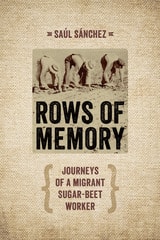
Rows of Memory
Journeys of a Migrant Sugar-Beet WorkerSaul Sanchez
University of Iowa Press, 2014
Rows of Memory tells his story and the story of his family and other migrant farm laborers like them, people who endured dangerous, dirty conditions and low pay, surviving because they took care of each other. Facing racism both on the road and at home, they lived a largely segregated life only occasionally breached by friendly employers.
Despite starting school late and leaving early every year and having to learn English on the fly, young Saúl succeeded academically. At the same time that Mexican Americans in South Texas upended the Anglo-dominated social order by voting their own leaders into local government, he upended his family’s order by deciding to go to college. Like many migrant children, he knew that his decision to pursue an education meant he would no longer be able to help feed and clothe the rest of his family. Nevertheless, with his parents’ support, he went to college, graduating in 1967 and, after a final display of his skill with a short hoe for his new friends, abandoned migrant labor for teaching.
In looking back at his youth, Sánchez invites us to appreciate the largely unrecognized and poorly rewarded strength and skill of the laborers who harvest the fruits and vegetables we eat. A first-person portrait of life on the bottom rung of the food system, this coming-of-age tale illuminates both the history of Latinos in the United States and the human consequences of industrial agriculture.