Results by title
128 books match the query 'Men' and 4 start with r
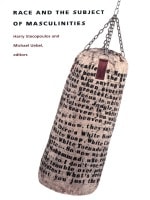
Race and the Subject of Masculinities
Harry Stecopoulos and Michael Uebel, eds.
Duke University Press, 1997
Discussing a wide range of subjects including the inherent homoeroticism of martial-arts cinema, the relationship between working-class ideologies and Elvis impersonators, the emergence of a gay, black masculine aesthetic in the works of James Van der Zee and Robert Mapplethorpe, and the comedy of Richard Pryor, Race and the Subject of Masculinities provides a variety of opportunities for thinking about how race, sexuality, and "manhood" are reinforced and reconstituted in today’s society. Editors Harry Stecopoulos and Michael Uebel have gathered together essays that make clear how the formation of masculine identity is never as obvious as it might seem to be. Examining personas as varied as Eddie Murphy, Bruce Lee, Tarzan, Malcolm X, and Andre Gidé, these essays draw on feminist critique and queer theory to demonstrate how cross-identification through performance and spectatorship among men of different races and cultural backgrounds has served to redefine masculinity in contemporary culture. By taking seriously the role of race in the making of men, Race and the Subject of Masculinities offers an important challenge to the new studies of masculinity.
Contributors. Herman Beavers, Jonathan Dollimore, Richard Dyer, Robin D. G. Kelly, Christopher Looby, Leerom Medovoi, Eric Lott, Deborah E. McDowell, José E. Muñoz, Harry Stecopoulos, Yvonne Tasker, Michael Uebel, Gayle Wald, Robyn Wiegman
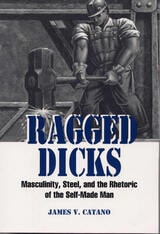
Ragged Dicks
Masculinity, Steel, and the Rhetoric of the Self-Made ManJames V. Catano
Southern Illinois University Press, 2001
Portraits of self-made men are rife in Western culture, as James V. Catano observes. Positive and negative, admittedly fictional and ostensibly factual, these portraits endure because the general rhetorical practice embodied in the myth of the self-made man enacts both the need and the very means for making oneself masculine: verbal power and prowess. The myth of the self-made man, in short, is part of ongoing rhetorical practices that constitute society, culture, and subjects.
To explain those practices and their effectiveness, Catano argues that the basic narrative achieves much of its effectiveness by engaging and enacting the traditional psychological dynamics of the family romance: preoedipal separation, oedipal conflict, and “proper” postoedipal self-definition and socialization.
To focus on the combined social, psychological, and rhetorical dynamics that constitute the ongoing activity he calls masculine self-making, Catano emphasizes a particular strand: masculinity and steelmaking. Pursuing that strand, he argues that these representations of masculine self-making are rhetorical enactments of cultural needs and desires, and that they are ongoing and formative arguments about what society and its individuals either are or should be.
Reading and Disorder in Antebellum America
David M. Stewart
The Ohio State University Press, 2011
Reclaimed Powers
Men and Women in Later LifeDavid Gutmann
Northwestern University Press, 1994