Results by title
94 books match the query 'Middle Ages, 600-1500' and 4 start with r
Reading Job with St. Thomas Aquinas
Matthew Levering
Catholic University of America Press, 2020
Reading Job with St. Thomas Aquinas is a scholarly contribution to Thomistic studies, specifically to the study of Aquinas’s biblical exegesis in relation to his philosophy and theology. Each of the thirteen chapters has a different focus, within the shared concentration of the book on Aquinas’s Literal Exposition on Job. The essays are arranged in three Parts: “Job and Sacra Doctrina”; “Providence and Suffering”; and “Job and the Moral Life”. Boyle’s opening essay argues that Aquinas’s commentary seeks to show what is required in the “Magister” (namely, Job and God) for the effective communication of wisdom. Mansini’s essay argues that by speaking, God reveals the virtue of Job and its value in God’s providence; without the personal revelation or speech of God, Job could not have known the value of his suffering. Vijgen’s essay explores the commentary’s use of Aristotle for reflecting upon divine providence, sorrow and anger, resurrection, and the new heavens and new earth. Levering’s essay explores the commentary’s citations of the Gospel of John and argues that these pertain especially to divine speech and to light/darkness. Bonino’s essay explains why divine incomprehensibility does not mean that Job is wrong to seek to understand God’s ways. Te Velde’s essay explores how Aquinas’s commentary draws upon the reasoning of his Summa contra gentiles with regard to the good order of the universe. Goris’s essay reflects upon how, according to Aquinas’s commentary, sin is and is not related to suffering. Knasas’s essay argues that Aquinas does not hold that the resurrection of the body is a necessary philosophical corollary of the human desire for happiness. Wawrykow’s essay explores merit, in relation to the connection between sin and punishment/affliction as well as to the connection between good actions and flourishing. Spezzano’s essay shows that Job’s hope and filial fear transform his suffering, making him an exemplar of the consolation they provide to the just. Mullady’s essay reflects upon the moral problems and opportunities posed by the passions, along with the ordering of the virtues to the reward of human happiness. Flood’s essay shows how Aquinas defends Job’s possession of the qualities needed for true friendship (including friendship with God), such as patience, delight in the presence of the friend, and compassion. Lastly, Kromholtz’s essay argues that although Aquinas’s Literal Exposition on Job never extensively engages eschatology, Aquinas depends throughout upon the reasonableness of hoping for the resurrection of the body and the final judgment.
[more]
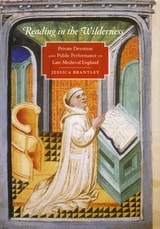
Reading in the Wilderness
Private Devotion and Public Performance in Late Medieval EnglandJessica Brantley
University of Chicago Press, 2007
Just as twenty-first-century technologies like blogs and wikis have transformed the once private act of reading into a public enterprise, devotional reading experiences in the Middle Ages were dependent upon an oscillation between the solitary and the communal. In Reading in the Wilderness, Jessica Brantley uses tools from both literary criticism and art history to illuminate Additional MS 37049, an illustrated Carthusian miscellany housed in the British Library. This revealing artifact, Brantley argues, closes the gap between group spectatorship and private study in late medieval England.
Drawing on the work of W. J. T. Mitchell, Michael Camille, and others working at the image-text crossroads, Reading in the Wilderness addresses the manuscript’s texts and illustrations to examine connections between reading and performance within the solitary monk’s cell and also outside. Brantley reimagines the medieval codex as a site where the meanings of images and words are performed, both publicly and privately, in the act of reading.
Drawing on the work of W. J. T. Mitchell, Michael Camille, and others working at the image-text crossroads, Reading in the Wilderness addresses the manuscript’s texts and illustrations to examine connections between reading and performance within the solitary monk’s cell and also outside. Brantley reimagines the medieval codex as a site where the meanings of images and words are performed, both publicly and privately, in the act of reading.
[more]
Reassessing Reform
Christopher M. Bellitto
Catholic University of America Press, 2012
Now, in celebration of the fiftieth anniversaries of the publication of The Idea of Reform and the Second Vatican Council, Reassessing Reform explores and critiques the enduring significance of Ladner's study, surveying new avenues and insights of more recent reform scholarship, especially concerning the long Middle Ages.
[more]
Robert of Arbrissel
Sex, Sin, and Salvation in the Middle AgesJacques Dalarun
Catholic University of America Press, 2006
This book tells the fascinating story of Robert of Arbrissel (ca. 1045-1116). Robert was a parish priest, longtime student, reformer, hermit, wandering preacher, and, most famously, founder of the abbey of Fontevraud
[more]