Results by title
60 books match the query 'Middle Eastern Studies' and 6 start with r

Resisting War
The Politics of Conscientious ObjectionPinar Kemerli
Duke University Press, 2027
Political theorists conventionally frame conscientious objection as a private and apolitical corollary of civil disobedience. In Resisting War, Pınar Kemerli challenges this depoliticized interpretation and argues that conscientious objection can be a radically political practice that calls into question the state’s right to coerce individuals to partake in wars deemed oppressive and unjust. Interweaving a study of the evolution of conscientious objection theory and practice from the First World War onward with extensive fieldwork examining the Turkish antiwar movement, Kemerli tracks the many ways this resistance practice taps into the diverse histories and paradigms of anticolonialism and anti-imperialism. Connecting the stories of African American Muslims to Vietnam and then to Turks and Kurds in the Middle East, Kemerli shows how the refusal to participate in war ultimately raises its own distinct contestation of state sovereignty, nationalist allegiance, and the normative religiosities that claim people in the service of militarized nationalism.
[more]
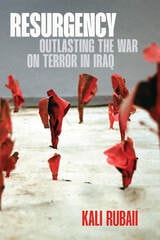
Resurgency
Outlasting the War on Terror in IraqKali Rubaii
Duke University Press, 2026
Resurgency examines how Iraqi farmers outlast the long shadow of US military intervention as they return to repair their war-damaged homeland. Based on detailed ethnographic research, Kali Rubaii expands the temporal and descriptive definitions of war, displacement, and resistance.
In Resurgency, Kali Rubaii offers detailed ethnographic insight into how decades of war have affected everyday life in Iraq. Drawing on fieldwork in Anbar province and Iraqi Kurdistan in 2014–15 and 2021–24, Rubaii foregrounds the practices of displaced people who stubbornly outlast their occupiers, returning to homes that feel estranging, repairing war-damaged land, and surviving into futures to which they have been disinvited. Following Anbari farmers in their struggle to counter the social and environmental fallout from toxic military waste, depleted ecosystems, and transformed political economies, Resurgency expands the temporal and descriptive categories of what war is—and what resistance looks like. By asking what actions and dispositions make sense when conditions of survival are diminished, and when today may be better than tomorrow, Rubaii offers new methods and insights to those concerned about the possibilities of life amid environmental devastation, mass displacement, and the slow violence of the forever wars.
In Resurgency, Kali Rubaii offers detailed ethnographic insight into how decades of war have affected everyday life in Iraq. Drawing on fieldwork in Anbar province and Iraqi Kurdistan in 2014–15 and 2021–24, Rubaii foregrounds the practices of displaced people who stubbornly outlast their occupiers, returning to homes that feel estranging, repairing war-damaged land, and surviving into futures to which they have been disinvited. Following Anbari farmers in their struggle to counter the social and environmental fallout from toxic military waste, depleted ecosystems, and transformed political economies, Resurgency expands the temporal and descriptive categories of what war is—and what resistance looks like. By asking what actions and dispositions make sense when conditions of survival are diminished, and when today may be better than tomorrow, Rubaii offers new methods and insights to those concerned about the possibilities of life amid environmental devastation, mass displacement, and the slow violence of the forever wars.
[more]
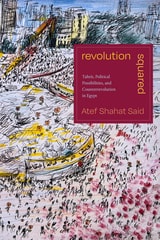
Revolution Squared
Tahrir, Political Possibilities, and Counterrevolution in EgyptAtef Shahat Said
Duke University Press, 2024
In Revolution Squared Atef Shahat Said examines the 2011 Egyptian Revolution to trace the expansive range of liberatory possibilities and containment at the heart of every revolution. Drawing on historical analysis and his own participation in the revolution, Said outlines the importance of Tahrir Square and other physical spaces as well as the role of social media and digital spaces. He develops the notion of lived contingency—the ways revolutionary actors practice and experience the revolution in terms of the actions they do or do not take—to show how Egyptians made sense of what was possible during the revolution. Said charts the lived contingencies of Egyptian revolutionaries from the decade prior to the revolution’s outbreak to its peak and the so-called transition to democracy to the 2013 military coup into the present. Contrary to retrospective accounts and counterrevolutionary thought, Said argues that the Egyptian Revolution was not doomed to defeat. Rather, he demonstrates that Egyptians did not fully grasp their immense clout and that limited reformist demands reduced the revolution’s potential for transformation.
[more]
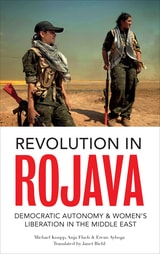
Revolution in Rojava
Democratic Autonomy and Women's Liberation in the Syrian KurdistanMichael Knapp, Ercan Ayboga, and Anja Flach
Pluto Press, 2016
“Their first-hand experiences and active participation in the anti-capitalist society being built in the region make this the first detailed account of the popular revolution….The definitive book so far on Rojava."― Morning Star
Revolution in Rojava tells the story of Rojava's groundbreaking experiment in what they call democratic confederalism, a communally organized democracy that is fiercely anti-capitalist and committed to female equality, while rejecting reactionary nationalist ideologies.
Rooted in the ideas of imprisoned Kurdish leader Abdullah Ocalan, the system is built on effective gender quotas, bottom-up democratic structures, far-sighted ecological policies, and a powerful militancy that has allowed the region to keep ISIS at bay.
Given the widespread violence and suffering in Syria, it's not unreasonable that outsiders look at the situation as unrelentingly awful. And while the reality of the devastation is undeniable, there is reason for hope in at least one small pocket of the nation: the cantons of Rojava in Syrian Kurdistan, where in the wake of war people are quietly building one of the most progressive societies in the world today. Chapters here include:
*Rojava's Diverse Cultures
*Democratic Confederalism
*The Liberation
*A Women's Revolution
*Democratic Autonomy in Rojava
*Civil Society Associations
*The Theory of the Rose: Defense
*The New Justice System
*Democratization of Education
*Health Care
*The Social Economy
*Ecological Challenges
This first full-length study of democratic developments in Rojava tells an extraordinary and powerfully hopeful story of a little-known battle for true freedom in dark times. With excellent first-hand background information about this important, but little understood struggle, Revolution in Rojava will educate and inspire the reader to learn more about Rojava, Syria, and the fight for change in one of the world’s most dangerous regions.
[more]

Riding
Pardis Mahdavi
Duke University Press, 2025
In Riding, Pardis Mahdavi meditates on the lessons learned over a lifetime of horseback riding and the falling, failing, and joy it brings. At once a history of Caspian horses, an exploration of Mahdavi’s Iranian-American identity and family history, and a consideration of the capacity for self-reflection and self-compassion through human-animal relationships, Riding offers a roadmap for learning to live in harmony with the self and the environment around us. Mahdavi shows how her relationship with horses gives her insights into intergenerational strength and tools for healing intergenerational trauma. Riding from the mountains of Iran to the beaches of California, Mahdavi shares her love affair with horses, rediscovers a homeland she longs for, and ultimately finds her strength.
[more]