Results by title
187 books match the query 'Minorities' and 9 start with r
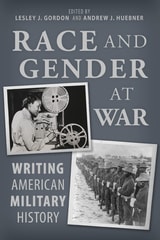
Race and Gender at War
Writing American Military HistoryEdited by Lesley J. Gordon and Andrew J. Huebner
University of Alabama Press, 2024
Beyond the battlefield: How race and gender redefined war, identity, and memory in Civil War America.
Race and Gender at War is a collection of essays that illuminates ways that race and gender have persistently shaped the military history of the United States. Editors Lesley J. Gordon and Andrew J. Huebner showcase historians with varied research agendas in the field of “war and society,” a fertile area of inquiry that shares space (and often overlaps) with operational studies inside the broader field of military history. Chronicling more than 150 years of American history, the essays in this volume demonstrate that the tensions and injustices surrounding race, gender, and the military remain relevant and controversial, and continue to roil American politics, society, and culture to this day.
Spanning the two centuries from the 1830s to the present, the collection examines topics such as Choctaw Natives who served in the Confederate Army, the trailblazing but fraught experiences of Black servicemen from the Civil War through World War I, the hypersexualized images of World War II servicemen, and the varied and mutable roles of women in the armed services. Utilizing diverse methodologies, the book examines how these factors influenced everything from military policy to civilian experiences, encompassing topics like martial rhetoric, citizenship, propaganda, and patriotism.
CONTRIBUTORS
Kevin Adams / Amanda Bellows / Kari L. Boyd-Weisenberger / Michele Curran Cornell / Lesley J. Gordon / Andrew J. Huebner / Gregory Mixon / Caroline Wood Newhall / Heather Marie Stur / Patrick T. Troester / Chad L. Williams / Fay A. Yarbrough
Race and Human Rights
Curtis Stokes
Michigan State University Press, 2008
The terrorist attacks against U.S. targets on September 11, 2001, and the subsequent wars in Afghanistan and Iraq, sparked an intense debate about "human rights." According to contributors to this provocative book, the discussion of human rights to date has been far too narrow. They argue that any conversation about human rights in the United States must include equal rights for all residents.
Essays examine the historical and intellectual context for the modern debate about human rights, the racial implications of the war on terrorism, the intersection of racial oppression, and the national security state. Others look at the Pinkerton detective agency as a forerunner of the Federal Bureau of Investigation, the role of Africa in post–World War II American attempts at empire-building, and the role of immigration as a human rights issue.
Race and Retail
Consumption across the Color LineBay, Mia
Rutgers University Press, 2015
Race in the College Classroom
TuSmith, Bonnie
Rutgers University Press, 2002
Winner of the 2003 American Educational Studies Association Critics' Choice Awards
Winner of the 2003 Gustavus Myers Outstanding Book Award
Did affirmative action programs solve the problem of race on American college campuses, as several recent books would have us believe? If so, why does talking about race in anything more than a superficial way make so many students uncomfortable? Written by college instructors from many disciplines, this volume of essays takes a bold first step toward a nationwide conversation. Each of the twenty-nine contributors addresses one central question: what are the challenges facing a college professor who believes that teaching responsibly requires an honest and searching examination of race?
Professors from the humanities, social sciences, sciences, and education consider topics such as how the classroom environment is structured by race; the temptation to retreat from challenging students when faced with possible reprisals in the form of complaints or negative evaluations; the implications of using standardized evaluations in faculty tenure and promotion when the course subject is intimately connected with race; and the varying ways in which white faculty and faculty of color are impacted by teaching about race.
Race, Ethnicity, and the COVID-19 Pandemic
Edited by Melvin E. Thomas, Loren M. Henderson, and Hayward Derrick Horton
University of Minnesota Press, 2022
To understand racial disparities in COVID-19 infections and deaths, we must first understand how they are linked to racial inequality. In the United States, the material advantages afforded by whiteness lead to lower rates of infections and deaths from COVID-19 when compared to the rates among Black, Latino, and Native American populations. Most experts point to differences in population density, underlying health conditions, and proportions of essential workers as the primary determinants in the levels of COVID-19 deaths.
The national response to the pandemic has laid bare the fundamentals of a racialized social structure. Assembled by a prestigious group of sociologists, this volume examines how particularly during the first year of COVID-19, the socioeconomic impact of the pandemic led to different and poorer outcomes for Black, Latino, and Native American populations. While color-blindness shaped national discussions on essential workers, charity, and differential mortality, minorities were overwhelmingly affected. The essays in this collection provide a mix of critical examination of the progress and direction of our COVID-19 response, personal accounts of the stark difference in care and outcomes for minorities throughout the United States, and offer recommendations to create a foundation for future response and research during the critical early days.
Race, Religion, Region
Landscapes of Encounter in the American WestEdited by Fay Botham and Sara M. Patterson
University of Arizona Press, 2006
This book moves beyond familiar stereotypes to achieve a more nuanced understanding of race while also showing how ethnicity formed in conjunction with religious and regional identity. The chapters demonstrate how religion shaped cultural encounters, contributed to the construction of racial identities, and served as a motivating factor in the lives of historical actors. The opening chapters document how religion fostered community in Los Angeles in the first half of the twentieth century. The second section examines how physical encounters—such as those involving Chinese immigrants, Hermanos Penitentes, and Pueblo dancers—shaped religious and racial encounters in the West. The final essays investigate racial and religious identity among the Latter-day Saints and southern California Muslims. As these contributions clearly show, race, religion, and region are as critical as gender, sexuality, and class in understanding the melting pot that is the West. By depicting the West as a unique site for understanding race and religion, they open a new window on how we view all of America.
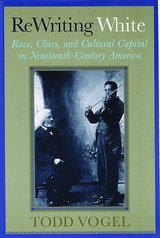
Rewriting White
Race, Class, and Cultural Capital in Nineteenth-Century AmericaTodd Vogel
Rutgers University Press, 2004
What did it mean for people of color in nineteenth-century America to speak or write "white"? More specifically, how many and what kinds of meaning could such "white" writing carry? In ReWriting White, Todd Vogel looks at how America has racialized language and aesthetic achievement. To make his point, he showcases the surprisingly complex interactions between four nineteenth-century writers of color and the "standard white English" they adapted for their own moral, political, and social ends. The African American, Native American, and Chinese American writers Vogel discusses delivered their messages in a manner that simultaneously demonstrated their command of the dominant discourse of their times-using styles and addressing forums considered above their station-and fashioned a subversive meaning in the very act of that demonstration.
The close readings and meticulous archival research in ReWriting White upend our conventional expectations, enrich our understanding of the dynamics of hegemony and cultural struggle, and contribute to the efforts of other cutting-edge contemporary scholars to chip away at the walls of racial segregation that have for too long defined and defaced the landscape of American literary and cultural studies.
Rhetorical Listening
Identification, Gender, WhitenessKrista Ratcliffe
Southern Illinois University Press, 2005
Extending the feminist rhetorical project to define and model rhetorical listening
Long-ignored within rhetoric and composition studies, listening has returned to the disciplinary radar. Rhetorical Listening: Identification, Gender, Whiteness argues that rhetorical listening facilitates conscious identifications needed for cross-cultural communication.
Krista Ratcliffe establishes eavesdropping, listening metonymically, and listening pedagogically as approaches to rhetorical listening. She defines and models rhetorical listening, addressing identifications with gender and whiteness within public debates, scholarship, and pedagogy. Offering an approach grounded in classical rhetorical theory, Heideggerian theory, feminist theory, and critical race theory, Ratcliffe presents rhetorical listening as an invention tactic that engages spoken and written texts and supplements reading, writing, speaking, and silence as a rhetorical art.
Theorizing intersections of gender and whiteness, Rhetorical Listening examines how whiteness functions as an "invisible" racial category and provides disciplinary and cultural reasons for the displacement of listening and for the use of rhetorical listening as a code of cross-cultural conduct. Ratcliffe presents rhetorical listening in terms of cultural logics, stances, and dominant interpretive tropes. She highlights the modern identification theory of Kenneth Burke and the postmodern identification and disidentification theory of Diana Fuss and presents nonidentification as a more productive site for rhetorical listening.
Rise Up!
Activism as EducationAmalia Dache
Michigan State University Press, 2019