Results by title
149 books match the query 'Modernity' and 10 start with r
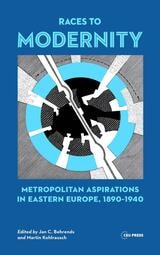
Races to Modernity
Metropolitan Aspirations in Eastern Europe, 1890–1940Martin Kohlrausch
Central European University Press, 2014

Red Creative
Culture and Modernity in ChinaJustin O'Connor and Xin Gu
Intellect Books, 2020
Red Creative is an exploration of China’s cultural economy over the last twenty years, particularly through the lens of its creative hub of Shanghai. The research presented here raises questions about the nature of contemporary ‘creative’ capitalism and the universal claims of Western modernity, offering new ways of thinking about cultural policy in China.
Taking a long-term historical perspective, Justin O’Connor and Xin Gu analyze the ongoing development of China’s cultural industries, examining the institutions, regulations, interests, and markets that underpin the Chinese cultural economy and the strategic position of Shanghai within it. Further, the authors explore cultural policy reforms in post-colonial China and articulate Shanghai’s significance in paving China’s path to modernity and entry to global capitalism. In-depth and illuminating, Red Creative carefully situates China’s contemporary cultural economy in its larger global and historical context, revealing the limits of Western thought in understanding Chinese history, culture, and society.
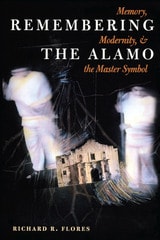
Remembering the Alamo
Memory, Modernity, and the Master SymbolBy Richard R. Flores
University of Texas Press, 2002
"Remember the Alamo!" reverberates through Texas history and culture, but what exactly are we remembering? Over nearly two centuries, the Mexican victory over an outnumbered band of Alamo defenders has been transformed into an American victory for the love of liberty. Why did the historical battle of 1836 undergo this metamorphosis in memory and mythology to become such a potent master symbol in Texan and American culture?
In this probing book, Richard Flores seeks to answer that question by examining how the Alamo's transformation into an American cultural icon helped to shape social, economic, and political relations between Anglo and Mexican Texans from the late nineteenth to the mid-twentieth centuries. In the first part of the book, he looks at how the attempts of heritage society members and political leaders to define the Alamo as a place have reflected struggles within Texas society over the place and status of Anglos and Mexicans. In the second part, he explores how Alamo movies and the transformation of Davy Crockett into an Alamo hero/martyr have advanced deeply racialized, ambiguous, and even invented understandings of the past.
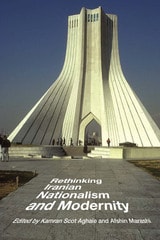
Rethinking Iranian Nationalism and Modernity
Edited by Kamran Scot Aghaie and Afshin Marashi
University of Texas Press, 2014
While recent books have explored Arab and Turkish nationalism, the nuances of Iran have received scant book-length study—until now. Capturing the significant changes in approach that have shaped this specialization, Rethinking Iranian Nationalism and Modernity shares innovative research and charts new areas of analysis from an array of scholars in the field.
Delving into a wide range of theoretical and conceptual perspectives, the essays—all previously unpublished—encompass social history, literary theory, postcolonial studies, and comparative analysis to address such topics as:
- Ethnicity in the Islamic Republic of Iran
- Political Islam and religious nationalism
- The evolution of U.S.-Iranian relations before and after the Cold War
- Comparing Islamic and secular nationalism(s) in Egypt and Iran
- The German counterrevolution and its influence on Iranian political alliances
- The effects of Israel’s image as a Euro-American space
- Sufism
- Geocultural concepts in Azar’s Atashkadeh
Interdisciplinary in essence, the essays also draw from sociology, gender studies, and art and architecture. Posing compelling questions while challenging the conventional historiographical traditions, the authors (many of whom represent a new generation of Iranian studies scholars) give voice to a research approach that embraces the modern era’s complexity while emphasizing Iranian nationalism’s contested, multifaceted, and continuously transformative possibilities.
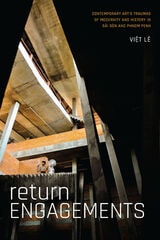
Return Engagements
Contemporary Art's Traumas of Modernity and History in Sài Gòn and Phnom PenhViet Lê
Duke University Press, 2021
Rhetoric on the Margins of Modernity
Vico, Condillac, MonboddoCatherine L. Hobbs
Southern Illinois University Press, 2002
Changes in English studies today, particularly the rise of cultural studies, have forced reexaminations of historical genealogies. Three complex figures whose places are currently being reassessed include the Neapolitan Giambattista Vico (1668 –1744), the Frenchman Etienne de Condillac (1714 –1780), and the Scotsman James Burnet(t), Lord Monboddo (1714 –1799) in our histories of communication, linguistics, English studies, and now rhetoric.
In Rhetoric on the Margins of Modernity: Vico, Condillac, Monboddo, Catherine L. Hobbs focuses primarily on these three key figures in whose work rhetoric and linguistics intertwine as they respond to emerging attitudes and values of science and philosophy in the eighteenth century. Through her examination of works of Vico, Condillac, Monboddo and other marginal figures, Hobbs presents a different and more nuanced view of the transformation of rhetoric from classical to modern.
In order to redefine each figure’s position, Hobbs brings together the histories of linguistics, literature, rhetoric, and communication, rather than leaving them isolated in separate disciplines. She examines each figure’s theory of language origin and development as it has motivated their rhetorical theories. The result is Rhetoric on the Margins of Modernity: Vico, Condillac, Monboddo, an original and significant account of the formation of modern rhetoric.
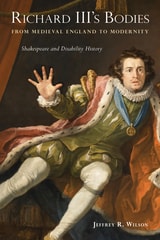
Richard III's Bodies from Medieval England to Modernity
Shakespeare and Disability HistoryJeffrey R. Wilson
Temple University Press, 2022
Richard III will always be central to English disability history as both man and myth—a disabled medieval king made into a monster by his nation’s most important artist.
In Richard III’s Bodies from Medieval England to Modernity, Jeffrey Wilson tracks disability over 500 years, from Richard’s own manuscripts, early Tudor propaganda, and x-rays of sixteenth-century paintings through Shakespeare’s soliloquies, into Samuel Johnson’s editorial notes, the first play produced by an African American Theater company, Freudian psychoanalysis, and the rise of disability theater. For Wilson, the changing meanings of disability created through shifting perspectives in Shakespeare’s plays prefigure a series of modern attempts to understand Richard’s body in different disciplinary contexts—from history and philosophy to sociology and medicine.
While theorizing a role for Shakespeare in the field of disability history, Wilson reveals how Richard III has become an index for some of modernity’s central concerns—the tension between appearance and reality, the conflict between individual will and external forces of nature and culture, the possibility of upward social mobility, and social interaction between self and other, including questions of discrimination, prejudice, hatred, oppression, power, and justice.
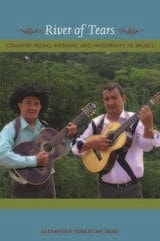
River of Tears
Country Music, Memory, and Modernity in BrazilAlexander Sebastian Dent
Duke University Press, 2009
Since 1998, Alexander Sebastian Dent has analyzed rural music in the state of São Paulo, interviewing and spending time with listeners, musicians, songwriters, journalists, record-company owners, and radio hosts. Dent not only describes the production and reception of this music, he also explains why the genre experienced such tremendous growth as Brazil transitioned from an era of dictatorship to a period of intense neoliberal reform. Dent argues that rural genres reflect a widespread anxiety that change has been too radical and has come too fast. In defining their music as rural, Brazil’s country musicians—whose work circulates largely in cities—are criticizing an increasingly inescapable urban life characterized by suppressed emotions and an inattentiveness to the past. Their performances evoke a river of tears flowing through a landscape of loss—of love, of life in the countryside, and of man’s connections to the natural world.
Romanticism Against the Tide of Modernity
Michael Löwy and Robert Sayre
Duke University Press, 2001
After critiquing previous conceptions of romanticism and discussing its first European manifestations, Löwy and Sayre propose a typology of the sociopolitical positions held by romantic writers-from “restitutionist” to various revolutionary/utopian forms. In subsequent chapters, they give extended treatment to writers as diverse as Coleridge and Ruskin, Charles Peguy, Ernst Bloch and Christa Wolf. Among other topics, they discuss the complex relationship between Marxism and romanticism before closing with a reflection on more contemporary manifestations of romanticism (for example, surrealism, the events of May 1968, and the ecological movement) as well as its future.
Students and scholars of literature, humanities, social sciences, and cultural studies will be interested in this elegant and thoroughly original book.
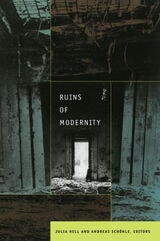
Ruins of Modernity
Julia Hell and Andreas Schönle, eds.
Duke University Press, 2009
Several contributors discuss ideas about ruins developed by philosophers such as Immanuel Kant, Georg Simmel, and Walter Benjamin. One contributor examines how W. G. Sebald’s novel The Rings of Saturn betrays the ruins erased or forgotten in the Hegelian philosophy of history. Another analyzes the repressed specter of being bombed out of existence that underpins post-Second World War modernist architecture, especially Le Corbusier’s plans for Paris. Still another compares the ways that formerly dominant white populations relate to urban-industrial ruins in Detroit and to colonial ruins in Namibia. Other topics include atomic ruins at a Nevada test site, the connection between the cinema and ruins, the various narratives that have accrued around the Inca ruin of Vilcashuamán, Tolstoy’s response in War and Peace to the destruction of Moscow in the fire of 1812, the Nazis’ obsession with imperial ruins, and the emergence in Mumbai of a new “kinetic city” on what some might consider the ruins of a modernist city. By focusing on the concept of ruin, this collection sheds new light on modernity and its vast ramifications and complexities.
Contributors. Kerstin Barndt, Jon Beasley-Murray, Russell A. Berman, Jonathan Bolton, Svetlana Boym, Amir Eshel, Julia Hell, Daniel Herwitz, Andreas Huyssen, Rahul Mehrotra, Johannes von Moltke, Vladimir Paperny, Helen Petrovsky, Todd Presner, Helmut Puff, Alexander Regier, Eric Rentschler, Lucia Saks, Andreas Schönle, Tatiana Smoliarova, George Steinmetz, Jonathan Veitch, Gustavo Verdesio, Anthony Vidler