Results by title
92 books match the query 'Multiculturalism' and 6 start with r
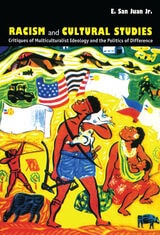
Racism and Cultural Studies
Critiques of Multiculturalist Ideology and the Politics of DifferenceE. San Juan Jr.
Duke University Press, 2002
Individual chapters engage the themes of ethnicity versus racism, gender inequality, sexuality, and the politics of identity configured with the discourse of postcoloniality and postmodernism. Questions of institutional racism, social justice, democratization, and international power relations between the center and the periphery are explored and analyzed. San Juan fashions a critique of dominant disciplinary approaches in the humanities and social sciences and contends that “the racism question” functions as a catalyst and point of departure for cultural critiques based on a radical democratic vision. He also asks urgent questions regarding globalization and the future of socialist transformation of “third world” peoples and others who face oppression.
As one of the most notable cultural theorists in the United States today, San Juan presents a provocative challenge to the academy and other disciplinary institutions. His intervention will surely compel the attention of all engaged in intellectual exchanges where race/ethnicity serves as an urgent focus of concern.

Reconstructions of Canadian Identity
Towards Diversity and InclusionVander Tavares
University of Manitoba Press, 2024
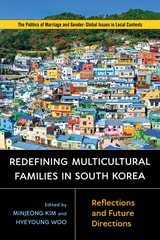
Redefining Multicultural Families in South Korea
Reflections and Future DirectionsMinjeong Kim
Rutgers University Press, 2022
Regulating Difference
Religious Diversity and Nationhood in the Secular WestMarian Burchardt
Rutgers University Press, 2020
Transnational migration has contributed to the rise of religious diversity and has led to profound changes in the religious make-up of society across the Western world. As a result, societies and nation-states have faced the challenge of crafting ways to bring new religious communities into existing institutions and the legal frameworks. Regulating Difference explores how the state regulates religious diversity and examines the processes whereby religious diversity and expression becomes part of administrative landscapes of nation-states and people’s everyday lives. Arguing that concepts of nationhood are key to understanding the governance of religious diversity, Regulating Difference employs a transatlantic comparison of the Spanish region of Catalonia and the Canadian province of Quebec to show how processes of nation-building, religious heritage-making and the mobilization of divergent interpretations of secularism are co-implicated in shaping religious diversity. It argues that religious diversity has become central for governing national and urban spaces.
This book is also freely available online as an open access digital edition.

Represent and Destroy
Rationalizing Violence in the New Racial CapitalismJodi Melamed
University of Minnesota Press, 2011
In the global convulsions in the aftermath of World War II, one dominant world racial order broke apart and a new one emerged. This is the story Jodi Melamed tells in Represent and Destroy, portraying the postwar racial break as a transition from white supremacist modernity to a formally antiracist liberal capitalist modernity in which racial violence works normatively by policing representations of difference.
Following the institutionalization of literature as a privileged domain for Americans to get to know difference—to describe, teach, and situate themselves with respect to race—Melamed focuses on literary studies as a cultural technology for transmitting liberal racial orders. She examines official antiracism in the United States and finds that these were key to ratifying the country’s global ascendancy. She shows how racial liberalism, liberal multiculturalism, and neoliberal multiculturalism made racism appear to be disappearing, even as they incorporated the assumptions of global capitalism into accepted notions of racial equality.
Yet Represent and Destroy also recovers an anticapitalist “race radical” tradition that provides a materialist opposition to official antiracisms in the postwar United States—a literature that sounds out the violence of liberal racial orders, relinks racial inequality to material conditions, and compels desire for something better than U.S. multiculturalism.
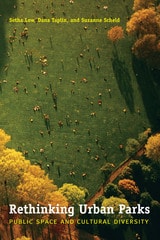
Rethinking Urban Parks
Public Space and Cultural DiversityBy Setha Low, Dana Taplin, and Suzanne Scheld
University of Texas Press, 2005
Urban parks such as New York City's Central Park provide vital public spaces where city dwellers of all races and classes can mingle safely while enjoying a variety of recreations. By coming together in these relaxed settings, different groups become comfortable with each other, thereby strengthening their communities and the democratic fabric of society. But just the opposite happens when, by design or in ignorance, parks are made inhospitable to certain groups of people.
This pathfinding book argues that cultural diversity should be a key goal in designing and maintaining urban parks. Using case studies of New York City's Prospect Park, Orchard Beach in Pelham Bay Park, and Jacob Riis Park in the Gateway National Recreation Area, as well as New York's Ellis Island Bridge Proposal and Philadelphia's Independence National Historical Park, the authors identify specific ways to promote, maintain, and manage cultural diversity in urban parks. They also uncover the factors that can limit park use, including historical interpretive materials that ignore the contributions of different ethnic groups, high entrance or access fees, park usage rules that restrict ethnic activities, and park "restorations" that focus only on historical or aesthetic values. With the wealth of data in this book, urban planners, park professionals, and all concerned citizens will have the tools to create and maintain public parks that serve the needs and interests of all the public.