Results by title
111 books match the query 'Museum Studies' and 6 start with r
Reframing the Ethnographic Museum
Histories, Politics and FuturesEdited by Michael Rowlands, Nick Stanley, and Graeme Were
University College London, 2025
Amid calls for decolonization and digital innovation, this necessary work explores the shifting histories and futures of ethnographic museums worldwide.
Ethnographic museums are at a crossroads; caught between colonial legacies, and the difficulties of captivating new audiences in a digital world. Reframing the Ethnographic Museum brings together leading scholars and curators to study the shifting role of these institutions in a rapidly changing cultural and political landscape. From Asia to Africa, the book explores how different museum strategies have grappled with decolonization and digital transformation, engaging in critical analysis and including case studies of innovative curatorial practices.
As museums confront calls for accountability and reconsider their collections, this volume provides a relevant exploration of the dilemmas and possibilities facing ethnographic display today. Reframing the Ethnographic Museum urges us to rethink how we engage with the past, and how museums can become spaces of dialogue and reflection.
[more]
Rescued from Oblivion
Historical Cultures in the Early United StatesAlea Henle
University of Massachusetts Press, 2020
In 1791, a group of elite Bostonian men established the first historical society in the nation. Within sixty years, the number of local history organizations had increased exponentially, with states and territories from Maine to Louisiana and Georgia to Minnesota boasting collections of their own.
With in-depth research and an expansive scope, Rescued from Oblivion offers a vital account of the formation of historical culture and consciousness in the early United States, re-centering in the record groups long marginalized from the national memory. As Alea Henle demonstrates, these societies laid the groundwork for professional practices that are still embraced today: collection policies, distinctions between preservation of textual and nontextual artifacts, publication programs, historical rituals and commemorations, reconciliation of scholarly and popular approaches, and more. At the same time, officers of these early societies faced challenges to their historical authority from communities interested in preserving a broader range of materials and documenting more inclusive histories, including fellow members, popular historians, white women, and peoples of color.
With in-depth research and an expansive scope, Rescued from Oblivion offers a vital account of the formation of historical culture and consciousness in the early United States, re-centering in the record groups long marginalized from the national memory. As Alea Henle demonstrates, these societies laid the groundwork for professional practices that are still embraced today: collection policies, distinctions between preservation of textual and nontextual artifacts, publication programs, historical rituals and commemorations, reconciliation of scholarly and popular approaches, and more. At the same time, officers of these early societies faced challenges to their historical authority from communities interested in preserving a broader range of materials and documenting more inclusive histories, including fellow members, popular historians, white women, and peoples of color.
[more]
Rethinking Heritage for Sustainable Development
International Frameworks, Local ImpactsSophia Labadi
University College London, 2022
An innovative look at heritage in sustainable development, based on archival research on UN and World Bank documents and ethnographic fieldwork in Africa.
In 2015, the UN adopted Sustainable Development Goals (SDGs), which have since influenced international and intergovernmental organizations and governments and dictated priorities for international aid spending. Culture, including heritage, is often presented as fundamental to addressing the SDGs. Yet in practice heritage is marginalized when SDGs are being discussed and implemented.
This volume presents a substantial and original assessment of whether and how heritage has contributed to three key dimensions of sustainable development (poverty reduction, gender equality, and environmental sustainability) within the context of its marginalization from the SDGs and from previous international development agendas. The book adopts a novel, inclusive, large-scale, and systematic approach, providing the first comprehensive history of the international approaches to culture (including heritage) in development from 1970 to the present day. It critically assesses the international projects implemented in sub-Saharan Africa that aimed to demonstrate the contribution of heritage for development in time for the negotiation of the SDGs, reflecting on the shortcomings of selected projects and providing recommendations for rethinking heritage for development.
[more]
Rethinking the Greek Campaign to Repatriate the Parthenon Marbles
Problems and Complexities with Contested Cultural HeritageJames Beresford
Central European University Press, 2026
Offering an incisive examination into aspects of the controversy regarding ownership of the marble sculptures infamously removed from the Parthenon by Lord Elgin in the early nineteenth century, this volume challenges long-held scholarly assumptions frequently made in support of the return of the artworks to Athens. With the fate of the Parthenon’s marbles thrust into the spotlight of international media attention over recent years as high-level talks have been underway in an effort to resolve the long-running dispute, this timely book exposes some of the historical inaccuracies and misleading information frequently passed off to academics, students and the general public in an effort to bolster support for the repatriation of the marbles to Greece. It is a volume that offers a fresh perspective on what has long been regarded as the touchstone case for disputes concerning contested cultural heritage.
[more]
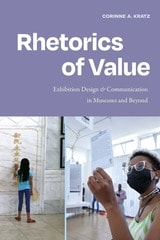
Rhetorics of Value
Exhibition Design and Communication in Museums and BeyondCorinne A. Kratz
Duke University Press, 2025
In Rhetorics of Value, Corinne A. Kratz explores how exhibition design creates and conveys values that have the potential to touch, educate, and engage visitors. Drawing on case studies from the Victoria and Albert Museum, museums in South Africa and Kenya, a Hawaiian resort hotel, and the Smithsonian’s National Museum of African American History and Culture, among others, Kratz shows how exhibits help shape and narrate cultural categories, values, and histories while provoking questions and evoking memories and experiences. She crosses contexts to consider ethnographic, history, and art exhibits in national and community museums and other display settings. Through these examples, Kratz traces how exhibition designers combine objects, texts, images, lighting, audio, space, and narratives to craft a complex, multilayered communicative form that visitors experience as they move through museums. By investigating the relationship between audience reception and exhibition design strategies, Kratz contends that through design, exhibits can shape the ways we know, the stories we tell, and our contours of meaning and engagement.
[more]
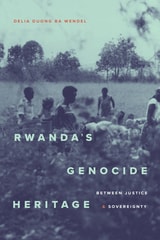
Rwanda's Genocide Heritage
Between Justice and SovereigntyDelia Duong Ba Wendel
Duke University Press, 2025
In Rwanda’s Genocide Heritage, Delia Duong Ba Wendel contends with the forms of justice and sovereignty enacted through sites of violent memory. Drawing from oral histories and a visual archive of memory work after the 1994 genocide in Rwanda, she explores the human rights and government priorities that preserved killing sites and victims’ remains for public display. Rwanda’s genocide memorials exemplify a global phenomenon that Wendel terms trauma heritage, wherein hidden or unrecognized violence is spatialized—made visible in public space—to demand justice and recognition. She argues that trauma heritage innovates on the form histories take by “writing” them into landscapes, constituting a reparative historiography from the Global South. Among those sites, Rwanda’s genocide heritage comprises exceptionally visceral sites of truth-telling that highlight the politics of a past made present. Wendel demonstrates that such sites of memory require reckoning with the ethical and political dilemmas that arise from viewing violence as forms of repair and control.
[more]