50 books match the query 'Music and race' and 3 start with r
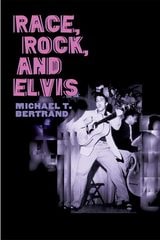
cover of Race, Rock, and Elvis

Race, Rock, and Elvis

Michael T. Bertrand

University of Illinois Press, 2000

Did Elvis Presley's brand of rock 'n' roll help revise racial attitudes in postwar America? Michael T. Bertrand delves into this question and many others to investigate popular music's revolutionary influence on black-white relations in the South. 

Youthful fans of rhythm and blues, rock 'n' roll, and other black-inspired music often broke from their segregationist elders and ignored the color line. Not coincidentally, these same young white people--the southern branch of a national and commercialized youth culture--led a general relaxation of racist attitudes. Bertrand argues that African American music facilitated a new recognition of black people as fellow human beings. African American audiences welcomed Elvis with enthusiasm while racially mixed audiences flocked to music venues at a time when adults expected separate performances for black and white audiences. Bertrand also describes the critical role of radio and recordings in making African American culture available to white fans on an unprecedented scale. Over time, southern working-class youth used the new music to define and express new values and build their own identities.
[more]
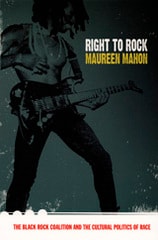
cover of Right to Rock: The Black Rock Coalition and the Cultural Politics of Race

Right to Rock

The Black Rock Coalition and the Cultural Politics of Race

Maureen Mahon

Duke University Press, 2004
The original architects of rock ’n’ roll were black musicians including Little Richard, Etta James, and Chuck Berry. Jimi Hendrix electrified rock with his explosive guitar in the late 1960s. Yet by the 1980s, rock music produced by African Americans no longer seemed to be “authentically black.” Particularly within the music industry, the prevailing view was that no one—not black audiences, not white audiences, and not black musicians—had an interest in black rock. In 1985 New York-based black musicians and writers formed the Black Rock Coalition (brc) to challenge that notion and create outlets for black rock music. A second branch of the coalition started in Los Angeles in 1989. Under the auspices of the brc, musicians organized performances and produced recordings and radio and television shows featuring black rock. The first book to focus on the brc, Right to Rock is, like the coalition itself, about the connections between race and music, identity and authenticity, art and politics, and power and change. Maureen Mahon observed and participated in brc activities in New York and Los Angeles, and she conducted interviews with more than two dozen brc members. In Right to Rock she offers an in-depth account of how, for nearly twenty years, members of the brc have broadened understandings of black identity and black culture through rock music.
[more]
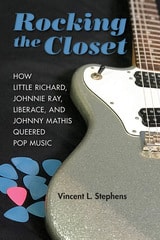
cover of Rocking the Closet: How Little Richard, Johnnie Ray, Liberace, and Johnny Mathis Queered Pop Music

Rocking the Closet

How Little Richard, Johnnie Ray, Liberace, and Johnny Mathis Queered Pop Music

Vincent Stephens

University of Illinois Press, 2019

The all-embracing, "whaddya got?" nature of rebellion in Fifties America included pop music's unlikely challenge to entrenched notions of masculinity. Within that upheaval, four prominent artists dared to behave in ways that let the public assume—but not see—their queerness. That these artists cultivated ambiguous sexual personas often reflected an understandable fear, but also a struggle to fulfill personal and professional expectations.Vincent L. Stephens confronts notions of the closet—both coming out and staying in—by analyzing the careers of Liberace, Johnny Mathis, Johnnie Ray, and Little Richard. Appealing to audiences hungry for novelty and exoticism, the four pop icons used performance and queering techniques that ran the gamut. Liberace's flamboyance shared a spectrum with Mathis's intimate sensitivity while Ray's overwrought displays as "Mr. Emotion" seemed worlds apart from Little Richard's raise-the-roof joyousness. As Stephens shows, the quartet not only thrived in an era of gray flannel manhood, they pioneered the ways generations of later musicians would consciously adopt sexual mystery as an appealing and proven route to success.
[more]