Results by title
59 books match the query 'Narratives' and 2 start with r
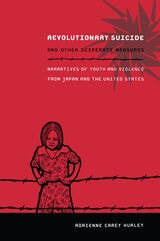
Revolutionary Suicide and Other Desperate Measures
Narratives of Youth and Violence from Japan and the United StatesAdrienne Carey Hurley
Duke University Press, 2011
In Revolutionary Suicide and Other Desperate Measures, Adrienne Carey Hurley examines how child abuse and youth violence are understood, manufactured, and represented, but still disavowed, in Japan and the United States. Through analysis of autobiographical fiction, journalism, film, and clinical case studies, she charts a “culture of child abuse” extending from the home to the classroom, the marketplace, and the streets in both countries. Hurley served as a court-appointed special advocate for abused children, and she brings that perspective to bear as she interprets texts. Undertaking close reading as a form of advocacy, she exposes how late-capitalist societies abuse and exploit youth, while at the same time blaming them for their own vulnerability and violence. She objects to rote designations of youth violence as “inexplicable,” arguing that such formulaic responses forestall understanding and intervention. Hurley foregrounds theories of youth violence that locate its origins in childhood trauma, considers what happens when young people are denied opportunities to develop a political analysis to explain their rage, and explores how the chance to engage in such an analysis affects the occurrence and meaning of youth violence.
[more]
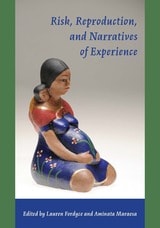
Risk, Reproduction, and Narratives of Experience
Lauren Fordyce
Vanderbilt University Press, 2012
As Carole Browner explains in her foreword: "These chapters compellingly reveal that although we anthropologists tend to speak of biomedicine in hegemonic terms, in fact its penetration is quite variable and often ambivalently met. . . . Risk, Reproduction, and Narratives of Experience sheds new light on a troubling core aspect of medicalization processes, which simultaneously render pregnant women more docile subjects even as they are impelled to actively engage with biomedicalized prenatal care regimes. . . . We also see that a consummate means by which states seek to consolidate power in the reproductive realm is through expansion of the biomedical concept of risk. This critical observation emerges repeatedly in this collection."
[more]