Results by title
72 books match the query 'Nature conservation' and 7 start with r
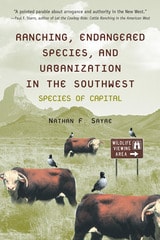
Ranching, Endangered Species, and Urbanization in the Southwest
Species of CapitalNathan F. Sayre
University of Arizona Press, 2002
Nathan Sayre now takes a close look at how the ranching ideal has come into play in the conversion of a large tract of Arizona rangeland from private ranch to National Wildlife Refuge. He tells how the Buenos Aires Ranch, a working operation for a hundred years, became not only a rallying point for multiple agendas in the "rangeland conflict" after its conversion to a wildlife refuge but also an expression of the larger shift from agricultural to urban economies in the Southwest since World War II.
The U.S. Fish and Wildlife Service bought the Buenos Aires Ranch in 1985, removed all livestock, and attempted to restore the land to its "original" grassland in order to protect an endangered species, the masked bobwhite quail. Sayre examines the history of the ranch and the bobwhite together, exploring the interplay of social, economic, and ecological issues to show how ranchers and their cattle altered the land—for better or worse—during a century of ranching and how the masked bobwhite became a symbol for environmentalists who believe that the removal of cattle benefits rangelands and wildlife.
Sayre evaluates both sides of the Buenos Aires controversy—from ranching's impact on the environment to environmentalism's sometimes misguided efforts at restoration—to address the complex and contradictory roles of ranching, endangered species conservation, and urbanization in the social and environmental transformation of the West. He focuses on three dimensions of the Buenos Aires story: the land and its inhabitants, both human and animal; the role of government agencies in shaping range and wildlife management; and the various species of capital—economic, symbolic, and bureaucratic—that have structured the activities of ranchers, environmentalists, and government officials.
The creation of the Buenos Aires National Wildlife Refuge has been a symbolic victory for environmentalists, but it comes at the cost of implicitly legitimizing the ongoing fragmentation and suburbanization of Arizona's still-wild rangelands. Sayre reveals how the polarized politics of "the rangeland conflict" have bound the Fish and Wildlife Service to a narrow, ineffectual management strategy on the Buenos Aires, with greater attention paid to increasing tourism from birdwatchers than to the complex challenge of restoring the masked bobwhite and its habitat. His findings show that the urban boom of the late twentieth century echoed the cattle boom of a century before—capitalizing on land rather than grass, humans rather than cattle—in a book that will serve as a model for restoration efforts in any environment.
Rarities
Conservation Science in a Time of Unintended ConsequencesZoe Nyssa
University of Chicago Press, 2026
A sweeping study that reveals how conservation science does more than simply protect by inadvertently making nature valuable in new ways.
Climate change and other environmental transformations are causing species to go extinct at accelerating rates. What, then, should a science of saving nature look like? In Rarities, Zoe Nyssa traces how conservation emerged as a distinct scientific endeavor in the United States over the twentieth century and how this history has shaped environmental research practices and policy today. Drawing on archival and ethnographic research with leading conservation labs and programs, Nyssa explores how conservation science appears to generate contradictory, even counterintuitive, results as scientists, policymakers, and the public all take up, respond to, and repurpose scientists’ ideas about rarity, vulnerability, and endangerment. The designation of new nature reserves can lead to increased poaching and habitat destruction. The listing of a species as endangered fuels their black-market consumption as pets, food, or luxury items. Protection of natural resources can push resource extraction into unprotected areas. Other effects are less simple to calculate; persuading the public to care about one species might siphon support for another, and paying for one kind of conservation behavior can discourage other forms of conservation activity.
The science of saving nature spans a century of work by ecologists and others to develop a scientific basis for conservation. Yet Nyssa shows how their efforts to understand the natural world in terms of endangerment and extinction unleashed new ways for nonscientists to experience and understand nature as well. The scientific values that emerge, she argues, can transform the complex interconnections between human and nonhuman life. Rarities offers a framework for understanding these surprising socio-ecological dynamics and why they matter, both for contemporary science and for the planet.
Rediscovering National Parks in the Spirit of John Muir
Michael Frome
University of Utah Press, 2015
As a journalist, advocate, and professor, Michael Frome has spent decades engaged with conservation topics and has taken particular interest in America’s national parks. He draws on this experience and knowledge to address what remains to be done in order to truly value and preserve these special places. Part memoir, part history, and part broadside against those who would diminish this heritage, Rediscovering National Parks in the Spirit of John Muir, through thoughtful reflections and ruminations, bears witness to the grandeur of our parks and to the need for a renewed sense of appreciation and individual responsibility for their care.
In recollections of his encounters and conversations with key people in national park history, Frome discusses park politics, conflicts between use and preservation, and impacts of commercialization. He proposes a dedicated return to the true spirit in which the parks were established, in the manner of John Muir. He advocates maintaining these lands as wild sanctuaries, places where we can find inspiration, solitude, silence, balance, and simplicity, reminding us why we must preserve our national treasures and why we need to connect with the deeper values they hold.
Regreening the National Parks
Michael Frome
University of Arizona Press, 1992
Overcrowding and commercialization are commonplace, and with the increase in visitation has come not only congestion but crime. Yet visitor enjoyment seems to be a higher priority of those who manage the parks than the protection and perpetuation of natural systems. How could this have happened? Michael Frome, one of the most outspoken and highly regarded observers of our national parks, here shows how the original mission of the National Park Service has been undermined by politicization and bureaucratization.
Regreening the National Parks tells how the Park Service has been transformed from a professional to a political agency and in the process has betrayed its own values by emphasizing recreation and "short-order wilderness served like fast food" rather than the preservation of the nation's natural heritage. Frome has drawn on both official documents and personal interviews to examine the policies--and personalities--behind the scenes at the National Park Service. He cites instances of personnel being forbidden to criticize public policy in which they found a conflict with conservation principles, and contends that, as the Park Service has become more bureaucratic, those for whom the environment deeply matters scarcely rise within its ranks. In considering the environmental abuse rampant today, Frome sees national parks as models of respect for nature and concludes his book with a ten-point program toward realizing that ideal.
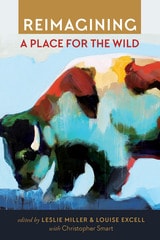
Reimagining a Place for the Wild
Leslie Miller, Louise Excell, and Christopher Smart
University of Utah Press, 2018
Reimagining a Place for the Wild contains a diverse collection of personal stories that describe encounters with the remaining wild creatures of the American West and critical essays that reveal wildlife’s essential place in western landscapes. Gleaned from historians, journalists, biologists, ranchers, artists, philosophers, teachers, and conservationists, these narratives expose the complex challenges faced by wild animals and those devoted to understanding them. Whether discussing keystone species like grizzly bears and gray wolves or microfauna swimming the thermal depths of geysers, these accounts reflect the authors’ expertise as well as their wonder and respect for wild nature. The writers do more than inform our sensibilities; their narratives examine both humanity’s conduct and its capacity for empathy toward other life. A selection of photos and paintings punctuates the volume.
This collection sprang from the Reimagine Western Landscapes Symposium held at the University of Utah’s Taft-Nicholson Environmental Humanities Education Center in Centennial Valley, Montana. These testaments join a chorus of voices seeking improved relations with the western wild in the twenty-first century.
Revenant Ecologies
Defying the Violence of Extinction and ConservationAudra Mitchell
University of Minnesota Press, 2024
Engaging a broad spectrum of ecological thought to articulate the ethical scale of global extinction
As global rates of plant and animal extinctions mount, anxieties about the future of the earth’s ecosystems are fueling ever more ambitious efforts at conservation, which draw on Western scientific principles to manage species and biodiversity. In Revenant Ecologies, Audra Mitchell argues that these responses not only ignore but also magnify powerful forms of structural violence like colonialism, racism, genocide, extractivism, ableism, and heteronormativity, ultimately contributing to the destruction of unique life forms and ecosystems.
Critiquing the Western discourse of global extinction and biodiversity through the lens of diverse Indigenous philosophies and other marginalized knowledge systems, Revenant Ecologies promotes new ways of articulating the ethical enormity of global extinction. Mitchell offers an ambitious framework—(bio)plurality—that focuses on nurturing unique, irreplaceable worlds, relations, and ecosystems, aiming to transform global ecological–political relations, including through processes of land return and critically confronting discourses on “human extinction.”
Highlighting the deep violence that underpins ideas of “extinction,” “conservation,” and “biodiversity,” Revenant Ecologies fuses political ecology, global ethics, and violence studies to offer concrete, practical alternatives. It also foregrounds the ways that multi-life-form worlds are actively defying the forms of violence that drive extinction—and that shape global efforts to manage it.
Retail e-book files for this title are screen-reader friendly with images accompanied by short alt text and/or extended descriptions.
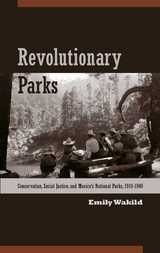
Revolutionary Parks
Conservation, Social Justice, and Mexico’s National Parks, 1910–1940Emily Wakild
University of Arizona Press, 2011
Revolutionary Parks tells the surprising story of how forty national parks were created in Mexico during the latter stages of the first social revolution of the twentieth century. By 1940 Mexico had more national parks than any other country. Together they protected more than two million acres of land in fourteen states. Even more remarkable, Lázaro Cárdenas, president of Mexico in the 1930s, began to promote concepts akin to sustainable development and ecotourism.
Conventional wisdom indicates that tropical and post-colonial countries, especially in the early twentieth century, have seldom had the ability or the ambition to protect nature on a national scale. It is also unusual for any country to make conservation a political priority in the middle of major reforms after a revolution. What emerges in Emily Wakild’s deft inquiry is the story of a nature protection program that takes into account the history, society, and culture of the times. Wakild employs case studies of four parks to show how the revolutionary momentum coalesced to create early environmentalism in Mexico.
According to Wakild, Mexico’s national parks were the outgrowth of revolutionary affinities for both rational science and social justice. Yet, rather than reserves set aside solely for ecology or politics, rural people continued to inhabit these landscapes and use them for a range of activities, from growing crops to producing charcoal. Sympathy for rural people tempered the radicalism of scientific conservationists. This fine balance between recognizing the morally valuable, if not always economically profitable, work of rural people and designing a revolutionary state that respected ecological limits proved to be a radical episode of government foresight.