Results by title
310 books match the query 'Performance' and 14 start with r
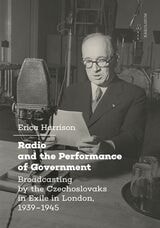
Radio and the Performance of Government
Broadcasting by the Czechoslovaks in Exile in London, 1939–1945Erica Harrison
Karolinum Press, 2023
Between 1939 and 1945, Czechoslovakia disappeared from the maps, existing only as an imagined ‘free republic’ on the radio waves. Following the German invasion and annexation of Bohemia and Moravia and the declaration of independence by Slovakia on 15 March 1939, the Czechoslovak Republic was gone. From their position in exile in wartime London, former Czechoslovak President Edvard Beneš and the government that formed around him depended on radio to communicate with the public they strove to represent. The broadcasts made by government figures in London enabled a performance of authority to impress their hosts, allies, occupying enemies, and claimed constituents.
This book examines this government program for the first time, making use of previously unstudied archival sources to examine how the exiles understood their mission and how their propaganda work was shaped by both British and Soviet influences. This study assesses the strengths, weaknesses, and limitations of the government’s radio propaganda as they navigated the complexities of exile, with chapters examining how they used the radio to establish their authority, how they understood the past and future of the Czechoslovak nation, and how they struggled to include Slovakia and Subcarpathian Ruthenia within it.
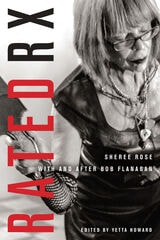
Rated RX
Sheree Rose with and after Bob FlanaganEdited by Yetta Howard
The Ohio State University Press, 2020
Curated with attention to queer-crip subjectivities and transgressive feminisms, Rated RX includes essays by and interviews with scholars, artists, and Rose’s collaborators that address gender politics, archival practices, minority embodiment, and disability in Rose’s work as well as more than eighty photographs and rare archival materials reflecting Rose’s recent and past performances. Offering a necessary corrective, Rated RX is the first collection to underscore Sheree Rose as a legendary figure in performance art and BDSM subcultural history, reflecting her lifetime of involvement in documenting the underground and the transformative role her work plays in sexual, subcultural, and art exhibitionism.
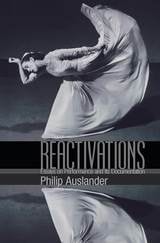
Reactivations
Essays on Performance and Its DocumentationPhilip Auslander
University of Michigan Press, 2018
performance from its documentation? What is the value of performance documentation?
The book treats performance documentation as a specific discursive use of media that arose in the middle of the 20th century alongside such forms of performance as the Happening and that is different, both discursively and as a practice, from traditional theater and dance photography. Philip Auslander explores the phenomenal relationship between the spectator who experiences the performance from the document and the document itself. The document is not merely a secondary iteration of the original event but a vehicle that gives us meaningful access to the performance itself as an artistic work.
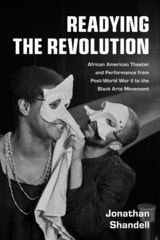
Readying the Revolution
African American Theater and Performance from Post-World War II to the Black Arts MovementJonathan Shandell
University of Michigan Press, 2025
2026 American Theatre and Drama Society John W. Frick Book Award Winner
Starting in 1966, African American activist Stokely Carmichael and other political leaders adopted the phrase "Black Power!" The slogan captured a militant, revolutionary spirit that was already emerging in the work of playwrights, poets, musicians, and visual artists throughout the Black Arts movement of the mid-1960s. But the story of those theater artists and performers whose work helped bring about the Black Arts revolution has not fully been told. Readying the Revolution: African American Theater and Performance from Post-World War II to the Black Arts Movement explores the dynamic era of Black culture between the end of World War II and the start of the Black Arts Movement (1946-1964) by illuminating how artists and innovators such as Jackie Robinson, Lorraine Hansberry, Ossie Davis, Nina Simone, and others helped radicalize Black culture and Black political thought. In doing so, these artists defied white cultural hegemony in the United States, and built the foundation for the revolutionary movement in Black theater that followed in the mid 1960s. Through archival research, close textual reading, and an analysis of performance artifacts, Shandell demonstrates how these artists negotiated a space on the public stage for cultivating radical Black aesthetics and built the foundation for the revolutionary movement in Black theater that followed in the mid-1960s.
Reckoning with Spirit in the Paradigm of Performance
Donnalee Dox
University of Michigan Press, 2016

Renaissance Drama 34
Media, Technology, and PerformanceW. B. Worthen
Northwestern University Press, 2006
This issue of Renaissance Drama, devoted to the topic of "Media, Technology, and Performance" is co-edited by W.B. Worthen, Wendy Wall, and Jeffrey Masten. The various articles displayed here address the interface between drama and its various modes of production over the past four centuries. This volume explores the relationship of drama to other forms of early modern spectacle (pageantry, masques), to the specificities of typography and the economics of the book industry, to the intersection of drama with film and DVD production, and to the way that stage technologies and theatrical economies of the 16th, 17th and 20th centuries define plays and playing. Rather than thinking of the early modern text as something simply reconstituted in its different incarnations, these essays make clear that different media force a rethinking of the terms that we use to envision, conceptualize, and even to see the work of drama.
Representing Aztec Ritual
Performance, Text, and Image in the Work of SahagunEloise Quiñones Keber
University Press of Colorado, 2020
Representing Aztec Ritual: Performance, Text, and Image in the Work of Sahagún uses Sahagún's corpus as a starting point to focus on ritual performance, a key element in the functioning of the Aztec world. With topics ranging from the ritual use of sand and paper to the sacrifice of women, contributors explore how Aztec rites were represented in the images and texts of documents compiled under colonial rule and the implications of this European filter for our understanding of these ceremonies. Incorporating diverse disciplinary perspectives, contributors include Davíd Carrasco, Philip P. Arnold, Kay Read, H. B. Nicholson, Eduardo Matos Moctezuma, Guilhem Olivier, Doris Heyden, and Eloise Quiñones Keber.
Restaging the Future
Neoliberalization, Theater, and Performance in BritainLouise Owen
Northwestern University Press, 2023
Post-Thatcher, British cultural politics were shaped by the government’s use of the arts in service of its own social and economic agenda. Restaging the Future: Neoliberalization, Theater, and Performance in Britain interrogates how arts practices and cultural institutions were enmeshed with the particular processes of neoliberalization mobilized at the end of the twentieth century and into the twenty-first.
Louise Owen traces the uneasy entanglement of performance with neoliberalism's marketization of social life. Focusing on this political moment, Owen guides readers through a wide range of performance works crossing multiple forms, genres, and spaces—from European dance tours, to Brazilian favelas, to the streets of Liverpool—attending to their distinct implications for the reenvisioned future in whose wake we now live.
Analyzing this array of participatory dance, film, music, public art, and theater projects, Owen uncovers unexpected affinities between community-based, experimental, and avant-garde movements. Restaging the Future provides key historical context for these performances, their negotiations of their political moment, and their themes of insecurity, identity, and inequality, created in a period of profound ideological and socioeconomic change.
Risk Culture
Performance and Danger in Early AmericaJoseph Fichtelberg
University of Michigan Press, 2010
---David Shields, University of South Carolina
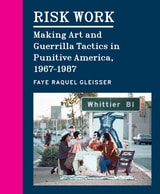
Risk Work
Making Art and Guerrilla Tactics in Punitive America, 1967–1987Faye Raquel Gleisser
University of Chicago Press, 2023
As US news covered anticolonialist resistance abroad and urban rebellions at home, and as politicians mobilized the perceived threat of “guerrilla warfare” to justify increased police presence nationwide, artists across the country began adopting guerrilla tactics in performance and conceptual art. Risk Work tells the story of how artists’ experimentation with physical and psychological interference from the late 1960s through the late 1980s reveals the complex and enduring relationship between contemporary art, state power, and policing.
Focusing on instances of arrest or potential arrest in art by Chris Burden, Adrian Piper, Jean Toche, Tehching Hsieh, Pope.L, the Guerrilla Girls, Asco, and PESTS, Faye Raquel Gleisser analyzes the gendered, sexualized, and racial politics of risk-taking that are overlooked in prevailing, white-centered narratives of American art. Drawing on art history and sociology as well as performance, prison, and Black studies, Gleisser argues that artists’ anticipation of state-sanctioned violence invokes the concept of “punitive literacy,” a collectively formed understanding of how to protect oneself and others in a carceral society.
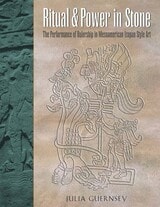
Ritual and Power in Stone
The Performance of Rulership in Mesoamerican Izapan Style ArtBy Julia Guernsey
University of Texas Press, 2006
The ancient Mesoamerican city of Izapa in Chiapas, Mexico, is renowned for its extensive collection of elaborate stone stelae and altars, which were carved during the Late Preclassic period (300 BC-AD 250). Many of these monuments depict kings garbed in the costume and persona of a bird, a well-known avian deity who had great significance for the Maya and other cultures in adjacent regions. This Izapan style of carving and kingly representation appears at numerous sites across the Pacific slope and piedmont of Mexico and Guatemala, making it possible to trace political and economic corridors of communication during the Late Preclassic period.
In this book, Julia Guernsey offers a masterful art historical analysis of the Izapan style monuments and their integral role in developing and communicating the institution of divine kingship. She looks specifically at how rulers expressed political authority by erecting monuments that recorded their performance of rituals in which they communicated with the supernatural realm in the persona of the avian deity. She also considers how rulers used the monuments to structure their built environment and create spaces for ritual and politically charged performances. Setting her discussion in a broader context, Guernsey also considers how the Izapan style monuments helped to motivate and structure some of the dramatic, pan-regional developments of the Late Preclassic period, including the forging of a codified language of divine kingship. This pioneering investigation, which links monumental art to the matrices of political, economic, and supernatural exchange, offers an important new understanding of a region, time period, and group of monuments that played a key role in the history of Mesoamerica and continue to intrigue scholars within the field of Mesoamerican studies.
Robert Schumann's Advice to Young Musicians
Revisited by Steven IsserlisRobert Schumann
University of Chicago Press, 2017
There is no end to learning.
Originally published in1850, Advice to Young Musicians: Musical Rules for Home and in Life offered composer Robert Schumann’s (1810–56) combination of practical advice and poetic words of wisdom for young people beginning their musical education. Presented in aphorisms and short paragraphs, the book’s insights remain as valuable today as when it was written. Recognizing the continued resonance of Schumann’s words, world-renowned cellist Steven Isserlis, himself a writer of children’s books and many articles for young musicians, set out to rescue the work from history. Here, in this beautiful gift edition, he revisits Schumann’s work and contributes his own contemporary counsel for musicians and music lovers.
For this edition, Isserlis retranslated Schumann’s text and arranged it into four thematic sections: “On being a musician,” “Playing,” “Practicing,” and “Composing.” Each page is decoratively designed, and accompanying Schumann’s original quotation are Isserlis’s thoughtful and often humorous glosses. The book concludes with Isserlis’s own reflections on his life as a musician and performer: “My Own Bits of Advice (For What They’re Worth).” The result is a unique and thought-provoking book that will be treasured by aspiring musicians of any age.
Ron Vawter's Life in Performance
Theresa Smalec
Seagull Books, 2018
Partly recuperative history, Ron Vawter’s Life in Performance explores the complex intersections of individual and group biography. It also offers a unique perspective on an era that spanned from the Vietnam War to the AIDS crisis, putting Vawter’s own activism at the forefront. This volume’s broad historical and cultural reach, coupled with its careful study of a beloved yet enigmatic performer, will make it a tremendous resource for theater scholars and practitioners.
Running Science
Optimizing Training and PerformanceJohn Brewer
University of Chicago Press, 2017
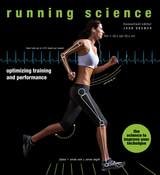
As a sports scientist and Running Fitness columnist, John Brewer has reviewed hundreds of scientific studies, and he offers runners the benefit of their findings in Running Science. Each chapter explores a different aspect of the sport through a series of questions. Many of the questions address practical matters: Do you really need to stretch? Which running shoes best suit your form and foot strike? Does carbo-loading lore stand up to scientific scrutiny—could a big bowl of spaghetti be the difference between a PR and a DNF? Other questions enhance appreciation for the incredible feats of the sport’s great athletes. (What would it take to run a two-hour marathon? Perfect weather, a straight, flat course, competition, and a lot of luck!) The answer to each question is presented in a straightforward, accessible manner, with accompanying infographics.
Whether you’re a beginner or a seasoned runner with many miles and medals behind you, Running Science is a must-have for anyone interested in the fascinating science behind the sport.