Results by title
68 books match the query 'Philosophical anthropology' and 2 start with r
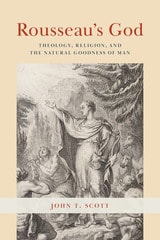
Rousseau's God
Theology, Religion, and the Natural Goodness of ManJohn T. Scott
University of Chicago Press, 2023
A landmark study of Rousseau’s theological and religious thought.
John T. Scott offers a comprehensive interpretation of Rousseau’s theological and religious thought, both in its own right and in relation to Rousseau’s broader oeuvre. In chapters focused on different key writings, Scott reveals recurrent themes in Rousseau’s views on the subject and traces their evolution over time. He shows that two concepts—truth and utility—are integral to Rousseau’s writings on religion. Doing so helps to explain some of Rousseau’s disagreements with his contemporaries: their different views on religion and theology stem from different understandings of human nature and the proper role of science in human life. Rousseau emphasizes not just what is true, but also what is useful—psychologically, morally, and politically—for human beings. Comprehensive and nuanced, Rousseau’s God is vital to understanding key categories of Rousseau’s thought.
John T. Scott offers a comprehensive interpretation of Rousseau’s theological and religious thought, both in its own right and in relation to Rousseau’s broader oeuvre. In chapters focused on different key writings, Scott reveals recurrent themes in Rousseau’s views on the subject and traces their evolution over time. He shows that two concepts—truth and utility—are integral to Rousseau’s writings on religion. Doing so helps to explain some of Rousseau’s disagreements with his contemporaries: their different views on religion and theology stem from different understandings of human nature and the proper role of science in human life. Rousseau emphasizes not just what is true, but also what is useful—psychologically, morally, and politically—for human beings. Comprehensive and nuanced, Rousseau’s God is vital to understanding key categories of Rousseau’s thought.
[more]
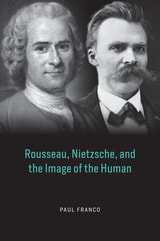
Rousseau, Nietzsche, and the Image of the Human
Paul Franco
University of Chicago Press, 2021
Rousseau and Nietzsche presented two of the most influential critiques of modern life and much can still be learned from their respective analyses of problems we still face.
In Rousseau, Nietzsche, and the Image of the Human, Paul Franco examines the relationship between Jean-Jacques Rousseau and Friedrich Nietzsche, arguably the two most influential shapers and explorers of the moral and cultural imagination of late modernity. Both thinkers leveled radical critiques of modern life, but those critiques differed in important respects. Whereas Rousseau focused on the growing inequality of modern society and the hypocrisy, self-division, and loss of civic virtue it spawned, Nietzsche decried the democratic equality he identified with Rousseau and the loss of individual and cultural greatness it entailed. Franco argues, however, that Rousseau and Nietzsche are more than mere critics; they both put forward powerful alternative visions of how we ought to live. Franco focuses specifically on their views of the self and its realization, their understandings of women and the relation between the sexes, and their speculative conceptions of politics. While there are many similarities in their positive visions, Franco argues that it is the differences between them from which we have most to learn.
In Rousseau, Nietzsche, and the Image of the Human, Paul Franco examines the relationship between Jean-Jacques Rousseau and Friedrich Nietzsche, arguably the two most influential shapers and explorers of the moral and cultural imagination of late modernity. Both thinkers leveled radical critiques of modern life, but those critiques differed in important respects. Whereas Rousseau focused on the growing inequality of modern society and the hypocrisy, self-division, and loss of civic virtue it spawned, Nietzsche decried the democratic equality he identified with Rousseau and the loss of individual and cultural greatness it entailed. Franco argues, however, that Rousseau and Nietzsche are more than mere critics; they both put forward powerful alternative visions of how we ought to live. Franco focuses specifically on their views of the self and its realization, their understandings of women and the relation between the sexes, and their speculative conceptions of politics. While there are many similarities in their positive visions, Franco argues that it is the differences between them from which we have most to learn.
[more]