Results by title
210 books match the query 'Philosophy, Theory & Social Aspects' and 5 start with r
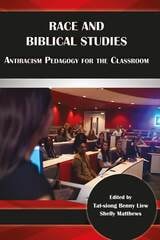
Race and Biblical Studies
Antiracism Pedagogy for the ClassroomTat-siong Benny Liew
SBL Press, 2022
Classrooms as communities are temporary, but the racial effects can be long term.
The biblical studies classroom can be a site of personal and social transformation. To make it a space for positive change, the contributors to this volume question and reevaluate traditional teaching practices and assessment tools that foreground white, Western scholarship in order to offer practical guidance for an antiracist pedagogy. The introduction and fifteen essays provide tools for engaging issues of social context and scriptural authority, nationalism and religious identities, critical race theory, and how race, gender, and class can be addressed empathetically. Contributors Sonja Anderson, Randall C. Bailey, Eric D. Barreto, Denise Kimber Buell, Greg Carey, Haley Gabrielle, Wilda C. Gafney, Julián Andrés González Holguín, Sharon Jacob, Tat-siong Benny Liew, Francisco Lozada Jr., Shelly Matthews, Roger S. Nam, Wongi Park, Jean-Pierre Ruiz, Abraham Smith, and Kay Higuera Smith share their experience creating classrooms that are spaces that enable the production of new knowledge without reproducing a white subject of the geopolitical West.
Race and Education, 1954-2007
Raymond Wolters
University of Missouri Press, 2008
In this compelling study, a scholar who has long observed the traumas of school desegregation uncovers the changes and difficulties with which public education has dealt over the last fifty years—and argues that some judicial decisions were ill-advised. Dealing candidly with matters usually considered taboo in academic discourse, Wolters argues that the Supreme Court acted correctly and in accordance with public sentiment in Brown but that it later took a wrong turn by equating desegregation with integration.
Retracing the history of desegregation and integration in America’s schools, Wolters distinguishes between several Court decisions, explaining that while Brown called for desegregation by requiring that schools deal with students on a racially nondiscriminatory basis, subsequent decisions—Green, Swann, Keyes—required actual integration through racial balancing. He places these decisions in the context of educational reform in the 1950s that sought to encourage bright students through advanced placement and honors courses—courses in which African American and Hispanic students were less likely to be enrolled. Then with the racial unrest of the 1960s, the pursuit of academic excellence yielded to concerns for uplifting disadvantaged youths and ensuring the predominance of middle-class peer groups in schools.
Wolters draws on rich historical records to document the devastating consequences of requiring racial balance and sheds new light on America’s legal, social, and cultural landscapes. He reexamines the educational theories of Kenneth Clark and James Coleman, and he challenges statistics that support the results of racial balancing by describing how school desegregation and integration actually proceeded in several towns, cities, and counties.
Race and Education is a bold challenge to political correctness in education and a corrective to the now widely accepted notion that desegregation and racially balanced integration are one and the same. It is essential reading for scholars of law and education and a wake-up call for citizens concerned about the future of America’s schools.
Re-membering Culture
Erasure and Renewal in Hmong American EducationBic Ngo
University of Minnesota Press, 2024
The untold stories of resilience in Hmong American education
Re-membering Culture is a deep exploration of the intricate dynamics of cultural memory and education, centering the experiences of Hmong American students and educators. Arguing that the school, as a product of coloniality, perpetuates the marginalization and erasure of non-Western epistemologies, author Bic Ngo sheds light on the subtle yet impactful process of structured forgetting within the American education system. This politics of forgetting, in turn, contributes to the fragmentation of Hmong cultural heritage, identity, and community.
Based on a high school in an urban center with a considerable Hmong immigrant community, Ngo’s work draws on extensive ethnographic research with Hmong American community leaders, school administrators, parents, teachers, staff, and high school students to understand how they navigate the terrain of Western pedagogy while attempting to retain and preserve Hmong knowledge systems. Exploring a range of school experiences, Ngo traverses students’ challenges in balancing school with family life and the everyday cultural racism encountered in the classroom as well as grassroots efforts to preserve culture, including the establishment of a Hmong Cultural Club.
Highlighting these experiences and voices, Ngo provides a nuanced understanding of the challenges Hmong Americans face within an assimilationist society while contesting the dominant anti-immigrant narratives of refugee suffering and poverty. Through these practices of (re)storytelling, resurgence, and refusal, she underscores the agency of the Hmong American community, illuminating how the critical consciousness fostered by re-membering serves as a powerful tool in confronting white hegemonic ideologies in education.
Retail e-book files for this title are screen-reader friendly.
Rethinking Open Society
CONTRIBUTORS: Anne Applebaum • Erica Benner• Dorothee Bohle • Thomas Christiano • Tim Crane • Niall Ferguson • Timothy Garton Ash • Béla Greskovits • Michael Ignatieff • Robert D. Kaplan • János Kis • Ivan Krastev • Mark Lilla • Margaret MacMillan • Jan-Werner Müller • Alina Mungiu-Pippidi • Stefan Roch • Pierre Rosanvallon • Jacques Rupnik • András Sajó • Daniela Schwarzer • Sir Roger Scruton • Stephen M. Walt
Central European University Press, 2018
Rise Up!
Activism as EducationAmalia Dache
Michigan State University Press, 2019