Results by title
314 books match the query 'Plants' and 4 start with r
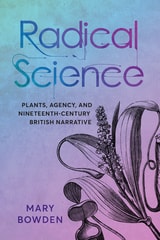
Radical Science
Plants, Agency, and Nineteenth-Century British NarrativeMary Bowden
The Ohio State University Press, 2026
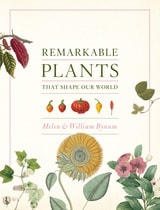
Remarkable Plants That Shape Our World
Helen Bynum and William Bynum
University of Chicago Press, 2014
Remarkable Plants celebrates the wonder and utility of the green kingdom, taking a detailed look at how plants have shaped our world. It focuses on eighty key species and richly explores their history, highlighting their importance and bringing to light surprising stories. Organized thematically into eight sections, the book starts with “Transformers” (including rice, beans, olives) and moves through sections such as “Heal and Harm” (poppy, aloe, strychnos) and “Revered and Adored” (lotus, frankincense, rose). Each species is introduced with its common and scientific names and followed by an exploration of its cultural, historical, botanical, and symbolic associations. Hundreds of botanical illustrations show full plants as well as highlight distinctive leaves, blooms, and fruits.
Rooted in one of the world’s most important and renowned temples of greenery, the Royal Botanic Gardens, Kew, Remarkable Plants is a symbiotic balance of science and art that will open readers’ eyes to the deep influence of the natural world on our modern one.
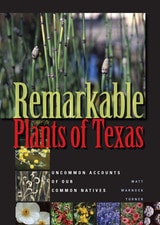
Remarkable Plants of Texas
Uncommon Accounts of Our Common NativesBy Matt Warnock Turner
University of Texas Press, 2009
With some 6,000 species of plants, Texas has extraordinary botanical wealth and diversity. Learning to identify plants is the first step in understanding their vital role in nature, and many field guides have been published for that purpose. But to fully appreciate how Texas's native plants have sustained people and animals from prehistoric times to the present, you need Remarkable Plants of Texas.
In this intriguing book, Matt Warnock Turner explores the little-known facts—be they archaeological, historical, material, medicinal, culinary, or cultural—behind our familiar botanical landscape. In sixty-five entries that cover over eighty of our most common native plants from trees, shrubs, and wildflowers to grasses, cacti, vines, and aquatics, he traces our vast array of connections with plants. Turner looks at how people have used plants for food, shelter, medicine, and economic subsistence; how plants have figured in the historical record and in Texas folklore; how plants nourish wildlife; and how some plants have unusual ecological or biological characteristics. Illustrated with over one hundred color photos and organized for easy reference, Remarkable Plants of Texas can function as a guide to individual species as well as an enjoyable natural history of our most fascinating native plants.

Remarkable Trees
Christina Harrison and Tony Kirkham
University of Chicago Press, 2019
Remarkable Trees tells the unique story of more than sixty species, each selected for its resonance and connection with people. In portraits that combine vivid cultural and historical narrative with a firm scientific grounding, Christina Harrison and Tony Kirkham reveal fascinating details of trees from the world’s major environmental zones and habitats. Some are obvious superstars such as oaks, redwoods and coconut, while others are more surprising: we learn of the monkey puzzle, a tree native to Chile that “can grow for 1,000 years,” and of the manchineel, a tree that contains sap so toxic to human skin that it’s a risk to stand beneath it on a rainy day. In these pages are trees that are healers and killers, trees that serve as foundations of great buildings and grand feasts, and trees that leave us with a sense of wonder and of worry for their survival.
In a tribute to the artists and botanists who have been inspired by trees for centuries, this book is filled with 240 delightful illustrations. The varied and beautiful images come from the unrivalled archive at the Royal Botanic Gardens, Kew, and they bring this enlightening and enchanting volume to life.
While trees have supported us for millennia, we have recently lost that direct, deep connection with them. Harrison and Kirkham remind us that we do not have to look far to reestablish that relationship and that we can still cherish the splendor and significance of these quiet giants.