72 books match the query 'Policy' and 15 start with r
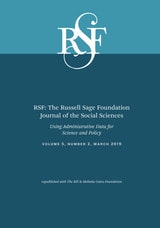
cover of RSF: The Russell Sage Foundation Journal of the Social Sciences: Using Administrative Data for Science and Policy

RSF

The Russell Sage Foundation Journal of the Social Sciences: Using Administrative Data for Science and Policy

Andrew M. Penner

Russell Sage Foundation, 2019

Note: The catalog copy refers to both issues 2 and 3.

In the twenty-first century, administrative data collected by the government, schools, hospitals, and other institutions are essential for effectively managing and evaluating public programs. Yet the U. S. lags behind many other countries when it comes to organizing these data and making linkages across different domains, such as education, health, and the labor market. This double issue of RSF, edited by sociologist Andrew Penner and developmental psychologist Kenneth Dodge, illustrates the tremendous potential of administrative data and provides guidance for the researchers and policymakers. Contributors across multiple disciplines demonstrate how linking disparate sources of administrative data can help us better understand the challenges faced by people in need, thereby improving the reach and efficiency of policy solutions.
 
Several contributors show how databases tracking educational attainment yield new insights into the role of schools in either ameliorating or perpetuating socioeconomic inequalities. Sean Reardon analyzes standardized test scores of roughly 45 million K-12 students nationwide to explore how educational opportunity varies by school districts over time. He finds that while affluent districts typically provide high levels of early childhood learning opportunities, there are some schools in high-poverty districts that do have increased average test scores between third and eighth grade. However, this growth still does not close the large achievement gap between low-and high-socioeconomic-status students. Megan Austin and coauthors, using student-level longitudinal data from Indiana, analyze the effects of school voucher programs on academic achievement and find that students who switch from a public to a private school with a voucher experience significant declines in achievement, particularly in math.
 
Other articles demonstrate how the analysis of administrative data can further our understanding of racial and gender inequality. Janelle Downing and Tim Bruckner link housing foreclosure records and birth records to show that foreclosures and related stresses during the Great Recession contributed to premature births and lower birth weights, particularly for Hispanic mothers and their children. Roberto Fernandez and Brian Rubineau investigate hiring data to explore how network recruitment, or recruitment through employer referrals, affects the “glass ceiling” in the workplace. They show that network recruitment increases women’s representation strongly at lower job levels, and to a lesser extent at higher levels.
 
Researchers now have unprecedented access to administrative data. As this issue shows, finding innovative ways to combine multiple data sets can facilitate partnerships between social scientists, administrators, and policymakers and extend our understanding of pressing social issues.
[more]
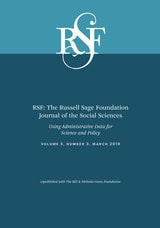
cover of RSF: The Russell Sage Foundation Journal of the Social Sciences: Using Administrative Data for Science and Policy

RSF

The Russell Sage Foundation Journal of the Social Sciences: Using Administrative Data for Science and Policy

Andrew M. Penner

Russell Sage Foundation, 2019

Note: The catalog copy refers to both issues 2 and 3.

In the twenty-first century, administrative data collected by the government, schools, hospitals, and other institutions are essential for effectively managing and evaluating public programs. Yet the U. S. lags behind many other countries when it comes to organizing these data and making linkages across different domains, such as education, health, and the labor market. This double issue of RSF, edited by sociologist Andrew Penner and developmental psychologist Kenneth Dodge, illustrates the tremendous potential of administrative data and provides guidance for the researchers and policymakers. Contributors across multiple disciplines demonstrate how linking disparate sources of administrative data can help us better understand the challenges faced by people in need, thereby improving the reach and efficiency of policy solutions.
 
Several contributors show how databases tracking educational attainment yield new insights into the role of schools in either ameliorating or perpetuating socioeconomic inequalities. Sean Reardon analyzes standardized test scores of roughly 45 million K-12 students nationwide to explore how educational opportunity varies by school districts over time. He finds that while affluent districts typically provide high levels of early childhood learning opportunities, there are some schools in high-poverty districts that do have increased average test scores between third and eighth grade. However, this growth still does not close the large achievement gap between low-and high-socioeconomic-status students. Megan Austin and coauthors, using student-level longitudinal data from Indiana, analyze the effects of school voucher programs on academic achievement and find that students who switch from a public to a private school with a voucher experience significant declines in achievement, particularly in math.
 
Other articles demonstrate how the analysis of administrative data can further our understanding of racial and gender inequality. Janelle Downing and Tim Bruckner link housing foreclosure records and birth records to show that foreclosures and related stresses during the Great Recession contributed to premature births and lower birth weights, particularly for Hispanic mothers and their children. Roberto Fernandez and Brian Rubineau investigate hiring data to explore how network recruitment, or recruitment through employer referrals, affects the “glass ceiling” in the workplace. They show that network recruitment increases women’s representation strongly at lower job levels, and to a lesser extent at higher levels.
 
Researchers now have unprecedented access to administrative data. As this issue shows, finding innovative ways to combine multiple data sets can facilitate partnerships between social scientists, administrators, and policymakers and extend our understanding of pressing social issues.
[more]
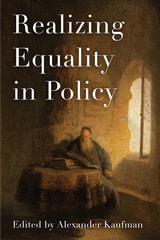
cover of Realizing Equality in Policy

Realizing Equality in Policy

Edited by Alexander Kaufman

University of Michigan Press, 2025

Economic and social inequality have become defining features of the world economy in the late twentieth and early twenty-first centuries. While increased inequality has been particularly pronounced in the United States, a similar phenomenon of increasing inequality of incomes and wealth has emerged in the economies of most major western European states. Realizing Equality in Policy brings together leading scholars to address current issues relating to rising inequality as it affects policy in the areas of education, health care, anti-poverty, employment, and economic policy. 

With contributions from scholars of both luck and relational egalitarianism, the essays reexamine a number of basic assumptions regarding social and economic policy from an egalitarian perspective. They explore gender-based discrimination, international justice, and the possibility for engagement between socialist and left-liberal thought. Rather than focusing on the subtle distinctions that divide egalitarian views, this volume shows that both views have the potential to offer important insights about how differences might be overcome and gaps might be closed. In offering new directions for solving wealth inequality through policy, Realizing Equality in Policy contributes to ongoing conversations in political theory, economic theory, and moral philosophy.
[more]
cover of Review of Environmental Economics and Policy, volume 15 number 1 (Winter 2021)

Review of Environmental Economics and Policy, volume 15 number 1 (Winter 2021)

The University of Chicago Press

University of Chicago Press Journals, 2021

[more]
cover of Review of Environmental Economics and Policy, volume 15 number 2 (Summer 2021)

Review of Environmental Economics and Policy, volume 15 number 2 (Summer 2021)

The University of Chicago Press

University of Chicago Press Journals, 2021
[more]
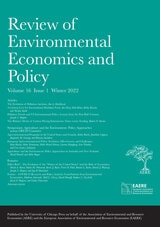
cover of Review of Environmental Economics and Policy, volume 16 number 1 (Winter 2022)

Review of Environmental Economics and Policy, volume 16 number 1 (Winter 2022)

The University of Chicago Press

University of Chicago Press Journals, 2022
This is volume 16 issue 1 of Review of Environmental Economics and Policy. The Review of Environmental Economics and Policy (REEP) is an official journal of the Association of Environmental and Resource Economists and the European Association of Environmental and Resource Economists. REEP publishes symposia, articles, and regular features that contribute to one or more of the following goals: to identify and synthesize lessons learned from recent and ongoing environmental economics research; to provide economic analysis of environmental policy issues; to promote the sharing of ideas and perspectives among the various sub-fields of environmental economics; to strengthen the linkages between environmental economics research and environmental policy; to encourage communication and connections between academics and the wider policy community; to offer suggestions for future research; to provide insights and readings for use in the classroom; to address issues of interest to the environmental economics profession.
[more]
cover of Review of Environmental Economics and Policy, volume 16 number 2 (Summer 2022)

Review of Environmental Economics and Policy, volume 16 number 2 (Summer 2022)

The University of Chicago Press

University of Chicago Press Journals, 2022
This is volume 16 issue 2 of Review of Environmental Economics and Policy. The Review of Environmental Economics and Policy (REEP) is an official journal of the Association of Environmental and Resource Economists and the European Association of Environmental and Resource Economists. REEP publishes symposia, articles, and regular features that contribute to one or more of the following goals: to identify and synthesize lessons learned from recent and ongoing environmental economics research; to provide economic analysis of environmental policy issues; to promote the sharing of ideas and perspectives among the various sub-fields of environmental economics; to strengthen the linkages between environmental economics research and environmental policy; to encourage communication and connections between academics and the wider policy community; to offer suggestions for future research; to provide insights and readings for use in the classroom; to address issues of interest to the environmental economics profession.
[more]
cover of Review of Environmental Economics and Policy, volume 17 number 1 (Winter 2023)

Review of Environmental Economics and Policy, volume 17 number 1 (Winter 2023)

The University of Chicago Press

University of Chicago Press Journals, 2023
This is volume 17 issue 1 of Review of Environmental Economics and Policy. The Review of Environmental Economics and Policy (REEP) is an official journal of the Association of Environmental and Resource Economists and the European Association of Environmental and Resource Economists. REEP publishes symposia, articles, and regular features that contribute to one or more of the following goals: to identify and synthesize lessons learned from recent and ongoing environmental economics research; to provide economic analysis of environmental policy issues; to promote the sharing of ideas and perspectives among the various sub-fields of environmental economics; to strengthen the linkages between environmental economics research and environmental policy; to encourage communication and connections between academics and the wider policy community; to offer suggestions for future research; to provide insights and readings for use in the classroom; to address issues of interest to the environmental economics profession.
[more]
cover of Review of Environmental Economics and Policy, volume 17 number 2 (Summer 2023)

Review of Environmental Economics and Policy, volume 17 number 2 (Summer 2023)

The University of Chicago Press

University of Chicago Press Journals, 2023
This is volume 17 issue 2 of Review of Environmental Economics and Policy. The Review of Environmental Economics and Policy (REEP) is an official journal of the Association of Environmental and Resource Economists and the European Association of Environmental and Resource Economists. REEP publishes symposia, articles, and regular features that contribute to one or more of the following goals: to identify and synthesize lessons learned from recent and ongoing environmental economics research; to provide economic analysis of environmental policy issues; to promote the sharing of ideas and perspectives among the various sub-fields of environmental economics; to strengthen the linkages between environmental economics research and environmental policy; to encourage communication and connections between academics and the wider policy community; to offer suggestions for future research; to provide insights and readings for use in the classroom; to address issues of interest to the environmental economics profession.
[more]
cover of Review of Environmental Economics and Policy, volume 18 number 1 (Winter 2024)

Review of Environmental Economics and Policy, volume 18 number 1 (Winter 2024)

The University of Chicago Press

University of Chicago Press Journals, 2024
This is volume 18 issue 1 of Review of Environmental Economics and Policy. The Review of Environmental Economics and Policy (REEP) is an official journal of the Association of Environmental and Resource Economists and the European Association of Environmental and Resource Economists. REEP publishes symposia, articles, and regular features that contribute to one or more of the following goals: to identify and synthesize lessons learned from recent and ongoing environmental economics research; to provide economic analysis of environmental policy issues; to promote the sharing of ideas and perspectives among the various sub-fields of environmental economics; to strengthen the linkages between environmental economics research and environmental policy; to encourage communication and connections between academics and the wider policy community; to offer suggestions for future research; to provide insights and readings for use in the classroom; to address issues of interest to the environmental economics profession.
[more]
cover of Review of Environmental Economics and Policy, volume 18 number 2 (Summer 2024)

Review of Environmental Economics and Policy, volume 18 number 2 (Summer 2024)

The University of Chicago Press

University of Chicago Press Journals, 2024
This is volume 18 issue 2 of Review of Environmental Economics and Policy. The Review of Environmental Economics and Policy (REEP) is an official journal of the Association of Environmental and Resource Economists and the European Association of Environmental and Resource Economists. REEP publishes symposia, articles, and regular features that contribute to one or more of the following goals: to identify and synthesize lessons learned from recent and ongoing environmental economics research; to provide economic analysis of environmental policy issues; to promote the sharing of ideas and perspectives among the various sub-fields of environmental economics; to strengthen the linkages between environmental economics research and environmental policy; to encourage communication and connections between academics and the wider policy community; to offer suggestions for future research; to provide insights and readings for use in the classroom; to address issues of interest to the environmental economics profession.
[more]
cover of Review of Environmental Economics and Policy, volume 19 number 1 (Winter 2025)

Review of Environmental Economics and Policy, volume 19 number 1 (Winter 2025)

The University of Chicago Press

University of Chicago Press Journals, 2025
This is volume 19 issue 1 of Review of Environmental Economics and Policy. The Review of Environmental Economics and Policy (REEP) is an official journal of the Association of Environmental and Resource Economists and the European Association of Environmental and Resource Economists. REEP publishes symposia, articles, and regular features that contribute to one or more of the following goals: to identify and synthesize lessons learned from recent and ongoing environmental economics research; to provide economic analysis of environmental policy issues; to promote the sharing of ideas and perspectives among the various sub-fields of environmental economics; to strengthen the linkages between environmental economics research and environmental policy; to encourage communication and connections between academics and the wider policy community; to offer suggestions for future research; to provide insights and readings for use in the classroom; to address issues of interest to the environmental economics profession.
[more]
cover of Review of Environmental Economics and Policy, volume 19 number 2 (Summer 2025)

Review of Environmental Economics and Policy, volume 19 number 2 (Summer 2025)

The University of Chicago Press

University of Chicago Press Journals, 2025
This is volume 19 issue 2 of Review of Environmental Economics and Policy. The Review of Environmental Economics and Policy (REEP) is an official journal of the Association of Environmental and Resource Economists and the European Association of Environmental and Resource Economists. REEP publishes symposia, articles, and regular features that contribute to one or more of the following goals: to identify and synthesize lessons learned from recent and ongoing environmental economics research; to provide economic analysis of environmental policy issues; to promote the sharing of ideas and perspectives among the various sub-fields of environmental economics; to strengthen the linkages between environmental economics research and environmental policy; to encourage communication and connections between academics and the wider policy community; to offer suggestions for future research; to provide insights and readings for use in the classroom; to address issues of interest to the environmental economics profession.
[more]
cover of Review of Environmental Economics and Policy, volume 20 number 1 (Winter 2026)

Review of Environmental Economics and Policy, volume 20 number 1 (Winter 2026)

The University of Chicago Press

University of Chicago Press Journals, 2026
This is volume 20 issue 1 of Review of Environmental Economics and Policy. The Review of Environmental Economics and Policy (REEP) is an official journal of the Association of Environmental and Resource Economists and the European Association of Environmental and Resource Economists. REEP publishes symposia, articles, and regular features that contribute to one or more of the following goals: to identify and synthesize lessons learned from recent and ongoing environmental economics research; to provide economic analysis of environmental policy issues; to promote the sharing of ideas and perspectives among the various sub-fields of environmental economics; to strengthen the linkages between environmental economics research and environmental policy; to encourage communication and connections between academics and the wider policy community; to offer suggestions for future research; to provide insights and readings for use in the classroom; to address issues of interest to the environmental economics profession.
[more]
cover of Review of Environmental Economics and Policy, volume 20 number 2 (Summer 2026)

Review of Environmental Economics and Policy, volume 20 number 2 (Summer 2026)

The University of Chicago Press

University of Chicago Press Journals, 2026

This is volume 20 issue 2 of Review of Environmental Economics and Policy. The Review of Environmental Economics and Policy (REEP) is an official journal of the Association of Environmental and Resource Economists and the European Association of Environmental and Resource Economists. REEP publishes symposia, articles, and regular features that contribute to one or more of the following goals: to identify and synthesize lessons learned from recent and ongoing environmental economics research; to provide economic analysis of environmental policy issues; to promote the sharing of ideas and perspectives among the various sub-fields of environmental economics; to strengthen the linkages between environmental economics research and environmental policy; to encourage communication and connections between academics and the wider policy community; to offer suggestions for future research; to provide insights and readings for use in the classroom; to address issues of interest to the environmental economics profession.
[more]