Results by title
87 books match the query 'Political Freedom' and 4 start with r
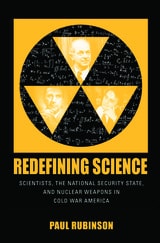
Redefining Science
Scientists, the National Security State, and Nuclear Weapons in Cold War AmericaPaul Rubinson
University of Massachusetts Press, 2016
The Cold War forced scientists to reconcile their values of internationalism and objectivity with the increasingly militaristic uses of scientific knowledge. For decades, antinuclear scientists pursued nuclear disarmament in a variety of ways, from grassroots activism to transnational diplomacy and government science advising. The U.S. government ultimately withstood these efforts, redefining science as a strictly technical endeavor that enhanced national security and deeming science that challenged nuclear weapons on moral grounds “emotional” and patently unscientific. In response, many activist scientists restricted themselves to purely technical arguments for arms control. When antinuclear protest erupted in the 1980s, grassroots activists had moved beyond scientific and technical arguments for disarmament. Grounding their stance in the idea that nuclear weapons were immoral, they used the “emotional” arguments that most scientists had abandoned.
Redefining Science shows that the government achieved its Cold War “consensus” only by active opposition to powerful dissenters and helps explain the current and uneasy relationship between scientists, the public, and government in debates over issues such as security, energy, and climate change.
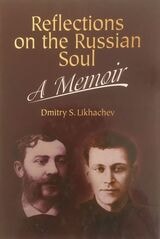
Reflections on the Russian Soul
A MemoirDmitry S. Likhachev
Central European University Press, 2000
This compelling and often traumatic book is the memoir of one of the most important figures in modern Russian history, Dmitry S. Likhachev, revered as ‘a guardian of national culture’. Reflections on the Russian Soul is an incredible account of an intellectual’s turbulent journey through twentieth century Russia. Likhachev re-counts the fortunes of people with whom he came into contact and reproduces the air of passed years in Russia.
Likhachev vividly portrays his childhood years in St. Petersburg and continues into his student life at Leningrad University that led to an agonizing period of imprisonment and near death. He describes how a harmless prank caught the attention of the Secret Police, resulting in his exile and confinement within the infamous prison island of Solovki. He describes his first-hand experience of brutality in prison during the early Stalin years and the incident that not only saved him but also haunted him for the rest of his life.
He reflects on the years after his release from prison and the events leading up to the Second World War. His powerful recollection of the blockade of Leningrad provides the reader with a horrific insight into the harsh effects of war, hunger and survival. Lichachev goes on to describe post-war Russia and how his own livelihood developed from literary editor to a return to Leningrad University as Professor of History. This compelling autobiography finishes with Likhachev’s poignant return to Solovki as a free man.
Religious Liberty and the American Founding
Natural Rights and the Original Meanings of the First Amendment Religion ClausesVincent Phillip Muñoz
University of Chicago Press, 2022
The Founders understood religious liberty to be an inalienable natural right. Vincent Phillip Muñoz explains what this means for church-state constitutional law, uncovering what we can and cannot determine about the original meanings of the First Amendment’s Religion Clauses and constructing a natural rights jurisprudence of religious liberty.
Drawing on early state constitutions, declarations of religious freedom, Founding-era debates, and the First Amendment’s drafting record, Muñoz demonstrates that adherence to the Founders’ political philosophy would lead neither to consistently conservative nor consistently liberal results. Rather, adopting the Founders’ understanding would lead to a minimalist church-state jurisprudence that, in most cases, would return authority from the judiciary to the American people. Thorough and convincing, Religious Liberty and the American Founding is key reading for those seeking to understand the Founders’ political philosophy of religious freedom and the First Amendment Religion Clauses.

Revolutionary Social Change in Colombia
The Origin and Direction of the FARC-EPJames J. Brittain
Pluto Press, 2010
This book presents an insider's account of Columbia's internal conflict. At the forefront are the Revolutionary Armed Forces of Colombia-People's Army (FARC-EP).
Although they are one of the most powerful military forces in Latin American history, little is known about the FARC-EP. James J. Brittain explains where and why this political military movement came into existence and assesses whether the methods employed by the insurgency have the potential to free those marginalised in Colombia.
As democratic socialism develops in Venezuela and Bolivia, Brittain's fascinating study assesses the relevance of armed struggle to 21st century Latin American politics. This is an essential title for those wishing to develop a full understanding of the continent.
By evaluating the FARC-EP's actions, ideological construction, and their theoretical placement, the book gauges how this guerrilla movement relates to revolutionary theory and practice and through what tangible mechanisms, if any, they are creating a new Colombia.