Results by title
64 books match the query 'Political corruption' and 2 start with r

Red Tape
Bureaucracy, Structural Violence, and Poverty in IndiaAkhil Gupta
Duke University Press, 2012
Gupta conducted ethnographic research among officials charged with coordinating development programs in rural Uttar Pradesh. Drawing on that research, he offers insightful analyses of corruption; the significance of writing and written records; and governmentality, or the expansion of bureaucracies. Those analyses underlie his argument that care is arbitrary in its consequences, and that arbitrariness is systematically produced by the very mechanisms that are meant to ameliorate social suffering. What must be explained is not only why government programs aimed at providing nutrition, employment, housing, healthcare, and education to poor people do not succeed in their objectives, but also why, when they do succeed, they do so unevenly and erratically.
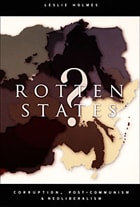
Rotten States?
Corruption, Post-Communism, and NeoliberalismLeslie Holmes
Duke University Press, 2006
Drawing on data including surveys commissioned especially for this study, Holmes examines the causes and consequences of official corruption as well as ways of combating it. He focuses particular attention on the timing of the recent increase in reports of corruption, the relationship between post-communism and corruption, and the interplay between corruption and the delegitimation and weakening of the state. Holmes argues that the global turn toward neoliberalism—with its focus on ends over means, flexibility, and a reduced role for the state—has generated much of the corruption in post-communist states. At the same time, he points out that neoliberalism is perhaps the single most powerful tool for overcoming the communist legacy, which is an even more significant cause of corruption. Among the conclusions that Holmes draws is that a strong democratic state is needed in the early stages of the transition from communism in order to prevent corruption from taking hold.