Results by title
213 books match the query 'Political parties' and 10 start with r
Radical American Partisanship
Mapping Violent Hostility, Its Causes, and the Consequences for DemocracyNathan P. Kalmoe and Lilliana Mason
University of Chicago Press, 2022
Political violence is rising in the United States, with Republicans and Democrats divided along racial and ethnic lines that spurred massive bloodshed and democratic collapse earlier in the nation’s history. The January 6, 2021 insurrection and the partisan responses that ensued are a vivid illustration of how deep these currents run. How did American politics become so divided that we cannot agree on how to categorize an attack on our own Capitol?
For over four years, through a series of surveys and experiments, Nathan P. Kalmoe and Lilliana Mason have been studying radicalism among ordinary American partisans. In this groundbreaking book, they draw on new evidence—as well as insights from history, psychology, and political science—to put our present partisan fractiousness in context and to explain broad patterns of political and social change. Early chapters reveal the scope of the problem, who radical partisans are, and trends over time, while later chapters identify the conditions that partisans say justify violence and test how elections, political violence, and messages from leaders enflame or pacify radical views. Kalmoe and Mason find that ordinary partisanship is far more dangerous than pundits and scholars have recognized. However, these findings are not a forecast of inevitable doom; the current climate also brings opportunities to confront democratic threats head-on and to create a more inclusive politics. Timely and thought-provoking, Radical American Partisanship is vital reading for understanding our current political landscape.

Radicalism in the States
The Minnesota Farmer-Labor Party and the American Political EconomyRichard M. Valelly
University of Chicago Press, 1989
Richard M. Valelly treats in detail the political economy of the Minnesota Farmer-Labor Party (1918-1944), the most successful radical, state-level party in American history. With the aid of numerous interviews of surviving organizers and participants in the party's existence, Valelly recreates the party's rise to power and subsequent decline, seeking answers to some broad, developmental questions. Why did this type of politics arise, and why did it collapse when it did? What does the party's history tell us about national political change? The answers lie, Valelly argues, in America's transition from the political economy of the 1920s to the New Deal. Combining case study and comparative state politics, he reexamines America's political economy prior to the New Deal and the scope and ironies of the New Deal's reorganization of American politics. The results compellingly support his argument that the federal government's increasing intervention in the economy profoundly transformed state politics. The interplay between national economy policy-making and federalism eventually reshaped the dynamics of interest-group politics and closed off the future of "state-level radicalism." The strength of this argument is highlighted by Valelly's cross-national comparison with Canadian politics. In vivid contrast to the fate of American movements, "province level radicalism" thrived in the Canadian political environment.
In the course of analyzing one of the "supressed alternatives" of American politics, Valelly illuminates the influence of the national political economy on American political development. Radicalism in the States will interest students of economic protest, of national policy-making, of interest-group politics and party politics.
Rationality of Irrationality
Political Determinants and Effects of Party Position BlurringKyung Joon Han
University of Michigan Press, 2022
Citizens in democracies complain that political parties’ positions on major issues are too ambiguous for them to confidently understand. Why is party position ambiguity so common? Are party positions ambiguous because political parties fail in forming clear policies or because they deliberately blur their positions? Rationality of Irrationality argues that political parties are motivated to strategically blur their position on an issue when they struggle with a certain disadvantage in the issue. Specifically, political parties present an ambiguous position when their own supporters are divided in their stances on the issue. A political party also blurs position stances when voters do not acknowledge that the party has the ability and integrity to solve problems related to the issue. Political parties blur their position in these cases because ambiguous party positions divert voters’ attention from the issue. Voters support a political party whose policy positions on major issues are close to their own stances. However, voters cannot confidently and exactly estimate party positions on an issue when they are only ambiguous.
Reaching for a New Deal
Ambitious Governance, Economic Meltdown, and Polarized Politics in Obama's First Two YearsTheda Skocpol
Russell Sage Foundation, 2011
Realignment in American Politics
Toward a TheoryEdited by Bruce A. Campbell and Richard J. Trilling
University of Texas Press, 1980
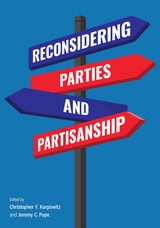
Reconsidering Parties and Partisanship
Edited by Christopher F. Karpowitz and Jeremy C. Pope
University of Michigan Press, 2026
The scholars here approach parties from the standpoint of partisan and social identities, polarization, the prevalence of independents (and pseudo-independents), political campaigns, and more. In linking the different faces or levels—party-in-the-electorate, party-in-government, and party-as-an-organization—the chapters provide a wide-ranging set of theories and ideas to consider. Through this exploration, Reconsidering Parties and Partisanship provides a valuable road map for partisanship in our current era.
Readers will learn
- How conditional party government seems to work in this highly partisan era
- How donors and pressure groups have taken ownership over campaigns
- How independents are often undercover partisans, but who also feel repelled by the existing parties—even the one they typically support
- How various identities converge to produce partisan affection (when that exists)
- How partisanship relates to ideology.
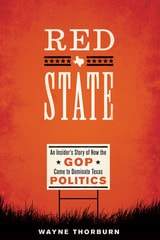
Red State
An Insider's Story of How the GOP Came to Dominate Texas PoliticsBy Wayne Thorburn
University of Texas Press, 2014
In November 1960, the Democratic party dominated Texas. The newly elected vice president, Lyndon Johnson, was a Texan. Democrats held all thirty statewide elective positions. The state legislature had 181 Democrats and no Republicans or anyone else. Then fast forward fifty years to November 2010. Texas has not voted for a Democratic president since 1976. Every statewide elective office is held by Republicans. Representing Texas in Washington is a congressional delegation of twenty-five Republicans and nine Democrats. Republicans control the Texas Senate by a margin of nineteen to twelve and the Texas House of Representatives by 101 to 49.
Red State explores why this transformation of Texas politics took place and what these changes imply for the future. As both a political scientist and a Republican party insider, Wayne Thorburn is especially qualified to explain how a solidly one-party Democratic state has become a Republican stronghold. He analyzes a wealth of data to show how changes in the state’s demographics—including an influx of new residents, the shift from rural to urban, and the growth of the Mexican American population—have moved Texas through three stages of party competition, from two-tiered politics, to two-party competition between Democrats and Republicans, and then to the return to one-party dominance, this time by Republicans. His findings reveal that the shift from Democratic to Republican governance has been driven not by any change in Texans’ ideological perspective or public policy orientation—even when Texans were voting Democrat, conservatives outnumbered liberals or moderates—but by the Republican party’s increasing identification with conservatism since 1960.
Religion and the Demise of Liberal Rationalism
The Foundational Crisis of the Separation of Church and StateJ. Judd Owen
University of Chicago Press, 2001
J. Judd Owen answers these questions with a remarkable critical analysis of four twentieth-century liberal and postliberal thinkers: John Dewey, John Rawls and, most extensively, Richard Rorty and Stanley Fish. His unique readings of these theorists and their approaches to religion lead him to conclusions that are meticulously constructed and surprising, arguing against the perception of liberalism as simple moral or religious neutrality, calling into question the prevailing justifications for separation of church and state, and challenging the way we think about the very basis of constitutional government.
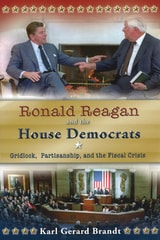
Ronald Reagan and the House Democrats
Gridlock, Partisanship, and the Fiscal CrisisKarl Gerard Brandt
University of Missouri Press, 2009
Russian-American Dialogue on the History of U.S. Political Parties
Edited by Joel H. Silbey
University of Missouri Press, 2000
Russian-American Dialogue on the History of U.S. Political Parties is the fourth volume in the Russian-American Dialogues series—a series that brings together scholars in the former Soviet Union and the United States who share an interest in the study of America's heritage and its importance to contemporary Russia.
In this valuable work, Russian scholars such as N. V. Sivachev, Alexander S. Manykin, and Vladimir V. Sogrin examine the history of American political parties and the role they played across two centuries. The Russians draw their own conclusions about the durability of the two-party system, giving careful consideration to historical crises—the secessionist movement and the Civil War, the reform era of the Populists and Progressives at the turn of the twentieth century, the Great Depression and the New Deal—in which the two-party structure was tested. Russian perspectives are also applied in analyzing the evolution of particular parties, from the rise and fall of the nineteenth-century Whigs to the shifting balance between twentieth-century Democrats and Republicans. The dialogue is then developed through commentaries by American historians such as Allan G. Bogue and Theodore J. Lowi and through counter-responses, often strongly expressed, by the Russian authors.
This lively exchange of ideas helps advance an understanding of key aspects of American party history and offers thought-provoking discussions of comparative international studies and historiography. Because the book provides unique perspectives on the American partisan experience by non-American specialists, it will be welcomed by all historians, as well as by anyone with an interest in the American-Russian connection.