81 books match the query 'Post-communism' and 8 start with r
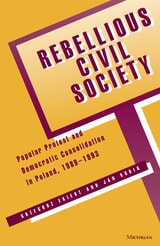
cover of Rebellious Civil Society: Popular Protest and Democratic Consolidation in Poland, 1989-1993

Rebellious Civil Society

Popular Protest and Democratic Consolidation in Poland, 1989-1993

Grzegorz Ekiert and Jan Kubik

University of Michigan Press, 2001

Poland is the only country in which popular protest and mass opposition, epitomized by the Solidarity movement, played a significant role in bringing down the communist regime. This book, the first comprehensive study of the politics of protest in postcommunist Central Europe, shows that organized protests not only continued under the new regime but also had a powerful impact on Poland's democratic consolidation.
Following the collapse of communism in 1989, the countries of Eastern Europe embarked on the gargantuan project of restructuring their social, political, economic, and cultural institutions. The social cost of these transformations was high, and citizens expressed their discontent in various ways. Protest actions became common events, particularly in Poland. In order to explain why protest in Poland was so intense and so particularized, Grzegorz Ekiert and Jan Kubik place the situation within a broad political, economic, and social context and test it against major theories of protest politics. They conclude that in transitional polities where conventional political institutions such as parties or interest groups are underdeveloped, organized collective protest becomes a legitimate and moderately effective strategy for conducting state-society dialogue. The authors offer an original and rich description of protest movements in Poland after the fall of communism as a basis for developing and testing their ideas. They highlight the organized and moderate character of the protests and argue that the protests were not intended to reverse the change of 1989 but to protest specific policies of the government.
This book contributes to the literature on democratic consolidation, on the institutionalization of state-society relationship, and on protest and social movements. It will be of interest to political scientists, sociologists, historians, and policy advisors.
Grzegorz Ekiert is Professor of Government, Harvard University. Jan Kubik is Associate Professor of Political Science, Rutgers University.
[more]
cover of Red Hangover: Legacies of Twentieth-Century Communism

Red Hangover

Legacies of Twentieth-Century Communism

Kristen Ghodsee

Duke University Press, 2017
In Red Hangover Kristen Ghodsee examines the legacies of twentieth-century communism twenty-five years after the Berlin Wall fell. Ghodsee's essays and short stories reflect on the lived experience of postsocialism and how many ordinary men and women across Eastern Europe suffered from the massive social and economic upheavals in their lives after 1989. Ghodsee shows how recent major crises—from the Russian annexation of Crimea and the Syrian Civil War to the rise of Islamic State and the influx of migrants in Europe—are linked to mistakes made after the collapse of the Eastern Bloc when fantasies about the triumph of free markets and liberal democracy blinded Western leaders to the human costs of "regime change." Just as the communist ideal has become permanently tainted by its association with the worst excesses of twentieth-century Eastern European regimes, today the democratic ideal is increasingly sullied by its links to the ravages of neoliberalism. An accessible introduction to the history of European state socialism and postcommunism, Red Hangover reveals how the events of 1989 continue to shape the world today.
[more]
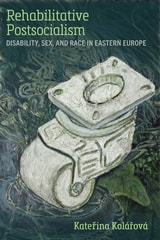
cover of Rehabilitative Postsocialism: Disability, Sex, and Race in Eastern Europe

Rehabilitative Postsocialism

Disability, Sex, and Race in Eastern Europe

Katerina Kolárová

University of Michigan Press, 2025

Winner of the 2019 Tobin Siebers Prize for Disability Studies in the Humanities

Kateřina Kolářová’s Rehabilitative Postsocialism offers a timely interdisciplinary and intersectional analysis of how disability, race, class, and gender operate as ideological tools within the postsocialist Czech Republic (formerly Czechoslovakia). Kolářová presents postsocialism as an analytic that can and should be brought to bear to understand cultural politics, economic formations, and state politics through the present day. 

Rehabilitative Postsocialism names disability, sexuality, and race as central yet invisible to negotiations of the postsocialist consensus. Drawing from a rich and varied archive, Rehabilitative Postsocialism maps the formation of new structures of inequalities and social imaginaries of wellness, merit, and justice in order to understand current articulations of global disenchantment with democracy, social justice, and solidarity. The book also makes clear that disability, race, and ethnicity continue to circulate in depictions of Eastern Europe as suspended in a chronic developmental “delay.” Rehabilitative Postsocialism both situates this positioning within its political and historical formation and offers the analytical tools to challenge its continued deployment.
[more]
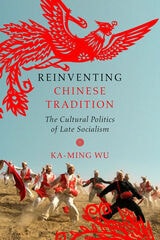
cover of Reinventing Chinese Tradition: The Cultural Politics of Late Socialism

Reinventing Chinese Tradition

The Cultural Politics of Late Socialism

Ka-ming Wu

University of Illinois Press, 2015

The final destination of the Long March and center of the Chinese Communist Party's red bases, Yan'an acquired mythical status during the Maoist era. Though the city's significance as an emblem of revolutionary heroism has faded, today's Chinese still glorify Yan'an as a sanctuary for ancient cultural traditions.

Ka-ming Wu's ethnographic account of contemporary Yan'an documents how people have reworked the revival of three rural practices--paper-cutting, folk storytelling, and spirit cults--within (and beyond) the socialist legacy. Moving beyond dominant views of Yan'an folk culture as a tool of revolution or object of market reform, Wu reveals how cultural traditions become battlegrounds where conflicts among the state, market forces, and intellectuals in search of an authentic China play out. At the same time, she shows these emerging new dynamics in the light of the ways rural residents make sense of rapid social change.

Alive with details, Reinventing Chinese Tradition is an in-depth, eye-opening study of an evolving culture and society within contemporary China.
[more]
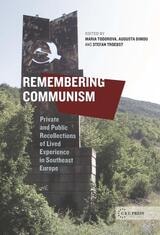
cover of Remembering Communism: Private and Public Recollections of Lived Experience in Southeast Europe

Remembering Communism

Private and Public Recollections of Lived Experience in Southeast Europe

Contributors: Simina Bădica, Iskra Baeva, Tanya Boneva, Corina Cimpoieru, Liliana Deyanova, Albena Hranova, Nataliya Hristova, Petya Kabakchieva, Evgenia Kalinova, Anny Kirilova, Thomas Lindenberger, Tamás Lőnhárt, Izabella Main, Tsvetana Manova, Iliiana Marcheva, Vasil Markov, Andi Mihalache, Cătălina Mihalache, Milla Mineva, Cristina Petrescu, Dragoş Petrescu, Vania Stoyanova, Virgiliu Ţârău, Nikolai Vukov, Smaranda Vultur

Central European University Press, 2014

Remembering Communism examines the formation and transformation of the memory of communism in the post-communist period. The majority of the articles focus on memory practices in the post-Stalinist era in Bulgaria and Romania, with occasional references to the cases of Poland and the GDR. Based on an interdisciplinary approach, including history, anthropology, cultural studies and sociology, the volume examines the mechanisms and processes that influence, determine and mint the private and public memory of communism in the post-1989 era. The common denominator to all essays is the emphasis on the process of remembering in the present, and the modalities by means of which the present perspective shapes processes of remembering, including practices of commemoration and representation of the past.

The volume deals with eight major thematic blocks revisiting specific practices in communism such as popular culture and everyday life, childhood, labor, the secret police, and the perception of “the system”.
[more]
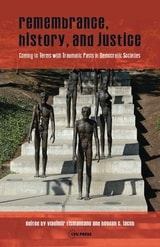
cover of Remembrance, History, and Justice: Coming to terms with traumatic pasts in democratic societies

Remembrance, History, and Justice

Coming to terms with traumatic pasts in democratic societies

Bogdan C. Iacob

Central European University Press, 2015
The twentieth century has left behind a painful and complicated legacy of massive trauma, monstrous crimes, radical social engineering, or collective/individual guilt syndromes that were often the premises for and the specters haunting the process of democratization in the various societies that emerged out of these profoundly de-structuring contexts. The present manuscript is a state of the art reassessment and analysis of how the interplay between memory, history, and justice generates insight that is multifariously relevant for comprehending the present and future of democracy without becoming limited to a Europe-centric framework of understanding. The manuscript is structured on three complementary and interconnected trajectories: the public use of history, politics of memory, and transitional justice. Key words 1. Europe, Eastern—Politics and government—1989– 2. Collective memory—Europe,Eastern. 3. Memory—Political aspects—Europe, Eastern. 4. Democratization—Social aspects—Europe, Eastern. 5. Europe, Eastern—Historiography—Socialaspects. 6. Europe, Eastern—Historiography—Political aspects. 7. Social justice—Europe, Eastern. 8. Post-communism—Europe, Eastern. 9. Fascism—Socialaspects—Europe, Eastern. 10. Dictatorship—Social aspects—Europe, Eastern.
[more]
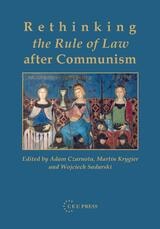
cover of Rethinking the Rule of Law after Communism

Rethinking the Rule of Law after Communism

Wojciech Sadurski

Central European University Press, 2005
In the original euphoria that attended the virtually simultaneous demise of so many dictatorships in the late 1980s and early 90s, there was a widespread belief that problems of 'transition' basically involved shedding a known past, and replacing it with an also-known future. This volume surveys and contributes to the prolific debates that occurred in the years between the collapse of communism and the enlargement of the European Union regarding the issues of constitutionalism, dealing with the past, and the rule of law in the post-communist world. Eminent scholars explore the issue of transitional justice, highlighting the distinct roles of legal and constitutional bodies in the post-transition period. The introduction seeks to frame the work as an intervention in the discussion of communism and transition-two stable and separate points-while emphasizing the instability of the post-transition moment.
[more]
cover of Rotten States?: Corruption, Post-Communism, and Neoliberalism

Rotten States?

Corruption, Post-Communism, and Neoliberalism

Leslie Holmes

Duke University Press, 2006

Official corruption has become increasingly prevalent around the world since the early 1990s. The situation appears to be particularly acute in the post-communist states. Corruption—be it real or perceived—is a major problem with concrete implications, including a lowered likelihood of foreign investment. In Rotten States? Leslie Holmes analyzes corruption in post-communist countries, paying particular attention to Bulgaria, Hungary, Poland, and Russia, as well as China, which Holmes argues has produced, through its recent economic liberalization, a system similar to post-communism. As he points out, these countries offer useful comparisons: they vary in terms of size, religious orientation, ethnic homogeneity, and their approaches to and economic success with the transition from communism.

Drawing on data including surveys commissioned especially for this study, Holmes examines the causes and consequences of official corruption as well as ways of combating it. He focuses particular attention on the timing of the recent increase in reports of corruption, the relationship between post-communism and corruption, and the interplay between corruption and the delegitimation and weakening of the state. Holmes argues that the global turn toward neoliberalism—with its focus on ends over means, flexibility, and a reduced role for the state—has generated much of the corruption in post-communist states. At the same time, he points out that neoliberalism is perhaps the single most powerful tool for overcoming the communist legacy, which is an even more significant cause of corruption. Among the conclusions that Holmes draws is that a strong democratic state is needed in the early stages of the transition from communism in order to prevent corruption from taking hold.

[more]