Results by title
50 books match the query 'Press and politics' and 3 start with r
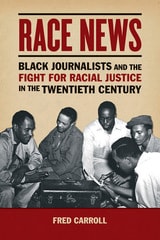
Race News
Black Journalists and the Fight for Racial Justice in the Twentieth CenturyFred Carroll
University of Illinois Press, 2017
Racializing Objectivity
How the White Southern Press Used Journalism Standards to Defend Jim CrowGwyneth Mellinger
University of Massachusetts Press, 2024
Winner of the 2025 American Journalism Historians Association Book of the Year Award
Winner of the 2025 Association for Education in Journalism and Mass Communication (AEJMC)'s Tankard Book Award and the AEJMC's History Division Book Award
When the civil rights movement began to challenge Jim Crow laws, the white southern press reframed the coverage of racism and segregation as a debate over journalism standards. Many white southern editors, for instance, designated Black Americans as “Negro” in news stories, claiming it was necessary for accuracy and “objectivity,” even as white subjects went unlabeled. These news professionals disparaged media outlets that did not adhere to these norms, such as the Black press. In this way, the southern white press weaponized journalism standards—and particularly the idea of objectivity—to counter and discredit reporting that challenged white supremacy.
Through deep engagement with letters and other materials in numerous archives from editors, journalists, and leaders of newswire services, Racializing Objectivity interrogates and exposes how the white southern press used journalism standards as a professional rationalization for white supremacy and a political strategy to resist desegregation. Gwyneth Mellinger argues that white skin privilege gave these news professionals a stake in the racial status quo and was thus a conflict of interest as they defended Jim Crow. Her study includes an examination of the Southern Education Reporting Service, an objectivity project whose impartiality, she contends, instead affirmed systemic racism. In a pointed counternarrative, Mellinger highlights Black editors and academics who long criticized the supposed objectivity of the press and were consequently marginalized and often dismissed as illegitimate, fanciful, and even paranoid.
Elegant and incisive, Racializing Objectivity unequivocally demonstrates that a full telling of twentieth-century press history must reckon with the white southern press’s cooptation of objectivity and other professional standards to skew racial narratives about Black Americans, the freedom struggle, and democracy itself.
Revolutionary News
The Press in France, 1789–1799Jeremy D. Popkin
Duke University Press, 1990