Results by title
176 books match the query 'Prevention' and 6 start with r
Rebuilding Trust
Clergy Morale in the Wake of the Abuse CrisisBrandon Vaidyanathan
Catholic University of America Press, 2025
Reducing Firearm Injury and Death
A Public Health Sourcebook on GunsTrudy A. Karlson
Rutgers University Press, 1997
There are few issues more explosive than guns. "Guns don't kill people, people kill people," is an often-heard response to calls for firearm control. But are there ways to make guns safer without placing further restrictions on gun owners? Can guns be engineered to reduce the number and severity of injuries?
This book is about guns and new solutions for addressing problems they create. Trudy Karlson and Stephen Hargarten, two experts in public health and injury control, show readers how guns are products, designed to injure and kill, and how changes in the design, technology, and marketing of firearms can lead to reductions in the number of injuries and fatalities.
Just as innovations in the design and technology of motor vehicles succeeded in creating safer cars, Karlson and Hargarten describe how responsible changes to gun products can reduce the number of serious injuries and fatalities. The injury control perspective illustrates how the characteristics of guns and ammunition are associated with their ability to cause injury and death. It also provides options for how guns can be re-engineered to ensure a greater degree of safety and protection. Reducing Firearm Injury and Death teaches basic facts about guns and gun injuries, and by reframing the problem of firearms as a public health issue, offers hope for saving lives.

Rejecting Climate Doomism
Diana Stuart
University of Michigan Press, 2026
Drawing from climate science, sociology, psychology, and philosophy, Rejecting Climate Doomism outlines the reasons to instead choose action grounded in active hope. It examines how global warming could be effectively limited through specific policy proposals. Despite the many obstacles to achieving some of the policies discussed in this book, they are still possible and worth pursuing. By outlining a positive vision of the far-reaching changes that can be used to minimize warming, the book encourages readers to advocate for the social and economic changes necessary to forge the best path for people and the planet.
Retention and Resistance
Writing Instruction and Students Who LeavePegeen Reichert Powell
Utah State University Press, 2014
Retention is a vital issue for institutions, but as these students’ stories show, leaving college is often the result of complex and idiosyncratic individual situations that make institutional efforts difficult and ultimately ineffective. An adjustment of institutional and pedagogical objectives is needed to refocus on educating as many students as possible, including those who might leave before graduation.
Much of the pedagogy, curricula, and methodologies of composition studies assume students are preparing for further academic study. Retention and Resistance argues for a new kairotic pedagogy that moves toward an emphasis on the present classroom experience and takes students’ varied experiences into account. Infusing the discourse of retention with three individual student voices, Powell explores the obligation of faculty to participate in designing an institution that educates all students, no matter where they are in their educational journey or how far that journey will go.
Retention, Persistence, and Writing Programs
Todd Ruecker
Utah State University Press, 2017
From scholars working in a variety of institutional and geographic contexts and with a wide range of student populations, Retention, Persistence, and Writing Programs offers perspectives on how writing programs can support or hinder students’ transitions to college. The contributors present individual and program case studies, student surveys, a wealth of institutional retention data, and critical policy analysis.
Rates of student retention in higher education are a widely acknowledged problem: although approximately 66 percent of high school graduates begin college, of those who attend public four-year institutions, only about 80 percent return the following year, with 58 percent graduating within six years. At public two-year institutions, only 60 percent of students return, and fewer than a third graduate within three years. Less commonly known is the crucial effect of writing courses on these statistics.
First-year writing is a course that virtually all students have to take; thus, writing programs are well-positioned to contribute to larger institutional conversations regarding retention and persistence and should offer themselves as much-needed sites for advocacy, research, and curricular innovation. Retention, Persistence, and Writing Programs is a timely resource for writing program administrators as well as for new writing teachers, advisors, administrators, and state boards of education.
Contributors: Matthew Bridgewater, Cristine Busser, Beth Buyserie, Polina Chemishanova, Michael Day, Bruce Feinstein, Patricia Freitag Ericsson, Nathan Garrett, Joanne Baird Giordano, Tawanda Gipson, Sarah E. Harris, Mark Hartlaub, Holly Hassel, Jennifer Heinert, Ashley J. Holmes, Rita Malenczyk, Christopher P. Parker, Cassandra Phillips, Anna Plemons, Pegeen Reichert Powell, Marc Scott, Robin Snead, Sarah Elizabeth Snyder, Sara Webb-Sunderhaus, Susan Wolff Murphy
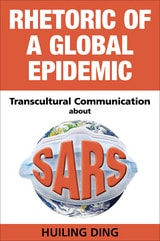
Rhetoric of a Global Epidemic
Transcultural Communication about SARSHuiling Ding
Southern Illinois University Press, 2014
2016 CCCC Best Book Award in Technical and Scientific Communication
In the past ten years, we have seen great changes in the ways government organizations and media respond to and report on emerging global epidemics. The first outbreak to garner such attention was SARS (severe acute respiratory syndrome). In Rhetoric of a Global Epidemic, Huiling Ding uses SARS to explore how various cultures and communities made sense of the epidemic and communicated about it. She also investigates the way knowledge production and legitimation operate in global epidemics, the roles that professionals and professional communicators, as well as individual citizens, play in the communication process, points of contention within these processes, and possible entry points for ethical and civic intervention.
Focusing on the rhetorical interactions among the World Health Organization, the United States, China, and Canada, Rhetoric of a Global Epidemic investigates official communication and community grassroots risk tactics employed during the SARS outbreak. It consists of four historical cases, which examine the transcultural risk communication about SARS in different geopolitical regions at different stages. The first two cases deal with risk communication practices at the early stage of the SARS epidemic when it originated in southern China. The last two cases move to transcultural rhetorical networks surrounding SARS.
With such threats as SARS, avian flu, and swine flu capturing the public imagination and prompting transnational public health preparedness efforts, the need for a rhetoric of global epidemics has never been greater. Government leaders, public health officials, health care professionals, journalists, and activists can learn how to more effectively craft and manage transcultural risk communication from Ding’s examination of the complex and varied modes of communication around SARS. In addition to offering a detailed case study, Rhetoric of a Global Epidemic provides a critical methodology that professional communicators can use in their investigations of epidemics and details approaches to facilitating more open, participatory risk communication at all levels.