Results by title
76 books match the query 'Principles' and 2 start with r
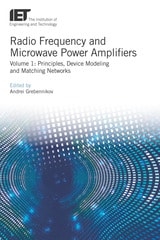
Radio Frequency and Microwave Power Amplifiers
Principles, Device Modeling and Matching Networks, Volume 1Andrei Grebennikov
The Institution of Engineering and Technology, 2019
Radio Frequency and Microwave Power Amplifiers are finding an increasingly broad range of applications, particularly in communications and broadcasting, but also in the industrial, medical, automotive, aviation, military, and sensing fields. Each application has its own design specifications, for example, high linearity in modern communication systems or high efficiency in broadcasting, and, depending on process technology, capability to operate efficiently at very high frequencies, such as 77 GHz and higher for automotive radars. Advances in design methodologies have practical applications in improving gain, power output, bandwidth, power efficiency, linearity, input and output impedance matching, and heat dissipation.
[more]
Representative Democracy
Principles and GenealogyNadia Urbinati
University of Chicago Press, 2006
It is usually held that representative government is not strictly democratic, since it does not allow the people themselves to directly make decisions. But here, taking as her guide Thomas Paine’s subversive view that “Athens, by representation, would have surpassed her own democracy,” Nadia Urbinati challenges this accepted wisdom, arguing that political representation deserves to be regarded as a fully legitimate mode of democratic decision making—and not just a pragmatic second choice when direct democracy is not possible.
As Urbinati shows, the idea that representation is incompatible with democracy stems from our modern concept of sovereignty, which identifies politics with a decision maker’s direct physical presence and the immediate act of the will. She goes on to contend that a democratic theory of representation can and should go beyond these identifications. Political representation, she demonstrates, is ultimately grounded in a continuum of influence and power created by political judgment, as well as the way presence through ideas and speech links society with representative institutions. Deftly integrating the ideas of such thinkers as Rousseau, Kant, Emmanuel Joseph Sieyès, Paine, and the Marquis de Condorcet with her own, Urbinati constructs a thought-provoking alternative vision of democracy.
[more]