61 books match the query 'Propaganda' and 4 start with r

cover of Reflections in a Bloodshot Lens: America, Islam and the War of Ideas

Reflections in a Bloodshot Lens

America, Islam and the War of Ideas

Lawrence Pintak

Pluto Press, 2006

There exists today a tragic rift between Americans and the world’s Muslims. Yet in the immediate aftermath of 9/11, there was widespread sympathy for the U.S. throughout the Muslim world. This book explores what happened. It examines the disconnect that leads Americans and Muslims to view the same words and images in fundamentally different ways. Partly a result of a centuries-old 'us' against 'them' dichotomy, the problem is exacerbated by an increasingly polarised media and by leaders on both sides who either don't understand or don't care what impact their words and policies have in the world at large.

Journalist-scholar Lawrence Pintak, a former CBS News Middle East correspondent, argues that the Arab media revolution and the rise of 'patriot-journalists' in the US marginalized voices of moderation, distorting perceptions on both sides of the divide with potentially disastrous results.

Built on the author's extensive journalistic experience, the book will appeal to policymakers, students of media studies, Middle East studies and Islamic studies, and general current affairs readers.
[more]
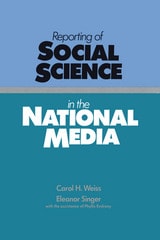
cover of Reporting of Social Science in the National Media

Reporting of Social Science in the National Media

Carol Weiss

Russell Sage Foundation, 1988
Policy makers, as well as the general public, are often unaware of social science research until a story about it appears in the national media. Even in official Washington, a staffer's report on social research may go unnoticed while a report in the Washington Post receives immediate attention. This study takes a systematic and revealing look at social science reporting. How do journalists hear about social science, and why do they select certain stories to cover and not others? How do journalistic standards for selection compare with social scientists' own judgments of merit? How do reporters attempt to ensure accuracy, and how freely do they introduce their own interpretations of social science findings? How satisfied are social scientists with the selection and accuracy of social science news? In Part I, Carol H. Weiss addresses these questions on the basis of personal interviews with social scientists and the journalists who wrote about their work. Part II, by Eleanor Singer, is based on an analysis of media content itself, and compares social science reporting over time (between 1970 and 1982) and across media (newspapers, newsmagazines, television). These two complementary perspectives combine to produce a thorough, realistic assessment of the way social science moves out of the academy and into the world of news.
[more]
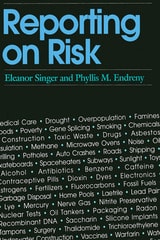
cover of Reporting on Risk: How the Mass Media Portray Accidents, Diseases, Other Hazards

Reporting on Risk

How the Mass Media Portray Accidents, Diseases, Other Hazards

Eleanor Singer

Russell Sage Foundation, 1993
After acts of airline terrorism, air travel tends to drop dramatically—yet Americans routinely pursue the far riskier business of driving cards, where accidents resulting in death or injury are much more likely to occur. Reporting on Risk argues that this selective concern with danger is powerfully shaped by the media, whose coverage of potentially hazardous events is governed more by a need to excite the public than to inform it. Singer and Endreny survey a wide range of print and electronic media to provide an unprecedented look at how hundreds of different hazards are presented to the public—from toxic waste and food poisoning to cigarette smoking, from transportation accidents to famine, and from experimental surgery to communicable diseases. Their investigations raise thought-provoking questions about what the media tell us about modern risks, which hazards are covered and which ignored, and how the media determine when hazards should be considered risky. Are natural hazards reported differently than man-made hazards? Is greater emphasis placed on the potential benefits or the potential drawbacks of complex new technologies? Are journalists more concerned with reporting on unproven cures or informing the public about preventative measures? Do newspapers differ from magazines and television in their risk reporting practices? Reporting on Risk investigates how the media place blame for disasters, and looks at how the reporting of risks has changed in the past twenty-five years as such hazards as nuclear power, birth control methods, and industrial by-products have grown in national prominence. The authors demonstrate that the media often fail to report on risks until energized by the occurrence of some disastrous or dramatic event—the Union Carbide pesticide leak in Bhopal, the Challenger explosion, the outbreak of famine in Somalia, or the failed transplant of a baboon heart to "Baby Fae." Sustained attention to these hazards depends less on whether the underlying issues have been resolved than on whether they continue to unfold in newsworthy events. Reporting on Risk examines the accuracy and the amount of information we receive about our environment. It offers a critical perspective on how our perceptions of risk, as shaped by the media, may contribute to misguided individual and public choices for action and prevention in an increasingly complex world. The authors' probing assessment of how the media report a vast array of risks offers insights useful to journalists, policy analysts, risk specialists, legislators, and concerned citizens.
[more]
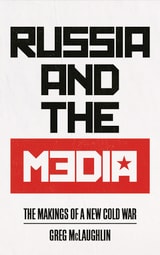
cover of Russia and the Media: The Makings of a New Cold War

Russia and the Media

The Makings of a New Cold War

Greg McLaughlin

Pluto Press, 2020

President Vladimir Putin is a figure of both fear and fascination in the Western imagination. In the minds of media pundits and commentators, he personifies Russia itself - a country riven with contradictions, enthralling and yet always a threat to world peace.

But recent propaganda images that define public debate around growing tensions with Russia are not new or arbitrary. Russia and the Media asks, what is the role of Western journalism in constructing a new kind of Cold War with Russia? Focusing on British and US media coverage of moments of crisis and of co-operation between the West and Russia, McLaughlin exposes how such a Cold War framework shapes public perceptions of a major, hostile power reasserting itself on the world stage.

Scrutinizing events such as the Ukraine/Crimea crisis, the Skripal Poisoning and Russia's military intervention in Syria - as well as analyzing media coverage of the 2018 Russian presidential election and build up to the 2018 World Cup - Russia and the Media makes a landmark intervention at the intersection of media studies and international relations.
[more]