Results by title
70 books match the query 'Protection' and 4 start with r
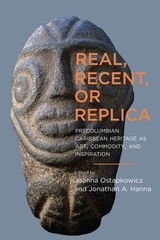
Real, Recent, or Replica
Precolumbian Caribbean Heritage as Art, Commodity, and InspirationEdited by Joanna Ostapkowicz and Jonathan A. Hanna
University of Alabama Press, 2021
A CHOICE OUTSTANDING ACADEMIC TITLE, 2022
Examines the largely unexplored topics in Caribbean archaeology of looting of heritage sites, fraudulent artifacts, and illicit trade of archaeological materials
Real, Recent, or Replica: Precolumbian Caribbean Heritage as Art, Commodity, and Inspiration is the first book-length study of its kind to highlight the increasing commodification of Caribbean Precolumbian heritage. Amerindian art, including “Taíno” art, has become highly coveted by collectors, spurring a prolific and increasingly sophisticated black market of forgeries, but also contemporary artistic engagement, openly appreciated as modern artworks taking inspiration from the past. The contributors to this volume contend with difficult subject matter including the continued looting of archaeological sites in the region, the seismic increase of forgeries, and the imbalance of power and economic relations between the producers and consumers of neo-Amerindian art.
The case studies document the considerable time depth of forgeries in the region (since the late nineteenth century), address the policies put in place by Caribbean governments and institutions to safeguard national patrimony, and explore the impact looted and forged artifacts have on how museums and institutions collect and ultimately represent the Caribbean past to their audiences. Overall, the volume emphasizes the continued desire for the “authentic” Precolumbian artifact, no matter the cost. It provides insights for archaeologists, museum professionals, art historians, and collectors to combat illegal trade and support communities in creating sustainable heritage industries.
Recreational Colonialism and the Rhetorical Landscapes of the Outdoors
Kyle Boggs
The Ohio State University Press, 2025
In Recreational Colonialism and the Rhetorical Landscapes of the Outdoors, Kyle Boggs chronicles the struggle between Indigenous peoples who have rooted religious and cultural ties to outdoor sites across the US and elsewhere and the settlers who claim the right to freely recreate in those same places. Synthesizing theories of rhetoric, environmental studies, and settler colonialism, Boggs confronts the ways that settler colonial experiences and expectations have been narrated through rhetorical practices on these so-called public lands. Fusing journalism and personal narrative with scholarly research, Boggs’s argument comes to bear on his central case study of a northern Arizona ski development on a mountain held sacred by at least thirteen Indigenous tribes. In illuminating the striking ways that settler imaginaries are accommodated, performed, and sustained in the everyday, Boggs offers a powerful reminder that even during leisure activities (in this case, sports such as ultrarunning, rock climbing, and skiing), complex webs of power control who can access resources and land and who has the right to protect histories and cultures.
Revolutionary Parks
Conservation, Social Justice, and Mexico’s National Parks, 1910–1940Emily Wakild
University of Arizona Press, 2011
Revolutionary Parks tells the surprising story of how forty national parks were created in Mexico during the latter stages of the first social revolution of the twentieth century. By 1940 Mexico had more national parks than any other country. Together they protected more than two million acres of land in fourteen states. Even more remarkable, Lázaro Cárdenas, president of Mexico in the 1930s, began to promote concepts akin to sustainable development and ecotourism.
Conventional wisdom indicates that tropical and post-colonial countries, especially in the early twentieth century, have seldom had the ability or the ambition to protect nature on a national scale. It is also unusual for any country to make conservation a political priority in the middle of major reforms after a revolution. What emerges in Emily Wakild’s deft inquiry is the story of a nature protection program that takes into account the history, society, and culture of the times. Wakild employs case studies of four parks to show how the revolutionary momentum coalesced to create early environmentalism in Mexico.
According to Wakild, Mexico’s national parks were the outgrowth of revolutionary affinities for both rational science and social justice. Yet, rather than reserves set aside solely for ecology or politics, rural people continued to inhabit these landscapes and use them for a range of activities, from growing crops to producing charcoal. Sympathy for rural people tempered the radicalism of scientific conservationists. This fine balance between recognizing the morally valuable, if not always economically profitable, work of rural people and designing a revolutionary state that respected ecological limits proved to be a radical episode of government foresight.
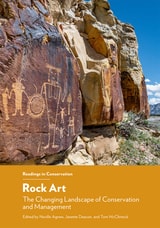
Rock Art
The Changing Landscape of Conservation and ManagementNeville Agnew
J. Paul Getty Trust, The, 2026
Painted and engraved marks and images on rock surfaces represent the oldest and most widespread form of human expression. Found globally in its original landscapes, with some images dating back fifty thousand years or more, the world’s rock art constitutes the most important body of latent knowledge about our deep past. Today, however, mass tourism, vandalism, theft, land development, and climate change are posing increasingly dire threats to this irreplaceable heritage.
This richly illustrated volume is the first interdisciplinary anthology to focus on the conservation and management of rock art sites. Its 133 readings survey the arc of published writings on the subject, ranging from early academic theories and oral narratives of Traditional peoples to an abundant selection of recent scholarship covering current best practices and advances in portable instrumentation that can be used in the field. Initial sections probe the origins and significance of these often-enigmatic forms, then survey scientific and technological methods of dating, monitoring, and documenting them. Subsequent readings discuss rock art’s physical characteristics and weathering, its importance to Indigenous communities, the decolonization of site management, the role of governments, the value of public outreach, and climate change. The volume closes with a selection of case studies drawn from major sites worldwide.