Results by title
74 books match the query 'Psychopathology' and 2 start with r
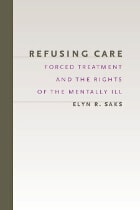
Refusing Care
Forced Treatment and the Rights of the Mentally IllElyn R. Saks
University of Chicago Press, 2002
It has been said that how a society treats its least well-off members speaks volumes about its humanity. If so, our treatment of the mentally ill suggests that American society is inhumane: swinging between overintervention and utter neglect, we sometimes force extreme treatments on those who do not want them, and at other times discharge mentally ill patients who do want treatment without providing adequate resources for their care in the community.
Focusing on overinterventionist approaches, Refusing Care explores when, if ever, the mentally ill should be treated against their will. Basing her analysis on case and empirical studies, Elyn R. Saks explores dilemmas raised by forced treatment in three contexts—civil commitment (forced hospitalization for noncriminals), medication, and seclusion and restraints. Saks argues that the best way to solve each of these dilemmas is, paradoxically, to be both more protective of individual autonomy and more paternalistic than current law calls for. For instance, while Saks advocates relaxing the standards for first commitment after a psychotic episode, she also would prohibit extreme mechanical restraints (such as tying someone spread-eagled to a bed). Finally, because of the often extreme prejudice against the mentally ill in American society, Saks proposes standards that, as much as possible, should apply equally to non-mentally ill and mentally ill people alike.
Mental health professionals, lawyers, disability rights activists, and anyone who wants to learn more about the way the mentally ill are treated—and ought to be treated—in the United States should read Refusing Care.
[more]
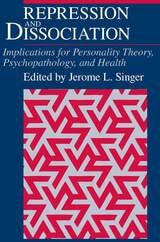
Repression and Dissociation
Implications for Personality Theory, Psychopathology and HealthJerome L. Singer
University of Chicago Press, 1990
This book features contributions from twenty six leading experts that survey the theoretical, historical, methodological, empirical, and clinical aspects of repression and the repressive personality style, from both psychoanalytic and cognitive psychological perspectives.
"Rarely does a volume present contributions on a controversial topic from such distinguished clinicians and experimentalists . . . . There is something of interest in this volume for almost anyone involved in experimental cognitive psychology and psychiatry."—Carroll E. Izard, Contemporary Psychology
"The concept of repression is the cornerstone of psychoanalytic theory. . . . This is a delightful book, unusually well-written. . . . Recommended."—Choice
"Readable, thorough, wide ranging and consistently interesting. . . . A testament to the continuing power of psychodynamic ideas when faced with individual psychopathology."—Sue Llewelyn, Psychologist
"Singer has brought together some of the best empirical research in the areas of unconscious mental activity and repression—that is at once interdisciplinary and scholarly."—Howard D. Lerner, International Review of Psycho-analysis
"A rich reference, replete with summaries and citations, covering a variety of topics related to the psychology of repression and dissociation. . . . A thoughtful, detailed and eclectic discussion of the scientific and theoretical basis of repression and dissociation."—Steven Lazrove, M.D., American Journal of Psychiatry
[more]