Results by title
97 books match the query 'Race discrimination' and 12 start with r
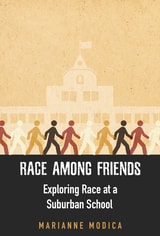
Race among Friends
Exploring Race at a Suburban SchoolModica, Marianne
Rutgers University Press, 2015
This intriguing volume focuses on a “racially friendly” suburban charter school called Excellence Academy, highlighting the ways that students and teachers think about race and act out racial identity. Modica finds that even in an environment where students of all racial backgrounds work and play together harmoniously, race affects the daily experiences of students and teachers in profound but unexamined ways. Some teachers, she notes, feared that talking about race in the classroom would open them to charges of racism, so they avoided the topic. And rather than generate honest and constructive conversations about race, student friendships opened the door for insensitive racial comments by whites, resentment and silence by blacks, and racially biased administrative practices. In the end, the school’s friendly environment did not promote—and may have hindered—serious discussion of race and racial inequity.
The desire to ignore race in favor of a “colorblind society,” Modica writes, has become an entrenched part of American culture. But as Race Among Friends shows, when race becomes a taboo subject, it has serious ramifications for students and teachers of all ethnic origins.
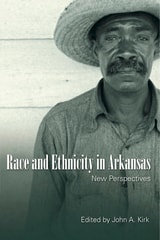
Race and Ethnicity in Arkansas
New PerspectivesJohn A. Kirk
University of Arkansas Press, 2014
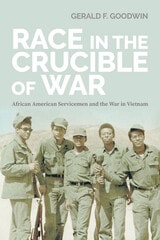
Race in the Crucible of War
African American Servicemen and the War in VietnamGerald F. Goodwin
University of Massachusetts Press, 2023
When African American servicemen went to fight in the Vietnam War, discrimination and prejudice followed them. Even in a faraway country, their military experiences were shaped by the racial environment of the home front. War is often viewed as a crucible that can transform society, but American race relations proved remarkably durable.
In Race in the Crucible of War, Gerald F. Goodwin examines how Black servicemen experienced and interpreted racial issues during their time in Vietnam. Drawing on more than fifty new oral interviews and significant archival research, as well as newspapers, periodicals, memoirs, and documentaries, Goodwin reveals that for many African Americans the front line and the home front were two sides of the same coin. Serving during the same period as the civil rights movement and the race riots in Chicago, Detroit, and dozens of other American cities, these men increasingly connected the racism that they encountered in the barracks and on the battlefields with the tensions and violence that were simmering back home.
Race to the Bottom
How Racial Appeals Work in American PoliticsLaFleur Stephens-Dougan
University of Chicago Press, 2020
Challenging what we think we know about race and politics, LaFleur Stephens-Dougan argues that candidates across the racial and political spectrum engage in “racial distancing,” or using negative racial appeals to communicate to racially moderate and conservative whites—the overwhelming majority of whites—that they will not disrupt the racial status quo. Race to the Bottom closely examines empirical data on racialized partisan stereotypes to show that engaging in racial distancing through political platforms that do not address the needs of nonwhite communities and charged rhetoric that targets African Americans, immigrants, and others can be politically advantageous. Racialized communication persists as a well-worn campaign strategy because it has real electoral value for both white and black politicians seeking to broaden their coalitions. Stephens-Dougan reveals that claims of racial progress have been overstated as our politicians are incentivized to employ racial prejudices at the expense of the most marginalized in our society.
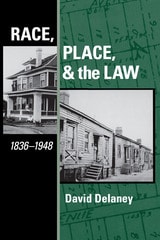
Race, Place, and the Law, 1836-1948
By David Delaney
University of Texas Press, 1998
Black and white Americans have occupied separate spaces since the days of "the big house" and "the quarters." But the segregation and racialization of American society was not a natural phenomenon that "just happened." The decisions, enacted into laws, that kept the races apart and restricted blacks to less desirable places sprang from legal reasoning which argued that segregated spaces were right, reasonable, and preferable to other arrangements.
In this book, David Delaney explores the historical intersections of race, place, and the law. Drawing on court cases spanning more than a century, he examines the moves and countermoves of attorneys and judges who participated in the geopolitics of slavery and emancipation; in the development of Jim Crow segregation, which effectively created apartheid laws in many cities; and in debates over the "doctrine of changed conditions," which challenged the legality of restrictive covenants and private contracts designed to exclude people of color from white neighborhoods. This historical investigation yields new insights into the patterns of segregation that persist in American society today.
Racial Care
On Asian American Suffering and SurvivalJames McMaster
Duke University Press, 2025
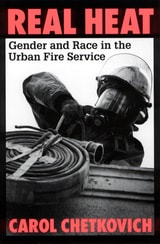
Real Heat
Gender and Race in the Urban Fire ServiceChetkovich, Carol
Rutgers University Press, 1997
In the struggle over affirmative action, no employment setting has seen more friction than urban fire departments. Thirty years of legal and political efforts have opened the doors of this historically white male preserve, but men of color have yet to consolidate their gains, and women's progress has been even more tenuous. In this unique and compelling account of affirmative action at the "street level," Carol Chetkovich explores the ways in which this program has succeeded and failed.
Chetkovich follows the men and women of the Oakland Fire Department Class 1-91 through their academy training and eighteen-month probation. In vivid and sometimes surprising narratives, newcomers tell of their first battle with a full-fledged fire, their reactions to hazing rituals, and their relationships with veterans and fellow trainees. Real Heat explores how the process of becoming a firefighter interacts with the dimensions of race and gender to support some and discourage others. The book examines the implications of these interactions for public policy and social justice.
Reel Inequality
Hollywood Actors and RacismNancy Wang Yuen
Rutgers University Press, 2016

Resolving Racial Conflict
The Community Relations Service and Civil Rights, 1964-1989Bertram Levine
University of Missouri Press, 2005
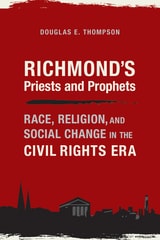
Richmond's Priests and Prophets
Race, Religion, and Social Change in the Civil Rights EraDouglas E. Thompson
University of Alabama Press, 2017
Douglas E. Thompson’s Richmond’s Priests and Prophets: Race, Religion, and Social Change in the Civil Rights Era presents a compelling study of religious leaders’ impact on the political progression of Richmond, Virginia, during the time of desegregation. Scrutinizing this city as an entry point into white Christians’ struggles with segregation during the 1950s, Thompson analyzes the internal tensions between ministers, the members of their churches, and an evolving world.
In the mid-twentieth-century American South, white Christians were challenged repeatedly by new ideas and social criteria. Neighborhood demographics were shifting, public schools were beginning to integrate, and ministers’ influence was expanding. Although many pastors supported the transition into desegregated society, the social pressure to keep life divided along racial lines placed Richmond’s ministers on a collision course with forces inside their own congregations. Thompson reveals that, to navigate the ideals of Christianity within a complex historical setting, white religious leaders adopted priestly and prophetic roles.
Moreover, the author argues that, until now, the historiography has not viewed white Christian churches with the nuance necessary to understand their diverse reactions to desegregation. His approach reveals the ways in which desegregationists attempted to change their communities’ minds, while also demonstrating why change came so slowly—highlighting the deeply emotional and intellectual dilemma of many southerners whose worldview was fundamentally structured by race and class hierarchies.
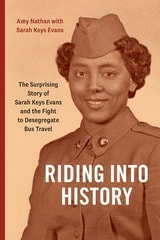
Riding into History
The Surprising Story of Sarah Keys Evans and the Fight to Desegregate Bus TravelAmy Nathan with Sarah Keys Evans
Duke University Press, 2026
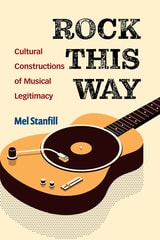
Rock This Way
Cultural Constructions of Musical LegitimacyMel Stanfill
University of Michigan Press, 2023
Any and all songs are capable of being remixed. But not all remixes are treated equally. Rock This Way examines transformative musical works—cover songs, remixes, mash-ups, parodies, and soundalike songs—to discover what contemporary American culture sees as legitimate when it comes to making music that builds upon other songs. Through examples of how popular discussion talked about such songs between 2009 and 2018, Mel Stanfill uses a combination of discourse analysis and digital humanities methods to interrogate our broader understanding of transformative works and where they converge at the legal, economic, and cultural ownership levels.
Rock This Way provides a new way of thinking about what it means to re-create and borrow music, how the racial identity of both the reusing artist and the reused artist matters, and the ways in which the law polices artists and their works. Ultimately, Stanfill demonstrates that the extent to which a work is seen as having new expression or meaning is contingent upon notions of creativity, legitimacy, and law, all of which are shaped by white supremacy.