Results by title
325 books match the query 'Race identity' and 24 start with r
Race & Archaeology Of Identity
Charles Orser Jr
University of Utah Press, 2002
Race is not a subject most people associate with archaeological research. Yet because of archaeologists’ interest in long time-spans they are perfectly positioned to investigate the “naturalness” of racial designations through time.
Race and the Archaeology of Identity brings together twelve of America’s most perceptive and talented historical archaeologists. Their focus is on the recent archaeological record—stretching geographically from Jamaica to northern Michigan; their time frame is from colonial days to the late nineteenth century; and their subjects range from frontier fur traders to Victorian city dwellers. Using textual and archaeological sources, contributors explore such topics as the connections of race to economics, the creation and maintenance of institutionalized poverty, the role of race in structuring and guiding intercultural connections, and the importance of race in creating and defining space.
Contributors explore such topics as the connections of race to economics, the role of race in structuring and guiding intercultural connections, and the importance of race in creating and defining space.
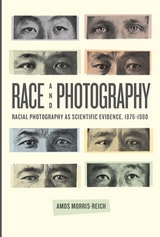
Race and Photography
Racial Photography as Scientific Evidence, 1876-1980Amos Morris-Reich
University of Chicago Press, 2015
Exploring the development of racial photography wherever it took place, including countries like France and England, Morris-Reich pays special attention to the German and Jewish contexts of scientific racism. Through careful reconstruction of individual cases, conceptual genealogies, and patterns of practice, he compares the intended roles of photography with its actual use in scientific argumentation. He examines the diverse ways it was used to establish racial ideologies—as illustrations of types, statistical data, or as self-evident record of racial signs. Altogether, Morris-Reich visits this troubling history to outline important truths about the roles of visual argumentation, imagination, perception, aesthetics, epistemology, and ideology within scientific study.
Race to the Bottom
How Racial Appeals Work in American PoliticsLaFleur Stephens-Dougan
University of Chicago Press, 2020
Challenging what we think we know about race and politics, LaFleur Stephens-Dougan argues that candidates across the racial and political spectrum engage in “racial distancing,” or using negative racial appeals to communicate to racially moderate and conservative whites—the overwhelming majority of whites—that they will not disrupt the racial status quo. Race to the Bottom closely examines empirical data on racialized partisan stereotypes to show that engaging in racial distancing through political platforms that do not address the needs of nonwhite communities and charged rhetoric that targets African Americans, immigrants, and others can be politically advantageous. Racialized communication persists as a well-worn campaign strategy because it has real electoral value for both white and black politicians seeking to broaden their coalitions. Stephens-Dougan reveals that claims of racial progress have been overstated as our politicians are incentivized to employ racial prejudices at the expense of the most marginalized in our society.
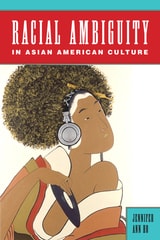
Racial Ambiguity in Asian American Culture
Ho, Jennifer Ann
Rutgers University Press, 2015
Racial Blackness and the Discontinuity of Western Modernity
Edited by Justin A. Joyce, Dwight A. McBride, and John Carlos Rowe
University of Illinois Press, 2013

Racial Care
On Asian American Suffering and SurvivalJames McMaster
Duke University Press, 2025
Racial Castration
Managing Masculinity in Asian AmericaDavid L. Eng
Duke University Press, 2001
Eng juxtaposes theortical discussions of Freud, Lacan, and Fanon with critical readings of works by Frank Chin, Maxine Hong Kingston, Lonny Kaneko, David Henry Hwang, Louie Chu, David Wong Louie, Ang Lee, and R. Zamora Linmark. While situating these literary and cultural productions in relation to both psychoanalytic theory and historical events of particular significance for Asian Americans, Eng presents a sustained analysis of dreamwork and photography, the mirror stage and the primal scene, and fetishism and hysteria. In the process, he offers startlingly new interpretations of Asian American masculinity in its connections to immigration exclusion, the building of the transcontinental railroad, the wartime internment of Japanese Americans, multiculturalism, and the model minority myth. After demonstrating the many ways in which Asian American males are haunted and constrained by enduring domestic norms of sexuality and race, Eng analyzes the relationship between Asian American male subjectivity and the larger transnational Asian diaspora. Challenging more conventional understandings of diaspora as organized by race, he instead reconceptualizes it in terms of sexuality and queerness.
Racial Melancholia, Racial Dissociation
On the Social and Psychic Lives of Asian AmericansDavid L. Eng and Shinhee Han
Duke University Press, 2018

Racing Romance
Love, Power, and Desire among Asian American/White CouplesNemoto, Kumiko
Rutgers University Press, 2009
Similar to black/white relationships, stereotypes have long played crucial roles in Asian American/white encounters. Partners grapple with media representations of Asian women as submissive or hypersexual and Asian men are often portrayed as weak laborers or powerful martial artists. Racing Romance reveals how allegedly progressive interracial relationships remain firmly shaped by the logic of patriarchy and gender inherent to the ideal of marriage, family, and nation in America, even as this ideal is juxtaposed with discourses of multiculturalism and color blindness.
Radicalizing Men
Fascist Desires, Great Replacement Propaganda, and Political ViolenceJessica Johnson
Duke University Press, 2026
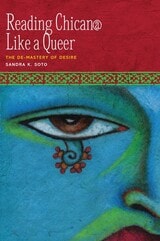
Reading Chican@ Like a Queer
The De-Mastery of DesireBy Sandra K. Soto
University of Texas Press, 2010
A race-based oppositional paradigm has informed Chicano studies since its emergence. In this work, Sandra K. Soto replaces that paradigm with a less didactic, more flexible framework geared for a queer analysis of the discursive relationship between racialization and sexuality. Through rereadings of a diverse range of widely discussed writers—from Américo Paredes to Cherríe Moraga—Soto demonstrates that representations of racialization actually depend on the sexual and that a racialized sexuality is a heretofore unrecognized organizing principle of Chican@ literature, even in the most unlikely texts. Soto gives us a broader and deeper engagement with Chican@ representations of racialization, desire, and both inter- and intracultural social relations.
While several scholars have begun to take sexuality seriously by invoking the rich terrain of contemporary Chicana feminist literature for its portrayal of culturally specific and historically laden gender and sexual frameworks, as well as for its imaginative transgressions against them, this is the first study to theorize racialized sexuality as pervasive to and enabling of the canon of Chican@ literature. Exemplifying the broad usefulness of queer theory by extending its critical tools and anti-heteronormative insights to racialization, Soto stages a crucial intervention amid a certain loss of optimism that circulates both as a fear that queer theory was a fad whose time has passed, and that queer theory is incapable of offering an incisive, politically grounded analysis in and of the current historical moment.
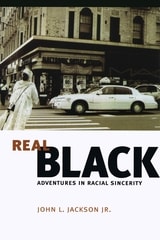
Real Black
Adventures in Racial SincerityJohn L. Jackson Jr.
University of Chicago Press, 2005
Jackson argues that authenticity caricatures identity as something imposed on people, imprisoning them within stereotypes: an African American high school student who excels in the classroom, for instance, might be dismissed as "acting white." On the other hand, sincerity, as Jackson defines it, imagines authenticity as an incomplete measuring stick, an analytical model that attempts to deny people agency in their search for identity.
Drawing on more than ten years of ethnographic research in and around New York City, Jackson offers a kaleidoscope of subjects and stories that directly and indirectly address how race is negotiated in today's world—including tales of book-vending numerologists, urban conspiracy theorists, corrupt police officers, mixed-race neo-Nazis, and gospel choirs forbidden to catch the Holy Ghost. Jackson records and retells their interconnected sagas, all the while attempting to reconcile these stories with his own crisis of identity and authority as an anthropologist terrified by fieldwork. Finding ethnographic significance where mere mortals see only bricks and mortar, his invented alter ego Anthroman takes to the streets, showing how race is defined and debated, imposed and confounded every single day.
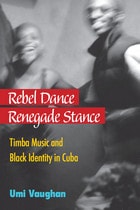
Rebel Dance, Renegade Stance
Timba Music and Black Identity in CubaUmi Vaughan
University of Michigan Press, 2013
Rebel Dance, Renegade Stanceshows how community music-makers and dancers take in all that is around them socially and globally, and publicly and bodily unfold their memories, sentiments, and raw responses within open spaces designated or commandeered for local popular dance. Umi Vaughan, an African American anthropologist, musician, dancer, and photographer "plantao" in Cuba—planted, living like a Cuban—reveals a rarely discussed perspective on contemporary Cuban society during the 1990s, the peak decade of timba, and beyond, as the Cuban leadership transferred from Fidel Castro to his brother. Simultaneously, the book reveals popular dance music in the context of a young and astutely educated Cuban generation of fierce and creative performers.
By looking at the experiences of black Cubans and exploring the notion of "Afro Cuba," Rebel Dance, Renegade Stanceexplains timba's evolution and achieved significance in the larger context of Cuban culture. Vaughan discusses a maroon aesthetic extended beyond the colonial era to the context of contemporary society; describes the dance spaces of Cuba; and examines the performance of identity and desire through the character of the "especulador." This book will find an audience with musicians, anthropologists, ethnomusicologists, interdisciplinary specialists in performance studies, cultural studies, and Latin American and Caribbean studies, as well as laypeople who are interested in Atlantic/African and African American/Africana studies and/or Cuban culture.
Recovering History, Constructing Race
The Indian, Black, and White Roots of Mexican AmericansBy Martha Menchaca
University of Texas Press, 2002
A CHOICE Outstanding Academic Book, 2002
The history of Mexican Americans is a history of the intermingling of races—Indian, White, and Black. This racial history underlies a legacy of racial discrimination against Mexican Americans and their Mexican ancestors that stretches from the Spanish conquest to current battles over ending affirmative action and other assistance programs for ethnic minorities. Asserting the centrality of race in Mexican American history, Martha Menchaca here offers the first interpretive racial history of Mexican Americans, focusing on racial foundations and race relations from prehispanic times to the present.
Menchaca uses the concept of racialization to describe the process through which Spanish, Mexican, and U.S. authorities constructed racial status hierarchies that marginalized Mexicans of color and restricted their rights of land ownership. She traces this process from the Spanish colonial period and the introduction of slavery through racial laws affecting Mexican Americans into the late twentieth-century. This re-viewing of familiar history through the lens of race recovers Blacks as important historical actors, links Indians and the mission system in the Southwest to the Mexican American present, and reveals the legal and illegal means by which Mexican Americans lost their land grants.
Relative Races
Genealogies of Interracial Kinship in Nineteenth-Century AmericaBrigitte Fielder
Duke University Press, 2020
Remapping Black Germany
New Perspectives on Afro-German History, Politics, and CultureSara Lennox
University of Massachusetts Press, 2016
In 1984 at the Free University of Berlin, the African American poet Audre Lorde asked her Black, German-speaking women students about their identities. The women revealed that they had no common term to describe themselves and had until then lacked a way to identify their shared interests and concerns. Out of Lorde's seminar emerged both the term “Afro-German” (or “Black German”) and the 1986 publication of the volume that appeared in English translation as Showing Our Colors: Afro-German Women Speak Out. The book launched a movement that has since catalyzed activism and scholarship in Germany.
Remapping Black Germany collects thirteen pieces that consider the wide array of issues facing Black German groups and individuals across turbulent periods, spanning the German colonial period, National Socialism, divided Germany, and the enormous outpouring of Black German creativity after 1986.
In addition to the editor, the contributors include Robert Bernasconi, Tina Campt, Maria I. Diedrich, Maureen Maisha Eggers, Fatima El-Tayeb, Heide Fehrenbach, Dirk Göttsche, Felicitas Jaima, Katja Kinder, Tobias Nagl, Katharina Oguntoye, Peggy Piesche, Christian Rogowski, and Nicola Lauré al-Samarai.
Resurrecting Slavery
Racial Legacies and White Supremacy in FranceCrystal Marie Fleming
Temple University Press, 2017
How can politicians and ordinary citizens face the racial past in a country that frames itself as colorblind? In her timely and provocative book, Resurrecting Slavery, Crystal Fleming shows how people make sense of slavery in a nation where talking about race, colonialism, and slavery remains taboo. Noting how struggles over the meaning of racial history are informed by contemporary politics of race, she asks: What kinds of group identities are at stake today for activists and French people with ties to overseas territories where slavery took place?
Fleming investigates the connections and disconnections that are made between racism, slavery, and colonialism in France. She provides historical context and examines how politicians and commemorative activists interpret the racial past and present. Resurrecting Slavery also includes in-depth interviews with French Caribbean migrants outside the commemorative movement to address the everyday racial politics of remembrance.
Bringing a critical race perspective to the study of French racism, Fleming’s groundbreaking study provides a more nuanced understanding of race in France along with new ways of thinking about the global dimensions of slavery, anti-blackness, and white supremacy.
Rethinking America's Past
Voices from the Kinsey African American Art and History CollectionEdited by Tim Gruenewald
University of Minnesota Press, 2019
Among the first scholarly books dedicated to a private African American collection, Rethinking America’s Past: Voices from the Kinsey African American Art and History Collection both chronicles the reach of this important cultural collection and contributes to its project by sharing selected objects and stories with a broader audience. Essays range in subject from iconic African American artists, such as Loïs Mailou Jones and Beauford Delaney, to important historical figures such as Frederick Douglas and Martin Luther King, to individuals whose experiences might be lost to history but for the found objects that preserve their stories. Rethinking America’s Past demonstrates how the African American story, from slavery through the present, is represented and can be actively remembered through the act of collecting.
Rethinking America’s Past will appeal to audiences interested in African American history as well as art history, but its real power is in linking the two, showing how important collections are in constructing and repairing historical narratives, and how in the words of editor Tim Gruenewald, “Collecting overlooked aspects of our past and sharing such collections enables a deeper understanding of the present moment, and facilitates a more inclusive and just future.”
Return to the Kingdom of Childhood
Re-envisioning the Legacy and Philosophical Relevance of NegritudeCheikh Thiam
The Ohio State University Press, 2014
Thiam contends that Senghor’s conception of race entails an innovative Afri-centered epistemology and ontology. For Senghor, races are the effects of particular groups’ relations to the world. The so-called “Negroes,” for example, are determined by their epistemology based on their fluid understanding of the ontological manifestations of being. The examination of this ontology and its ensuing epistemology, which is constitutive of the foundation of Senghor’s entire oeuvre, indicates that Negritude is a postcolonial philosophy that stands on its own.
The hermeneutics of Senghor’s race theory show that the Senegalese thinker’s pioneering postcolonial philosophy remains relevant in the postcolonial era. In fact, it questions and expands the works of major contemporary African-descended scholars such as Paul Gilroy, Edouard Glissant, and Molefi Asante. Thiam’s approach is thoroughly interdisciplinary, combining perspectives from philosophy, literary analysis, anthropology, and postcolonial, African, and cultural studies.
Rhetorical Economies of Whiteness
Exploring the Intersections of Power, Privilege, and RaceEdited by Robert Asen and Casey Ryan Kelly
The Ohio State University Press, 2024
Contributors:
Godfried Asante, Robert Asen, Charles Athanasopoulos, Paulami Banerjee, Anne Bonds, Linsay M. Cramer, Derek G. Handley, V. Jo Hsu, Kelly Jensen, Casey Ryan Kelly, Kyle R. Larson, George (Guy) F. McHendry Jr., Thomas K. Nakayama, Adedoyin Ogunfeyimi, Rico Self, Stacey K. Sowards, Corinne Mitsuye Sugino
Rhetorics of Whiteness
Postracial Hauntings in Popular Culture, Social Media, and EducationEdited by Tammie M. Kennedy, Joyce Irene Middleton, Krista Ratcliffe, with a foreword by Lilia D. Monzó and Peter McLaren
Southern Illinois University Press, 2017
With the election of our first black president, many Americans began to argue that we had finally ended racism, claiming that we now live in a postracial era. Yet near-daily news reports regularly invoke white as a demographic category and recount instances of racialized violence as well as an increased sensitivity to expressions of racial unrest. Clearly, American society isn’t as color-blind as people would like to believe. In Rhetorics of Whiteness: Postracial Hauntings in Popular Culture, Social Media, and Education, contributors reveal how identifications with racialized whiteness continue to manifest themselves in American culture.
The sixteen essays that comprise this collection not only render visible how racialized whiteness infiltrates new twenty-first-century discourses and material spaces but also offer critical tactics for disrupting this normative whiteness. Specifically, contributors examine popular culture (novels, films, TV), social media (YouTube, eHarmony, Facebook), education (state law, the textbook industry, dual credit programs), pedagogy (tactics for teaching via narratives, emotional literacy, and mindfulness) as well as cultural theories (concepts of racialized space, anti-dialogicism, and color blindness). Offering new approaches to understanding racialized whiteness, this volume emphasizes the importance of a rhetorical lens for employing whiteness studies’ theories and methods to identify, analyze, interpret, and interrupt representations of whiteness.
Although whiteness studies has been waning as an active research field for the past decade, the contributors to Rhetorics of Whiteness assert that it hasn’t lost its relevancy because racialized whiteness and issues of systemic racism persist in American society and culture today. Few whiteness studies texts have been published in rhetoric and composition in the past decade, so this collection should quickly become mandatory reading. By focusing on common, yet often overlooked, contemporary examples of how racialized whiteness haunts U.S. society, Rhetorics of Whiteness serves as a valuable text for scholars in the field as well as anyone else interested in the topic.
Riotous Deathscapes
Hugo ka Canham
Duke University Press, 2023

Ripe
EssaysNegesti Kaudo
The Ohio State University Press, 2022
A LitHub Most Anticipated Book of 2022
“Emotional range without consequence,” Negesti Kaudo writes in her debut collection, Ripe, is a privilege of whiteness. In these essays, she fights back, exhorting readers to follow her through fury, grief, love, and hope as she confronts what it means to own her Blackness and her body in contemporary America. A scathing and nuanced cultural critic, she disentangles intersections of race, class, pop culture, size, sexuality, and more in spaces where she always seems to be either too Black or not Black enough. From attending private school as a poor Black student to the evolution of her hair routine to being fat and sexual when society says she should be neither, Kaudo overlooks nothing as she names the ways that white America simultaneously denigrates and steals Black culture. Most of all, she writes against the idea that a Black woman’s anger makes her an “angry Black woman,” claiming full emotional range as her birthright and as a tool against injustice on her quest to find herself no matter how uncomfortable the journey.
Rule Of Racialization
Class, Identity, GovernanceSteve Martinot
Temple University Press, 2002