Results by title
119 books match the query 'Race in literature' and 16 start with r
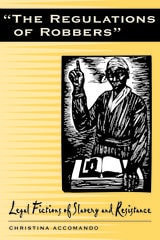
REGULATIONS OF ROBBERS
LEGAL FICTIONS OF SLAVERY AND RESISTANCEChristina Accomando
The Ohio State University Press, 2001
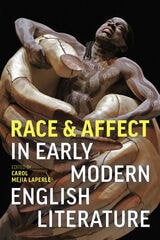
Race and Affect in Early Modern English Literature
Carole Mejia LaPerle
Arizona Center for Medieval and Renaissance Studies, 2021
Race and Affect in Early Modern English Literature puts the fields of critical race studies and affect theory into dialogue. Doing so opens a new set of questions: What are the emotional experiences of racial formation and racist ideologies? How do feelings—through the physical senses, emotional passions, or sexual encounters—come to signify race? What is the affective register of anti-blackness that pervades canonical literature? How can these visceral forms of racism be resisted in discourse and in practice? By investigating how race feels, this book offers new ways of reading and interpreting literary traditions, religious differences, gendered experiences, class hierarchies, sexuality, and social identities. So far scholars have shaped the discussion of race in the early modern period by focusing on topics such as genealogy, language, economics, religion, skin color, and ethnicity. This book, however, offers something new: it considers racializing processes as visceral, affective experiences.
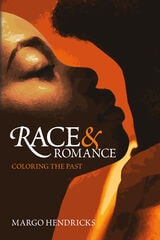
Race and Romance
Coloring the PastMargo Hendricks
Arizona Center for Medieval and Renaissance Studies, 2021
Race and Romance: Coloring the Past explores the literary and cultural genealogy of colorism, white passing, and white presenting in the romance genre. The scope of the study ranges from Heliodorus’ Aithiopika to the short novels of Aphra Behn, to the modern romance novel Forbidden by Beverly Jenkins. This analysis engages with the troublesome racecraft of “passing” and the instability of racial identity and its formation from the premodern to the present. The study also looks at the significance of white settler colonialism to early modern romance narratives. A bridge between studies of early modern romance and scholarship on twenty-first-century romance novels, this book is well-suited for those interested in the romance genre.
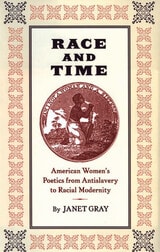
Race and Time
American Women's Poetics from Antislavery to Racial ModernityJanet Gray
University of Iowa Press, 2004
Gray clarifies the cultural roles women’s poetry played in the nineteenth-century United States and also reveals that these poems offer a fascinating, dynamic, and diverse field for students of social and cultural history. Gray’s readings provide a rich sense of the contexts in which this poetry is embedded and examine its aesthetic and political vitality in meticulous detail, linking careful explication of the texts with analysis of the history of poetry, canons, literacy, and literary authority.
Race and Time distinguishes itself from other critical studies not only through its searching, in-depth readings but also through its sustained attention to less known poets and its departure from a Dickinson-centered model. Most significantly, it offers a focus on race, demonstrating how changes in both the U.S. racial structure and women’s place in public culture set the terms for change in how women poets envisioned the relationship between poetry and social power.
Gray’s work makes contributions to several fields of study: poetry, U.S. literary history and American studies, women’s studies, African American studies and whiteness studies, children’s literature, and cultural studies. While placing the works of figures who have been treated elsewhere (e.g., Dickinson and Harper) into revealing new relationships, Race and Time does much to open interdisciplinary discussion of unfamiliar works.
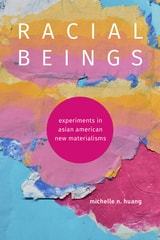
Racial Beings
Experiments in Asian American New MaterialismsMichelle N. Huang
Duke University Press, 2026
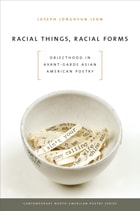
Racial Things, Racial Forms
Objecthood in Avant-Garde Asian American PoetryJoseph Jonghyun Jeon
University of Iowa Press, 2012
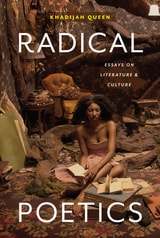
Radical Poetics
Essays on Literature & CultureKhadijah Queen
University of Michigan Press, 2025
Instead of operating from a base of unquestioned thought and systemic tradition, Radical Poetics presents more inclusive and accurate ways of contemplating literary work. Building on ideas and theoretical practices from Édouard Glissant, Toni Morrison, bell hooks, Saidiya Hartman, and Kimberlé Crenshaw, Queen reads for where love is present as well as for where it is absent—tracing systems of thought and aesthetic choices to track how characters are portrayed in terms of race, gender, class, and disability. She analyzes short stories, novels, nonfiction narratives, poetry, and a play from authors such as Herman Melville, Kate Chopin, Dionne Brand, Frances Ellen Watkins Harper, Ma-ka-tai-me-she-kia-kiak, Sor Juana Inés de la Cruz, Natasha Trethewey, and Muriel Rukeyser. Queen’s essays offer shifts in thinking about language—beyond calling out the ways language punishes vulnerability, entrenches harm, and suppresses true intercultural communication. Her intuitive approach aims to correct inaccuracies that have served as a foundation for the discriminatory thinking that undergirds American institutions and culture, particularly the continued glorification of violence. Radical Poetics makes a case for the imperative and practical value of understanding poetics beyond artistic and academic spaces and into everyday life.
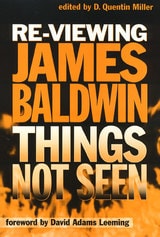
Re-Viewing James Baldwin
Quentin Miller
Temple University Press, 2000
This is an important book for anyone interested in Baldwin's work. It will engage readers interested in literature and African American Studies.
Reading Chican@ Like a Queer
The De-Mastery of DesireBy Sandra K. Soto
University of Texas Press, 2010
A race-based oppositional paradigm has informed Chicano studies since its emergence. In this work, Sandra K. Soto replaces that paradigm with a less didactic, more flexible framework geared for a queer analysis of the discursive relationship between racialization and sexuality. Through rereadings of a diverse range of widely discussed writers—from Américo Paredes to Cherríe Moraga—Soto demonstrates that representations of racialization actually depend on the sexual and that a racialized sexuality is a heretofore unrecognized organizing principle of Chican@ literature, even in the most unlikely texts. Soto gives us a broader and deeper engagement with Chican@ representations of racialization, desire, and both inter- and intracultural social relations.
While several scholars have begun to take sexuality seriously by invoking the rich terrain of contemporary Chicana feminist literature for its portrayal of culturally specific and historically laden gender and sexual frameworks, as well as for its imaginative transgressions against them, this is the first study to theorize racialized sexuality as pervasive to and enabling of the canon of Chican@ literature. Exemplifying the broad usefulness of queer theory by extending its critical tools and anti-heteronormative insights to racialization, Soto stages a crucial intervention amid a certain loss of optimism that circulates both as a fear that queer theory was a fad whose time has passed, and that queer theory is incapable of offering an incisive, politically grounded analysis in and of the current historical moment.
Reading in the Postgenomic Age
Race, Discipline, and Bionarrativity in Contemporary North American LiteratureLesley Larkin
The Ohio State University Press, 2025
Relative Races
Genealogies of Interracial Kinship in Nineteenth-Century AmericaBrigitte Fielder
Duke University Press, 2020
Revisiting Racialized Voice
African American Ethos in Language and LiteratureDavid G. Holmes
Southern Illinois University Press, 2004
Revisiting Racialized Voice:African American Ethos in Language and Literature argues that past misconceptions about black identity and voice, codified from the 1870s through the 1920s, inform contemporary assumptions about African American authorship and ethos. Tracing elements of racial consciousness in the works of Frederick Douglass, Charles Chesnutt, W. E. B. DuBois, Zora Neale Hurston, and others, David G. Holmes urges a revisiting of narratives from this period to strengthen and advance notions about racialized writing and to shape contemporary composition pedagogies.
Pointing to the intersection of African American identity, literature, and rhetoric, Revisiting Racialized Voice begins to construct rhetorically workable yet ideologically flexible definitions of black voice. Holmes maintains that political pressure to embrace“color blindness” endangers scholars’ ability to uncover links between racialized discourses of the past and those of the present, and he calls instead for a reassessment of the material realities and theoretical assumptions race represents and with which it has been associated.
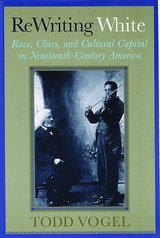
Rewriting White
Race, Class, and Cultural Capital in Nineteenth-Century AmericaTodd Vogel
Rutgers University Press, 2004
What did it mean for people of color in nineteenth-century America to speak or write "white"? More specifically, how many and what kinds of meaning could such "white" writing carry? In ReWriting White, Todd Vogel looks at how America has racialized language and aesthetic achievement. To make his point, he showcases the surprisingly complex interactions between four nineteenth-century writers of color and the "standard white English" they adapted for their own moral, political, and social ends. The African American, Native American, and Chinese American writers Vogel discusses delivered their messages in a manner that simultaneously demonstrated their command of the dominant discourse of their times-using styles and addressing forums considered above their station-and fashioned a subversive meaning in the very act of that demonstration.
The close readings and meticulous archival research in ReWriting White upend our conventional expectations, enrich our understanding of the dynamics of hegemony and cultural struggle, and contribute to the efforts of other cutting-edge contemporary scholars to chip away at the walls of racial segregation that have for too long defined and defaced the landscape of American literary and cultural studies.
Rita Dove's Cosmopolitanism
POEMSMalin Pereira
University of Illinois Press, 2003
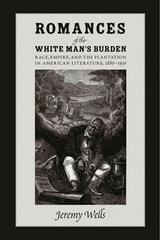
Romances of the White Man's Burden
Race, Empire, and the Plantation in American Literature, 1880-1936Jeremy Wells
Vanderbilt University Press, 2011
Romances of the White Man's Burden takes on works in American literature in which the proverbial "old plantation" is made to seem not a relic but a harbinger, a sign that the South had arrived at a multiracial modernity and harmony before the rest of the United States. Focusing on writers such as Joel Chandler Harris, Thomas Nelson Page, Henry W. Grady, Thomas Dixon, and William Faulkner, Jeremy Wells reveals their shared fixation on the figure of the white southern man as specially burdened by history. Each of these writers, in his own way, presented the plantation South as an emblem, not an aberration, of America.
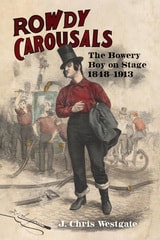
Rowdy Carousals
The Bowery Boy on Stage, 1848-1913J. Chris Westgate
University of Iowa Press, 2024
The book’s examination of working-class whiteness on stage, in the theatre, and in print culture invites theatre historians and critics to check the impulse to downplay or ignore questions about race and ethnicity in discussion of the Bowery Boy. J. Chris Westgate further explores links between the Bowery Boy’s rowdyism in the nineteenth century and the resurgence of white supremacy in the early twenty-first century.