Results by title
91 books match the query 'Radio' and 13 start with r
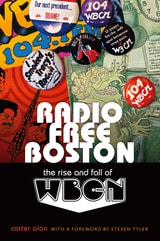
Radio Free Boston
The Rise and Fall of WBCNCarter Alan
University Press of New England, 2013
Radio Free Stein
Gertrude Stein's Parlor PlaysAdam J. Frank
Northwestern University Press, 2025
Returns us to Gertrude Stein’s theater by way of the modernist medium of radio
What happens when we listen to Gertrude Stein’s plays as radio and music theater? This book explores the sound of Stein’s theater and proposes that radio, when approached both historically and phenomenologically, offers technical solutions to her texts’ unique challenges. Adam J. Frank documents the collaborative project of staging Stein’s early plays and offers new critical interpretations of these lesser-known works. Radio Free Stein grapples with her innovative theater poetics from a variety of disciplinary perspectives: sound and media studies, affect and object relations theory, linguistic performativity, theater scholarship, and music composition.
Radio Man
The remarkable rise and fall of C.O. StanleyMark Frankland
The Institution of Engineering and Technology, 2002
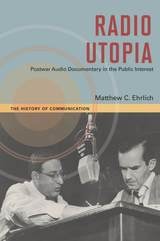
Radio Utopia
Postwar Audio Documentary in the Public InterestMatthew Ehrlich
University of Illinois Press, 2017
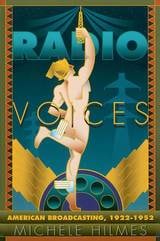
Radio Voices
American Broadcasting, 1922-1952Michele Hilmes
University of Minnesota Press, 1997

Radio and Television Broadcasting on the European Continent
Burton Paulu
University of Minnesota Press, 1967
Radio and Television Broadcasting on the European Continent was first published in
1967. Minnesota Archive Editions uses digital technology to make long-unavailable books once again accessible, and are published unaltered from the original University of Minnesota Press editions.In this book Dr. Paulu provides a comprehensive survey based on firsthand study of the development and current status of radio and television broadcasting in continental Europe. He discusses the technical, organizational, financial, and programming aspects of European broadcasting in both Communist and Western countries. The material is organized, not on a country-by-country basis, but as it relates to broad basic issues, and it is presented in a framework of such interrelated factors as geography, history politics, international relations, religious traditions, language, national economic standards, and cultural and social life. The broadcasting systems studied include those of the Soviet Union and other Communist countries, France, West Germany, Belgium, the Netherlands, Italy, Sweden, and Switzerland.
The account is particularly timely in view of the concern and discussion about the future course of broadcasting in the United States. It has relevance not only for communications specialists but for political scientists and other scholars in the social sciences as well as for the growing public which is interested in the improvement of American broadcasting.
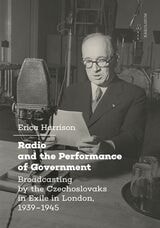
Radio and the Performance of Government
Broadcasting by the Czechoslovaks in Exile in London, 1939–1945Erica Harrison
Karolinum Press, 2023
Between 1939 and 1945, Czechoslovakia disappeared from the maps, existing only as an imagined ‘free republic’ on the radio waves. Following the German invasion and annexation of Bohemia and Moravia and the declaration of independence by Slovakia on 15 March 1939, the Czechoslovak Republic was gone. From their position in exile in wartime London, former Czechoslovak President Edvard Beneš and the government that formed around him depended on radio to communicate with the public they strove to represent. The broadcasts made by government figures in London enabled a performance of authority to impress their hosts, allies, occupying enemies, and claimed constituents.
This book examines this government program for the first time, making use of previously unstudied archival sources to examine how the exiles understood their mission and how their propaganda work was shaped by both British and Soviet influences. This study assesses the strengths, weaknesses, and limitations of the government’s radio propaganda as they navigated the complexities of exile, with chapters examining how they used the radio to establish their authority, how they understood the past and future of the Czechoslovak nation, and how they struggled to include Slovakia and Subcarpathian Ruthenia within it.
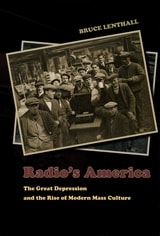
Radio's America
The Great Depression and the Rise of Modern Mass CultureBruce Lenthall
University of Chicago Press, 2007
Orson Welles’s greatest breakthrough into the popular consciousness occurred in 1938, three years before Citizen Kane, when his War of the Worlds radio broadcast succeeded so spectacularly that terrified listeners believed they were hearing a genuine report of an alien invasion—a landmark in the history of radio’s powerful relationship with its audience. In Radio’s America, Bruce Lenthall documents the enormous impact radio had on the lives of Depression-era Americans and charts the formative years of our modern mass culture.
Many Americans became alienated from their government and economy in the twentieth century, and Lenthall explains that radio’s appeal came from its capability to personalize an increasingly impersonal public arena. His depictions of such figures as proto-Fascist Charles Coughlin and medical quack John Brinkley offer penetrating insight into radio’s use as a persuasive tool, and Lenthall’s book is unique in its exploration of how ordinary Americans made radio a part of their lives. Television inherited radio’s cultural role, and as the voting tallies for American Idol attest, broadcasting continues to occupy a powerfully intimate place in American life. Radio’s America reveals how the connections between power and mass media began.
Radio's Second Century
Past, Present, and Future PerspectivesJohn Allen Hendricks
Rutgers University Press, 2020
One of the first books to examine the status of broadcasting on its one hundredth anniversary, Radio’s Second Century investigates both vanguard and perennial topics relevant to radio’s past, present, and future. As the radio industry enters its second century of existence, it continues to be a dominant mass medium with almost total listenership saturation despite rapid technological advancements that provide alternatives for consumers. Lasting influences such as on-air personalities, audience behavior, fan relationships, and localism are analyzed as well as contemporary issues including social and digital media. Other essays examine the regulatory concerns that continue to exist for public radio, commercial radio, and community radio, and discuss the hindrances and challenges posed by government regulation with an emphasis on both American and international perspectives. Radio’s impact on cultural hegemony through creative programming content in the areas of religion, ethnic inclusivity, and gender parity is also explored. Taken together, this volume compromises a meaningful insight into the broadcast industry’s continuing power to inform and entertain listeners around the world via its oldest mass medium--radio.
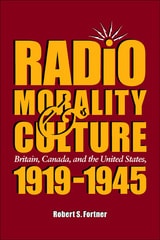
Radio, Morality, & Culture
Britain, Canada, and the United States, 1919 - 1945Robert S. Fortner
Southern Illinois University Press, 2005
Radio, Morality, and Culture: Britain, Canada, and the United States, 1919–1945 examines the moral controversies surrounding radio’s development during its formative years. In comparing the fledgling medium in Great Britain, Canada, and the United States, Robert S. Fortner documents how the church failed to participate in radio’s moral development and instead engaged in internecine warfare over issues of legitimacy and orthodoxy.
The church was arguing about theological turf and dealing with internal disputes while radio policy was being developed and communications history was being written. Fortner reveals how the church, doomed to play little more than a bit part in the future of radio, eventually lost its voice altogether in the continuing development of electronic media. Fortner effectively synthesizes cultural history and theory, communication studies, and the role religious organizations played in shaping the content and character of early radio. Geared to scholars of history, communications, and theology, Radio, Morality, and Culture provides a useful resource for research, scholarship, and public policy.
Recent Advances in High-Power Electromagnetics
Felix Vega
The Institution of Engineering and Technology, 2024
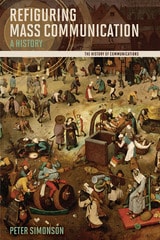
Refiguring Mass Communication
A HistoryPeter Simonson
University of Illinois Press, 2010
This unique inquiry into the history and ongoing moral significance of mass communication also represents a defense, extension, and overhaul of the idea and social form of the discipline. Organized around narrative accounts of individuals and their communicative worlds, Refiguring Mass Communication illuminates significant but overlooked rhetorical episodes in history to enable modern-day readers to rehabilitate and reinvigorate their own engagements with mass communication.
Coined in the 1920s as a way to describe radio, motion pictures, wide-circulation magazines, and the press, the term "mass communication" frequently is misused in the era of cable TV, niche marketing, and the Internet. In Refiguring Mass Communication, Peter Simonson compares his own vision of mass communication with distinct views articulated throughout history by Paul of Tarsus, Walt Whitman, Charles Horton Cooley, David Sarnoff, and Robert K. Merton, utilizing a collection of texts and tenets from a variety of time periods and perspectives. Drawing on textual and archival research as well as access to Merton's personal papers, Simonson broadly reconceives a sense of communication theory and what social processes might be considered species of mass communication. Simonson reveals the geographical and social contexts from which these visions have emerged and the religious and moral horizons against which they have taken shape. In a unique perspective, he considers the American county fair as an example of a live gathering and crucial site that is overlooked in contemporary forms of mass communication, urging a reconsideration of how individuals participate in and shape similar forms.
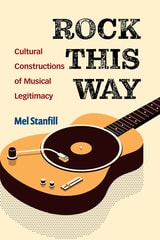
Rock This Way
Cultural Constructions of Musical LegitimacyMel Stanfill
University of Michigan Press, 2023
Any and all songs are capable of being remixed. But not all remixes are treated equally. Rock This Way examines transformative musical works—cover songs, remixes, mash-ups, parodies, and soundalike songs—to discover what contemporary American culture sees as legitimate when it comes to making music that builds upon other songs. Through examples of how popular discussion talked about such songs between 2009 and 2018, Mel Stanfill uses a combination of discourse analysis and digital humanities methods to interrogate our broader understanding of transformative works and where they converge at the legal, economic, and cultural ownership levels.
Rock This Way provides a new way of thinking about what it means to re-create and borrow music, how the racial identity of both the reusing artist and the reused artist matters, and the ways in which the law polices artists and their works. Ultimately, Stanfill demonstrates that the extent to which a work is seen as having new expression or meaning is contingent upon notions of creativity, legitimacy, and law, all of which are shaped by white supremacy.