Results by title
53 books match the query 'Rap & Hip Hop' and 6 start with r
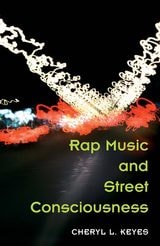
Rap Music and Street Consciousness
Cheryl L. Keyes
University of Illinois Press, 2002
In this first musicological history of rap music, Cheryl L. Keyes traces the genre's history from its roots in West African bardic traditions, the Jamaican dancehall tradition, and African American vernacular expressions to its permeation of the cultural mainstream as a major tenet of hip-hop lifestyle and culture.
Rap music, according to Keyes, addresses the political and economic disfranchisement of black youths and other groups, fosters ethnic pride, and displays culture values and aesthetics. Blending popular culture with folklore and ethnomusicology, Keyes offers a nuanced portrait of the artists, themes, and varying styles reflective of urban life and street consciousness. Her analysis draws on music, lives, politics, and interests of figures ranging from Afrika Bambaataa, the "godfather of hip-hop," to early artists like Grandmaster Flash, to crossover pioneers like LL Cool J, De La Soul, and Public Enemy, to megastars like Tupac Shakur and The Notorious B.I.G. At the same time, Keyes delves into the impact of the rapper-turned mogul phenomenon, the rise of Death Row Records, and the East Coast-West Coast tensions of the Nineties.
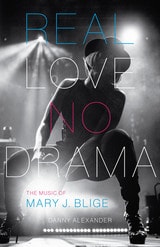
Real Love, No Drama
The Music of Mary J. BligeBy Danny Alexander
University of Texas Press, 2016
Mary J. Blige is an icon who represents the political consciousness of hip hop and the historical promise of soul. She is an everywoman, celebrated by Oprah Winfrey and beloved by pop music fans of all ages and races. Blige has sold over fifty million albums, won numerous Grammys, and even played at multiple White House events, as well as the 2013 Nobel Peace Prize ceremony. Displaying astonishing range and versatility, she has recorded everything from Broadway standards to Led Zeppelin anthems and worked with some of popular music’s greatest artists—Aretha Franklin, Eric Clapton, Elton John, Whitney Houston, Sting, U2, and Beyoncé, among them.
Real Love, No Drama: The Music of Mary J. Blige tells the story of one of the most important artists in pop music history. Danny Alexander follows the whole arc of Blige’s career, from her first album, which heralded the birth of “hip hop soul,” to her critically praised 2014 album, The London Sessions. He highlights the fact that Blige was part of the historically unprecedented movement of black women onto pop radio and explores how she and other women took control of their careers and used their music to give voice to women’s (and men’s) everyday struggles and dreams. This book adds immensely to the story of both black women artists and artists rooted in hip hop and pays tribute to a musician who, by expanding her reach and asking tough questions about how music can and should evolve, has proven herself an artistic visionary.
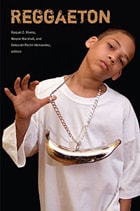
Reggaeton
Raquel Z. Rivera, Wayne Marshall, and Deborah Pacini Hernandez, eds.
Duke University Press, 2009
The collection opens with an in-depth exploration of the social and sonic currents that coalesced into reggaeton in Puerto Rico during the 1990s. Contributors consider reggaeton in relation to that island, Panama, Jamaica, and New York; Cuban society, Miami’s hip-hop scene, and Dominican identity; and other genres including reggae en español, underground, and dancehall reggae. The reggaeton artist Tego Calderón provides a powerful indictment of racism in Latin America, while the hip-hop artist Welmo Romero Joseph discusses the development of reggaeton in Puerto Rico and his refusal to embrace the upstart genre. The collection features interviews with the DJ/rapper El General and the reggae performer Renato, as well as a translation of “Chamaco’s Corner,” the poem that served as the introduction to Daddy Yankee’s debut album. Among the volume’s striking images are photographs from Miguel Luciano’s series Pure Plantainum, a meditation on identity politics in the bling-bling era, and photos taken by the reggaeton videographer Kacho López during the making of the documentary Bling’d: Blood, Diamonds, and Hip-Hop.
Contributors. Geoff Baker, Tego Calderón, Carolina Caycedo, Jose Davila, Jan Fairley, Juan Flores, Gallego (José Raúl González), Félix Jiménez, Kacho López, Miguel Luciano, Wayne Marshall, Frances Negrón-Muntaner, Alfredo Nieves Moreno, Ifeoma C. K. Nwankwo, Deborah Pacini Hernandez, Raquel Z. Rivera, Welmo Romero Joseph, Christoph Twickel, Alexandra T. Vazquez
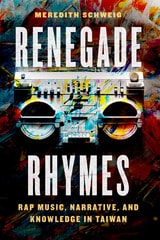
Renegade Rhymes
Rap Music, Narrative, and Knowledge in TaiwanMeredith Schweig
University of Chicago Press, 2022
Like many states emerging from oppressive political rule, Taiwan saw a cultural explosion in the late 1980s, when nearly four decades of martial law under the Chinese Nationalist Party ended. As members of a multicultural, multilingual society with a complex history of migration and colonization, Taiwanese people entered this moment of political transformation eager to tell their stories and grapple with their identities. In Renegade Rhymes, ethnomusicologist Meredith Schweig shows how rap music has become a powerful tool in the post-authoritarian period for both exploring and producing new knowledge about the ethnic, cultural, and political history of Taiwan.
Schweig draws on extensive ethnographic fieldwork, taking readers to concert venues, music video sets, scenes of protest, and more to show how early MCs from marginalized ethnic groups infused rap with important aspects of their own local languages, music, and narrative traditions. Aiming their critiques at the educational system and a neoliberal economy, new generations of rappers have used the art form to nurture associational bonds and rehearse rituals of democratic citizenship, making a new kind of sense out of their complicated present.
Rhymes in the Flow
How Rappers Flip the BeatMacklin Smith and Aurko Joshi
University of Michigan Press, 2020
Despite its global popularity, rap has received little scholarly attention in terms of its poetic features. Rhymes in the Flow systematically analyzes the poetics (rap beats, rhythms, rhymes, verse and song structures) of many notable rap songs to provide new insights on rap artistry and performance. Defining and describing the features of what rappers commonly call flow, the authors establish a theory of the rap line as they trace rap’s deepest roots and stylistic evolution—from Anglo-Saxon poetry to Lil Wayne—and contextualize its complex poetics. Rhymes in the Flow helps explain rap’s wide appeal by focusing primarily on its rhythmic and thematic power, while also claiming its historical, cultural, musical, and poetic importance.
Rhymin' and Stealin'
Musical Borrowing in Hip-HopJustin A. Williams
University of Michigan Press, 2014
Rhymin’ and Stealin’begins with a crucial premise: the fundamental element of hip-hop culture and aesthetics is the overt use of preexisting material to new ends. Whether it is taking an old dance move for a breakdancing battle, using spray paint to create street art, quoting from a famous speech, or sampling a rapper or 1970s funk song, hip-hop aesthetics involve borrowing from the past. By appropriating and reappropriating these elements, they become transformed into something new, something different, something hip-hop. Rhymin’ and Stealin’ is the first book-length study of musical borrowing in hip-hop music, which not only includes digital sampling but also demonstrates a wider web of references and quotations within the hip-hop world. Examples from Nas, Jay-Z, A Tribe Called Quest, Eminem, and many others show that the transformation of preexisting material is the fundamental element of hip-hop aesthetics. Although all music genres use and adapt preexisting material in different ways, hip-hop music celebrates and flaunts its “open source” culture through highly varied means. It is this interest in the web of references, borrowed material, and digitally sampled sounds that forms the basis of this book—sampling and other types of borrowing becomes a framework with which to analyze hip-hop music and wider cultural trends.