Results by title
61 books match the query 'Readers' and 5 start with r
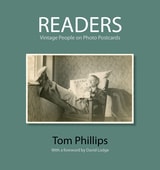
Readers
Vintage People on Photo PostcardsTom Phillips
Bodleian Library Publishing, 2010
To celebrate the acquisition of the archive of distinguished artist Tom Phillips, the Bodleian Library asked the artist to assemble and design a series of books drawing on his themed collection of over 50,000 photographic postcards. These encompass the first half of the twentieth century, a period in which, thanks to the ever cheaper medium of photography, ordinary people could afford to own portraits of themselves. Each book in the series contains two hundred images chosen from a visually rich vein of social history. Their covers also feature thematically linked paintings, specially created for each title, from Phillips’s signature work, A Humument.
Readers, as its title suggests, shows people reading (or pretending to read) a wide variety of material, from the Bible to Film Fun, either in the photographer’s studio, in their own home, or on vacation on the beach. Each of these unique and visually stunning books give a rich glimpse of forgotten times and will be greatly valued by art and history lovers alike.

Reading Akkadian Prayers and Hymns
An IntroductionAlan Lenzi
SBL Press, 2011
A thorough text for students of ancient Mesopotamian religion and the Hebrew Bible
Alan Lenzi places Akkadian prayers and hymns within both a religious studies perspective and a Mesopotamian studies perspective. Complete with vocabulary glosses, grammatical notes, literary commentary, and comparative suggestions to biblical material, this book provides a crucial tool for accessing ancient texts related to our understanding of the Hebrew Bible.
Features:
- Background essays
- Discussion of classes of Mesopotamian prayers and their comparative use in biblical studies
- Akkadian text, transliteration, translation, and commentary
- Notes on vocabulary and grammar
Alan Lenziis Associate Professor of Hebrew Bible and Ancient Near East at University of the Pacific. He is the author of Secrecy and the Gods: Secret Knowledge in Ancient Mesopotamia and Biblical Israel (Neo-Assyrian Text Corpus Project).
Reading Medieval Latin with the Legend of Barlaam and Josaphat
Donka D. Markus
University of Michigan Press, 2018
In Reading Medieval Latin with the Legend of Barlaam and Josaphat, Donka D. Markus offers comprehensive commentary on the 13th-century Dominican theologian Jacobus de Voragine’s retelling of the ancient story of the life of the Buddha that will resonate with contemporary students of Latin.
Jacobus’s version of the legend serves as a compelling, original Latin text. Vividly conveyed through parables, fables, and anecdotes, it naturally lends itself to a critical consideration of ethical principles and philosophical truths commonly shared across many cultures. With its rich stylistic devices and authentic classical Latin word order, it provides superb training for reading rhetorical prose before advancing to the works of more complex classical prose authors. At the same time, the text offers a unique opportunity for systematically learning the special features of Late and Medieval Latin. Included in this volume are two presentations of Jacobus’s text: one maintaining the original orthography reflecting Latin as it appears in medieval manuscripts, and one in which the orthography follows Classical Latin norms.
This textbook is designed for intermediate-level learners of Classical or Medieval Latin, whether in college, high school, or by self-directed study. The 5,000-word narrative text lends itself to a semester-long experience of reading one continuous work of prose. Each of the legend’s embedded stories can also be read as an independent selection with the help of the ample commentary, vocabulary, and grammar guidance. The extensive introduction provides the necessary background to contextualize the legend in its Latin iteration and sufficient historical information to make the reading meaningful for those without prior knowledge of Buddhism or medieval history. Additionally, this work makes Latin attractive to students of diverse backgrounds, as it highlights the language’s important role in disseminating the universally shared cultural legacy of humanity.
Reading Old English
A Primer and First Reader, Revised EditionROBERT HASENFRATZ
West Virginia University Press, 2010
With the immersion method dominating contemporary language learning, the knowledge of traditional grammar is at a low ebb, creating real barriers to any student wanting to learning dead or historical languages. This revised edition of Reading Old English aims to equip readers (advanced undergraduates, graduate students, and autodidacts) with the necessary tools to read the oldest recorded forms of the English language by explaining key language features clearly and methodically, without simplifying any of the core grammatical concepts. It includes a number of helpful exercises, a variety of interesting and unusual Old English texts to translate, as well as appendices covering the basics of traditional grammar and sound changes in Old English, along with an introduction to poetic structure.
Reading Together, Reading Apart
Identity, Belonging, and South Asian American CommunityTamara Bhalla
University of Illinois Press, 2016
Tamara Bhalla blends a case study with literary and textual analysis to illuminate this phenomenon. Her fascinating investigation considers institutions from literary reviews to the marketplace to social media and other technologies, as well as traditional forms of literary discussion like book clubs and academic criticism. Throughout, Bhalla questions how her subjects' circumstances, desires, and shared race and class, limit the values they ascribe to reading. She also examines how ideology circulating around a body of literature or a self-selected, imagined community of readers shapes reading itself and influences South Asians' powerful, if contradictory, relationship with ideals of cultural authenticity.