Results by title
144 books match the query 'Reading' and 55 start with r
Reading "The Waste Land"
Modernism and the Limits of InterpretationJewel Spears Brooker
University of Massachusetts Press, 1990
This study of T.S. Eliot's The Waste Land guides the reader through the poem line by line, taking into account a number of previous interpretations. Aims to offer a part-by-part analysis of the poem with periodic summations and a meditation on the limits of interpretation and the problematic nature of reading in the late 20th century.
Reading Palestine
Printing and Literacy, 1900-1948By Ami Ayalon
University of Texas Press, 2004
Prior to the twentieth century, Arab society in Palestine was predominantly illiterate, with most social and political activities conducted through oral communication. There were no printing presses, no book or periodical production, and no written signs in public places. But a groundswell of change rapidly raised the region's literacy rates, a fascinating transformation explored for the first time in Reading Palestine.
Addressing an exciting aspect of Middle Eastern history as well as the power of the printed word itself, Reading Palestine describes how this hurried process intensified the role of literacy in every sphere of community life. Ami Ayalon examines Palestine's development of a modern educational system in conjunction with the emergence of a print industry, libraries and reading clubs, and the impact of print media on urban and rural populations. Drawn from extensive archival sources, official reports, autobiographies, and a rich trove of early Palestinian journalism, Reading Palestine provides crucial insight into the dynamic rise of literacy that revolutionized the way Palestinians navigated turbulent political waters.
Reading Randomised Controlled Trials
Opening the BookRobert Savage, Amy Fox, Anneka Dawson, Helen Gray, and Clare Huxley
University College London, 2025
Reading Randomised Controlled Trials presents an illuminating exploration of how large-scale educational trials unfold in real-world settings, displaying the often-overlooked human decisions that shape their outcomes. Using the Flexible Phonics trial—an ambitious study involving nearly 3,000 children in 118 schools across England—as a case study, the authors examine the practical and ethical problems with conducting randomized controlled trials (RCTs) in education. Unlike pharmaceutical trials, educational RCTs operate in dynamic environments where factors such as teacher decision-making and school culture play a crucial role.
This book depicts the inner workings of education research and also underlines its broader significance, particularly in the wake of school closures during the COVID-19 pandemic. By focusing on early childhood literacy and the long-term impact of evidence-based interventions, Reading Randomised Controlled Trials provides important insights for educators and researchers seeking to bridge the gap between rigorous research and meaningful classroom practice. A must-read for those invested in improving educational outcomes, this book contests assumptions about what works in education—and why.
Reading The Social Body
Catherine B. Burroughs
University of Iowa Press, 1993
The overarching argument of Reading the Social Body is that the body is cultural rather than “natural.” Some of the essays treat the social construction of bodies that have actually existed in human history; others discuss the representation of bodies in artistic contexts; all recognize that everything visible to the human body—from posture and costume to the width of an eyebrow or a smile—is determined by and shaped in response to a particular culture.
Reading The Trail
Exploring The Literature And Natural History Of The California CrestCorey Lee Lewis
University of Nevada Press, 2005
A provocative new way to read and interpret the classic works of John Muir, Mary Austin, and Gary Snyder, and to bring their ideas into the discussion of ecological values and the current environmental crisis. Lewis combines a perceptive discussion of their work and ideas with an engaging account of his own trail experiences as hiker/backpacker and volunteer trail builder, proposing that such a field-based, interdisciplinary approach to literary study and outdoors experience can enrich our appreciation for the work of nature writers.
Reading With Clarice Lispector
Helene Cixous
University of Minnesota Press, 1990
Reading With Lincoln
Robert Bray
Southern Illinois University Press, 2010
Through extensive reading and reflection, Abraham Lincoln fashioned a mind as powerfully intellectual and superlatively communicative as that of any other American political leader. Reading with Lincoln uncovers the how of Lincoln’s inspiring rise to greatness by connecting the content of his reading to the story of his life.
At the core of Lincoln’s success was his self-education, centered on his love of and appreciation for learning through books. From his early studies of grammar school handbooks and children’s classics to his interest in Shakespeare’s Macbeth and the Bible during his White House years, what Lincoln read helped to define who he was as a person and as a politician. This unique study delves into the books, pamphlets, poetry, plays, and essays that influenced Lincoln’s thoughts and actions.
Exploring in great depth and detail those readings that inspired the sixteenth president, author Robert Bray follows Lincoln’s progress closely, from the young teen composing letters for illiterate friends and neighbors to the politician who keenly employed what he read to advance his agenda. Bray analyzes Lincoln’s radical period in New Salem, during which he came under the influence of Anglo-American and French Enlightenment thinkers such as Thomas Paine, C. F. Volney, and Voltaire, and he investigates Lincoln’s appreciation of nineteenth-century lyric poetry, which he both read and wrote. Bray considers Lincoln’s fascination with science, mathematics, political economics, liberal social philosophy, theology, and the Bible, and devotes special attention to Lincoln’s enjoyment of American humor. While striving to arrive at an understanding of the role each subject played in the development of this remarkable leader, Bray also examines the connections and intertextual relations between what Lincoln read and how he wrote and spoke.
This comprehensive and long-awaited book provides fresh insight into the self-made man from the wilderness of Illinois. Bray offers a new way to approach the mind of the political artist who used his natural talent, honed by years of rhetorical study and practice, to abolish slavery and end the Civil War.
Reading and Disorder in Antebellum America
David M. Stewart
The Ohio State University Press, 2011
Reading and Teaching Ancient Fiction
Jewish, Christian, and Greco-Roman NarrativesSara R. Johnson
SBL Press, 2018
The third volume of research on ancient fiction
This volume includes essays presented in the Ancient Fiction and Early Christian and Jewish Narrative section of the Society of Biblical Literature. Contributors explore facets of ongoing research into the interplay of history, fiction, and narrative in ancient Greco-Roman, Jewish, and Christian texts. The essays examine the ways in which ancient authors in a variety of genre and cultural settings employed a range of narrative strategies to reflect on pressing contemporary issues, to shape community identity, or to provide moral and educational guidance for their readers. Not content merely to offer new insights, this volume also highlights strategies for integrating the fruits of this research into the university classroom and beyond.
Features
- Insight into the latest developments in ancient Mediterranean narrative
- Exploration of how to use ancient texts to encourage students to examine assumptions about ancient gender and sexuality or to view familiar texts from a new perspective
- Close readings of classical authors as well as canonical and noncanonical Jewish and Christian texts
Reading and Writing Instruction in the Twenty-First Century
Recovering and Transforming the Pedagogy of Robert ScholesEllen C. Carillo
Utah State University Press, 2021
In this volume, Scholes’s scholarship is included alongside original essays, providing a resource for those considering everything from the place of the English major in the twenty-first century to best practices for helping students navigate misinformation and disinformation. Reading and Writing Instruction in the Twenty-First Century not only keeps Scholes’s legacy alive but carries it on through a commitment, in Scholes’s (1998) own words, to “offer our students . . . the cultural equipment they are going to need when they leave us.”
Contributors:
Angela Christie, Paul T. Corrigan, Lynée Lewis Gaillet, Doug Hesse, Alice S. Horning, Emily J. Isaacs, Christopher La Casse, Robert Lestón, Kelsey McNiff, Thomas P. Miller, Jessica Rivera-Mueller, Christian Smith, Kenny Smith
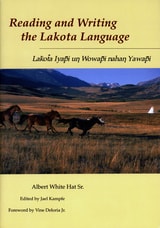
Reading and Writing Lakota Language
Albert White Hat Sr
University of Utah Press, 1999
Though Reading and Writing the Lakota Language is thorough in its inclusion of conjugation, syntax, and sentence, it emphasizes vocabulary and pronunciation. Author Albert White Hat Sr. presents Lakota philosophy as it applies to specific grammar lessons. Moreover, he documents the impact of the acculturation process on the language, showing how Lakota evolved as a result of non-Indian influences. The textual example offers new information and interpretation of Lakota society, even to scholars who specialize n Plains cultures. Beyond language instruction, readers will value the book for its cultural insights, humorous stories, and its entertaining tone.
Reading and Writing the Ambiente
Queer Sexualities in Latino, Latin American, and Spanish CultureSusana Chávez-Silverman
University of Wisconsin Press, 2000
In this dynamic collection of essays, many leading literary scholars trace gay and lesbian themes in Latin American, Hispanic, and U.S. Latino literary and cultural texts. Reading and Writing the Ambiente is consciously ambitious and far-ranging, historically as well as geographically. It includes discussions of texts from as early as the seventeenth century to writings of the late twentieth century.
Reading and Writing the Ambiente also underscores the ways in which lesbian and gay self-representation in Hispanic texts differs from representations in Anglo-American texts. The contributors demonstrate that—unlike the emphasis on the individual in Anglo- American sexual identity—Latino, Spanish, and Latin American sexual identity is produced in the surrounding culture and community, in the ambiente. As one of the first collections of its kind, Reading and Writing the Ambiente is expressive of the next wave of gay Hispanic and Latin scholarship.
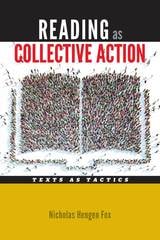
Reading as Collective Action
Text as TacticsNicholas Hengen Fox
University of Iowa Press, 2017
Reading as Collective Action shifts our focus outward, to another of literature’s powers: the power to reshape our world in very public, very active ways. In this book, you will encounter readers who criticized the Bush administration’s war on terror by republishing poems by writers ranging from Shakespeare to Amiri Baraka everywhere from lampposts to the New York Times. You will read about people in Michigan and Tennessee, who leveraged a community reading program on John Steinbeck’s The Grapes of Wrath to organize support for those in need during the Great Recession and to engage with their neighbors about immigration. You will meet a pair of students who took to public transit to talk with strangers about working-class literature and a trio who created a literary website that reclaimed the working-class history of the Pacific Northwest.
This book challenges dominant academic modes of reading. For adherents of the “civic turn,” it suggests how we can create more politically effective forms of service learning and community engagement grounded in a commitment to tactical, grassroots actions. Whether you’re a social worker or a student, a zine-maker, a librarian, a professor, or just a passionate reader with a desire to better your community, this book shows that when we read texts as tactics, “that book changed my life” can become “that book changed our lives.”
Reading as Therapy
What Contemporary Fiction Does for Middle-Class AmericansTimothy Aubry
University of Iowa Press, 2011
@font-face { font-family: "Myriad Pro";}p.MsoNormal, li.MsoNormal, div.MsoNormal { margin: 0in 0in 0.0001pt; font-size: 12pt; font-family: "Times New Roman"; }div.Section1 { page: Section1; }Why do Americans read contemporary fiction? This question seems simple, but is it? Do Americans read for the purpose of aesthetic appreciation? To satisfy their own insatiable intellectual curiosities? While other forms of media have come to monopolize consumers’ leisure time, in the past two decades book clubs have proliferated, Amazon has sponsored thriving online discussions, Oprah Winfrey has inspired millions of viewers to read both contemporary works and classics, and novels have retained their devoted following within middlebrow communities.
In Reading as Therapy, Timothy Aubry argues that contemporary fiction serves primarily as a therapeutic tool for lonely, dissatisfied middle-class American readers, one that validates their own private dysfunctions while supporting elusive communities of strangers unified by shared feelings. Aubry persuasively makes the case that contemporary literature’s persistent appeal depends upon its capacity to perform a therapeutic function.
Reading as Therapy traces the growth and proliferation of psychological concepts focused on the subjective interior within mainstream, middle-class society and the impact this has had on contemporary fiction. The prevailing tendency among academic critics has been to decry the personal emphasis of contemporary fiction as complicit with the rise of a narcissistic culture, the ascendency of liberal individualism, and the breakdown of public life. Reading as Therapy, by contrast, underscores the varied ideological effects that therapeutic culture can foster.
To uncover the many unpredictable ways in which contemporary literature answers the psychological needs of its readers, Aubry considers several different venues of reader-response—including Oprah’s Book Club and Amazon customer reviews—the promotional strategies of publishing houses, and a variety of contemporary texts, ranging from Khaled Hosseini’s The Kite Runner to Anita Shreve’s The Pilot’s Wife to David Foster Wallace’s Infinite Jest. He concludes that, in the face of an atomistic social landscape, contemporary fiction gives readers a therapeutic vocabulary that both reinforces the private sphere and creates surprising forms of sympathy and solidarity among strangers.
Reading in These Times
Purposes and Practices of Minoritized Biblical CriticismTat-siong Benny Liew
SBL Press, 2024
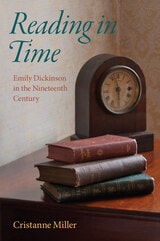
Reading in Time
Emily Dickinson in the Nineteenth CenturyCristanne Miller
University of Massachusetts Press, 2012
Before 1865, Dickinson at least ambivalently considered publication, circulated relatively few poems, and saved almost everything she wrote in organized booklets. After this date, she wrote far fewer poems, circulated many poems without retaining them, and took less interest in formally preserving her work. Yet, Miller argues, even when circulating relatively few poems, Dickinson was vitally engaged with the literary and political culture of her day and, in effect, wrote to her contemporaries. Unlike previous accounts placing Dickinson in her era, Reading in Time demonstrates the extent to which formal properties of her poems borrow from the short-lined verse she read in schoolbooks, periodicals, and single-authored volumes. Miller presents Dickinson's writing in relation to contemporary experiments with the lyric, the ballad, and free verse, explores her responses to American Orientalism, presents the dramatic lyric as one of her preferred modes for responding to the Civil War, and gives us new ways to understand the patterns of her composition and practice of poetry.
Reading in a Digital Age
David M. Durant
Against the Grain, LLC, 2017
The Charleston Briefings are written by authorities who provide an effective, readable overview of their topics—not an academic monograph. The intended audience is busy nonspecialist readers who want to be informed concerning important issues in our industry in an accessible and timely manner.
How is reading changing in the digital environment? How will it continue to change? Are we headed for an all- digital future? Or does print still have a place in the reading environment? Does format matter? What do readers tell us they want? This brief monograph offers librarians, publishers, vendors, and others an overview of these key issues as well as advice on how their institutions should approach the print versus digital controversy.
Reading in the Postgenomic Age
Race, Discipline, and Bionarrativity in Contemporary North American LiteratureLesley Larkin
The Ohio State University Press, 2025
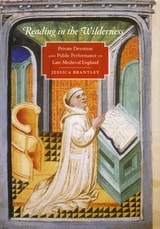
Reading in the Wilderness
Private Devotion and Public Performance in Late Medieval EnglandJessica Brantley
University of Chicago Press, 2007
Drawing on the work of W. J. T. Mitchell, Michael Camille, and others working at the image-text crossroads, Reading in the Wilderness addresses the manuscript’s texts and illustrations to examine connections between reading and performance within the solitary monk’s cell and also outside. Brantley reimagines the medieval codex as a site where the meanings of images and words are performed, both publicly and privately, in the act of reading.
Reading on the Middle Border
The Culture of Print in Late-Nineteenth-Century Osage, IowaChristine Pawley
University of Massachusetts Press, 2009
Christine Pawley investigates the use of print by "ordinary" Americans in the small, rural community of Osage, Iowa—the town that shaped Hamlin Garland—analyzing primary source material on education, religious life, a reading club, and business affairs. A major section of her study focuses on the public library, an institution that provides a valuable window into the reading practices of men and women of various ages, classes, ethnicities, and religions. An extensive database of library circulation and accessions information, combined with federal and state census data, sheds light on the elusive issue of "Who read what?"
Pawley explores the ways print confirmed or challenged people's economic, social, and religious world, and asks what values print expressed or confronted. She also raises questions relating to modes and contexts of reading, distinguishing between groups and individuals. The picture of print in Osage is complex and defies reduction, but by placing print in a community context and viewing printed materials as an expression of activities, not mere artifacts, Pawley enhances our understanding of the role of reading in American culture.
Reading the Bible in Ancient Traditions and Modern Editions
Studies in Memory of Peter W. FlintAndrew B. Perrin
SBL Press, 2017
A collection of essays commemorating the career contributions of Peter W. Flint
An international group of scholars specializing in various disciplines of biblical studies—Dead Sea Scrolls, Septuagint, Hebrew Bible/Old Testament, Second Temple Judaism, and Christian origins—present twenty-seven new contributions that commemorate the career of Peter W. Flint (1951–2016). Each essay interacts with and gives fresh insight into a field shaped by Professor Flint’s life work. Part 1 explores the interplay between text-critical methods, the growth and formation of the Hebrew Scriptures, and the making of modern critical editions. Part 2 maps dynamics of scriptural interpretation and reception in ancient Jewish and Christian literatures of the Second Temple period.
Features
- Essays that assess the state of the field and reflect on the methods, aims, and best practices for textual criticism and the making of modern critical text editions
- Demonstrations of how the processes of scriptural composition, transmission, and reception converge and may be studied together for mutual benefit
- Clarification of the state/forms of scripture in antiquity and how scripture was extended, rewritten, and recontextualized by ancient Jewish and Christian scribes and communities
Reading the Book of Nature
How Eight Best Sellers Reconnected Christianity and the Sciences on the Eve of the Victorian AgeJonathan R. Topham
University of Chicago Press, 2022
When Charles Darwin returned to Britain from the Beagle voyage in 1836, the most talked-about scientific books of the day were the Bridgewater Treatises. This series of eight works was funded by a bequest of the last Earl of Bridgewater and written by leading men of science appointed by the president of the Royal Society to explore "the Power, Wisdom, and Goodness of God, as manifested in the Creation." Securing public attention beyond all expectations, the series offered Darwin’s generation a range of approaches to one of the great questions of the age: how to incorporate the newly emerging disciplinary sciences into Britain’s overwhelmingly Christian culture.
Drawing on a wealth of archival and published sources, including many unexplored by historians, Jonathan R. Topham examines how and to what extent the series contributed to a sense of congruence between Christianity and the sciences in the generation before the fabled Victorian conflict between science and religion. Building on the distinctive insights of book history and paying close attention to the production, circulation, and use of the books, Topham offers new perspectives on early Victorian science and the subject of science and religion as a whole.
Reading the Book of Revelation
A Resource for StudentsDavid L. Barr
SBL Press, 2003
Reading the Dead Sea Scrolls
Essays in MethodGeorge J. Brooke
SBL Press, 2013
Reading the Difficulties
Dialogues with Contemporary American Innovative PoetryThomas Fink
University of Alabama Press, 2013
New Strategies for Reading the Most Innovative Poetry of Our Time.
Definitions of what constitutes innovative poetry are innumerable and are offered from every quarter. Some critics and poets argue that innovative poetry concerns free association (John Ashbery), others that experimental poetry is a “re-staging” of language (Bruce Andrews) or a syntactic and cognitive break with the past (Ron Silliman and Lyn Hejinian). The tenets of new poetry abound.
But what of the new reading that such poetry demands? Essays in Reading the Difficulties ask what kinds of stances allow readers to interact with verse that deliberately removes many of the comfortable cues to comprehension—poetry that is frequently nonnarrative, nonrepresentational, and indeterminate in subject, theme, or message.
Some essays in Thomas Fink and Judith Halden-Sullivan’s collection address issues of reader reception and the way specific stances toward reading support or complement the aesthetic of each poet. Others suggest how we can be open readers, how innovative poetic texts change the very nature of reader and reading, and how critical language can capture this metamorphosis. Some contributors consider how the reader changes innovative poetry, what language reveals about this interaction, which new reading strategies unfold for the audiences of innovative verse, and what questions readers should ask of innovative verse and of events and experiences that we might bring to reading it.
Reading the East India Company 1720-1840
Colonial Currencies of GenderBetty Joseph
University of Chicago Press, 2003
Drawing on the British East India Company's records as well as novels, memoirs, portraiture and guidebooks, Joseph shows how the company's economic and archival practices intersected to produce colonial "fictions" or "truth-effects" that strictly governed class and gender roles—in effect creating a "grammar of power" that kept the far-flung empire intact. And while women were often excluded from this archive, Joseph finds that we can still hear their voices at certain key historical junctures. Attending to these voices, Joseph illustrates how the writing of history belongs not only to the colonial project set forth by British men, but also to the agendas and mechanisms of agency—of colonized Indian, as well as European women. In the process, she makes a valuable and lasting contribution to gender studies, postcolonial theory, and the history of South Asia.
Reading the Epistle of James
A Resource for StudentsEric F. Mason
SBL Press, 2019
Foundational essays for students of New Testament epistles
This accessible introduction to contemporary scholarship on the Epistle of James begins with chapters that consider possible sources and backgrounds used by the author of James, the genre and literary structure of the book, and its major theological themes. Building on this foundation, subsequent chapters examine James through social-scientific readings, perspectives of Latin American immigrants and the marginalized, and major recent developments in textual criticism. The final chapters in the volume address the relationship between the epistle and the historical James, reception of the epistle in the early church, and major Catholic and Protestant interpretations of the book in the Reformation era. The contributions in this volume distill a range of important issues for readers undertaking a serious study of this letter for the first time.
Features
- An introduction to contemporary scholarship on this important but often-overlooked text
- Clear explanations of all technical terms and themes
- In-depth discussions of the importance of Jewish Scripture and interpretative traditions, Greco-Roman philosophy and Jewish wisdom motifs, and biblical perspectives on justice, wealth, and poverty
Reading the Epistle to the Hebrews
Eric F. Mason
SBL Press, 2011
Reading the Fascicles of Emily Dickinson
Dwelling in PossibilitiesEleanor Elson Heginbotham
The Ohio State University Press, 2020
We cannot know why Dickinson compiled the books or what she thought of them, but we can observe what she left in them. What she left is visible only by noting the way the poem answers in a dialogue across the pages, the way lines spilling onto a second page introduce the next poem, the way openings suggest image clusters so that each book has its own network of concerns and language—not a story or philosophical preachment but an aesthetic wholeness.
This book is the first to demonstrate that Dickinson’s poetic and philosophical creativity is most startling when the reader observes the individual lyric in the poet’s own, and only, context for them. For teacher, student, scholar, and poetry lover, Heginbotham creates an important new framework for understanding one of the most complex, clever, and profound U.S. poets.
Reading the Figural, or, Philosophy after the New Media
D. N. Rodowick
Duke University Press, 2001
To fully comprehend the emergence of the figural requires a genealogical critique of the aesthetic, Rodowick claims. Seeking allies in this effort to deconstruct the opposition of word and image and to create new concepts for comprehending the figural, he journeys through a range of philosophical writings: Thierry Kuntzel and Marie-Claire Ropars-Wuilleumier on film theory; Jacques Derrida on the deconstruction of the aesthetic; Siegfried Kracauer and Walter Benjamin on the historical image as a utopian force in photography and film; and Gilles Deleuze and Michel Foucault on the emergence of the figural as both a semiotic regime and a new stratagem of power coincident with the appearance of digital phenomena and of societies of control.
Scholars of philosophy, film theory, cultural criticism, new media, and art history will be interested in the original and sophisticated insights found in this book.
Reading the Illegible
Rainer Rumold
Northwestern University Press, 2003
In his scrutiny of selected works, and with reference to a rich variety of textual materials--from popular and scientific texts to visual art, political and cultural theories, and experimental films--Dworkin proposes a new way of apprehending the radical formalism of so-called unreadable texts. Dworkin unveils what he describes as "the politics of the poem"--what is signified by its form, enacted by its structures, and implicit in the philosophy of language; how it positions its reader; and other questions relating to the poem as material object. In doing so, he exposes the mechanics and function of truly radical formalism as a practice that move beyond aesthetic considerations into the realms of politics and ideology. Reading the Illegible asks us to reconsider poetry as a physical act, and helps us to see how the range of a text's linguistic and political maneuvers depends to a great extent on the material conditions of reading and writing as well as the mechanics of reproduction.
Reading the Illegible
Indigenous Writing and the Limits of Colonial Hegemony in the AndesLaura Leon Llerena
University of Arizona Press, 2023
The concept of legibility allows us to reconsider this unique manuscript within the intertwined histories of literacy, knowledge, and colonialism. Reading the Illegible shows that the anonymous author(s) of the Huarochirí Manuscript, along with two contemporaneous Andean-authored texts by Joan de Santa Cruz Pachacuti and Felipe Guaman Poma de Ayala, rewrote the history of writing and the notion of Christianity by deploying the colonizers’ technology of alphabetic writing.
Reading the Illegible weaves together the story of the peoples, places, objects, and media that surrounded the creation of the anonymous Huarochirí Manuscript to demonstrate how Andean people endowed the European technology of writing with a new social role in the context of a multimedia society.
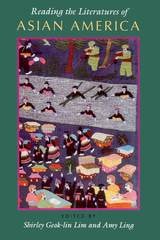
Reading the Literatures of Asian America
Shirley Geok-lin Lim
Temple University Press, 1992
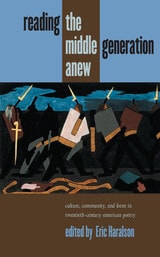
Reading the Middle Generation Anew
Culture, Community, and Form in Twentieth-Century American PoetryEric Haralson
University of Iowa Press, 2006
In addition to having worked during the broad middle of the last century, these poets constitute the center of twentieth-century American poetry in the larger sense, refuting invidious connotations of “middle” as coming after the great moderns and being superseded by a proliferating postmodern experimentation. This middle generation mediates the so-called American century and its prodigious body of poetry, even as it complicates historical and aesthetic categorizations.
Taking diverse formal and thematic angles on these poets—deconstructionist, biographical-historical, and more formalist accounts—this book re-examines their between-ness and ambivalence: their various positionings and repositionings in aesthetic, political, and personal matters. The essays study the interplay between these writers and such shifting formations as religious discourse, consumerism, militarism and war, the ideology of America as “nature’s nation,” and U.S. race relations and ethnic conflicts. Reading the Middle Generation Anew also shows the legacy of the middle generation, the ways in which their lives and writings continue to be a shaping force in American poetry. This fresh and invigorating collection will be of great interest to literary scholars and poets.
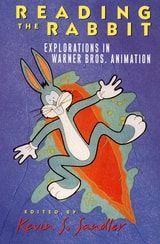
Reading the Rabbit
Explorations in Warner Bros. AnimationSandler, Kevin S
Rutgers University Press, 1998
"A wide-ranging inquiry into an important area of contemporary scholarly interest, and also an engaging, well written and intelligently conceived collection." -Eric Smoodin, author of Animating Culture: Hollywood Cartoons From the Sound Era
Despite the success of Bugs Bunny, Daffy Duck, and their Looney cohorts, Warner Bros. animation worked in the shadow of Disney for many years. The past ten years have seen a resurgence in Warner Bros. animation as they produce new Bugs Bunny cartoons and theatrical features like Space Jam as well as television shows like Tiny Toon Adventures and Animaniacs. While Disney's animation plays it safe and mirrors traditional cinema stories, Warner Bros. is known for a more original and even anarchistic style of narration, a willingness to take risks in story construction, a fearlessness in crossing gender lines with its characters, and a freedom in breaking boundaries. This collection of essays looks at the history of Warner Bros. animation, compares and contrasts the two studios, charts the rise and fall of creativity and daring at Warner's, and analyzes the ways in which the studio was for a time transgressive in its treatment of class, race, and gender. It reveals how safety and commercialization have, in the end, triumphed at Warner Bros. just as they much earlier conquered Disney.
The book also discusses fan parodies of Warner Bros. animation on the Internet today, the Bugs Bunny cross-dressing cartoons, cartoons that were censored by the studio, and the merchandising and licensing strategies of the Warner Bros. studio stores. Contributors are Donald Crafton, Ben Fraser, Michael Frierson, Norman M. Klein, Terry Lindvall, Bill Mikulak, Barry Putterman, Kevin S. Sandler, Hank Sartin, Linda Simensky, Kirsten Moana Thompson, Gene Walz, and Timothy R. White.
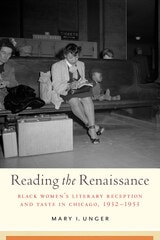
Reading the Renaissance
Black Women's Literary Reception and Taste in Chicago, 1932-1953Mary I. Unger
University of Massachusetts Press, 2025
From 1932 to 1953, during the Black Chicago Renaissance, numerous literary events were held within and for the city’s Black community. In book clubs, public forums, print reviews, little magazines, local programming, and other public venues, Black women in particular debated the role of literature in racial uplift efforts, set literary standards, and acted as community gatekeepers for cultural production during a time known as the Black Chicago Renaissance. Through these inspiring efforts, a mix of publishers, well-known authors, and everyday readers significantly fostered a robust literary culture in the Windy City.
Reading the Renaissance constructs a reception history of the Black women who read and reviewed, published and promoted, and collected and curated literature of the era. Mary Unger interprets how local figures such as Vivian G. Harsh, Ora Morrow, Gwendolyn Brooks, Alice Browning, Fern Gayden, and Margaret Walker cultivated particular literary tastes through collective acts of reading and reception. She does so by recovering a network of readers, book clubs, literary magazines, civic programs, and book businesses that Black women created, led, and transformed during the early 1930s through the early 1950s in Bronzeville, Chicago’s predominantly Black South Side neighborhood.
This illuminating work includes close readings of texts alongside letters, scrapbooks, meeting minutes, reviews, and other ephemera of local reading practices to show how Black women facilitated diverse strategies of reading while instructing community members how to engage a variety of print cultures at the time. Unger demonstrates how Black women readers influenced individual authors as well as the norms and expectations of African American literature more broadly, becoming important (yet too often overlooked) players in American literary history.
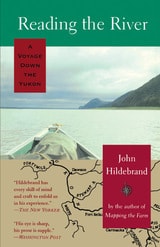
Reading the River
A Voyage Down the YukonJohn Hildebrand
University of Wisconsin Press, 1997
“John Hildebrand sets out in a canoe . . . to explore the great riverway of northwestern Canada and Alaska. . . . The geography is closely rendered and the characters especially sharply drawn. The country is filled with mad dropouts at river fish camps, good-hearted girls in the towns, sullen natives in tumbledown villages, cranky old-timers, terrible drunks and worse moralizers who live off the wild landscape and its abundant resources. . . . This is a fine work, and Hildebrand is a fine writer.”—Charles E. Little, Wilderness

Reading the Room
A Bookseller's TalePaul Yamazaki
Prickly Paradigm Press, 2024
Over twenty-four hours, Paul Yamazaki leads us through the stacks of storied City Lights Booksellers in San Francisco; the care and prowess of his approach to book buying; his upbringing in a Japanese American family in Southern California and moving to San Francisco at the height of revolutionary foment; working with legendary figures in the book publishing industry like Lawrence Ferlinghetti, Sonny Mehta, and others; and his vision for the future of bookselling. Navigating building trust with readers and nurturing relationships across the literary industry, Yamazaki testifies to the value of generosity, sharing knowledge, and dialogue in a life devoted to books.
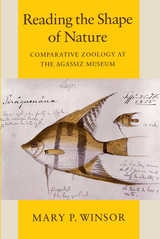
Reading the Shape of Nature
Comparative Zoology at the Agassiz MuseumMary P. Winsor
University of Chicago Press, 1991
In 1859, Louis Agassiz established the Museum of Comparative Zoology to house research on the ideal types that he believed were embodied in all living forms. Agassiz's vision arose from his insistence that the order inherent in the diversity of life reflected divine creation, not organic evolution. But the mortar of the new museum had scarcely dried when Darwin's Origin was published. By Louis Agassiz's death in 1873, even his former students, including his son Alexander, had defected to the evolutionist camp. Alexander, a self-made millionaire, succeeded his father as director and introduced a significantly different agenda for the museum.
To trace Louis and Alexander's arguments and the style of science they established at the museum, Winsor uses many fascinating examples that even zoologists may find unfamiliar. The locus of all this activity, the museum building itself, tells its own story through a wonderful series of archival photographs.
Reading the Skies
A Cultural History of English Weather, 1650-1820Vladimir Jankovic
University of Chicago Press, 2001
Jankovic interweaves classical traditions, folk/popular beliefs and practices, and the increasingly quantitative approaches of urban university men to understanding the wonders of the skies. He places special emphasis on the role that detailed meteorological observations played in natural history and chorography, or local geography; in religious and political debates; and in agriculture. Drawing on a number of archival sources, including correspondence and weather diaries, as well as contemporary pamphlets, tracts, and other printed sources reporting prodigious phenomena in the skies, this book will interest historians of science, Britain, and the environment.
Reading the Song of Songs with St. Thomas Aquinas
Serge-Thomas Bonino
Catholic University of America Press, 2022
Reading the Underthought
Jewish Hermeneutics and the Christian Poetry of Hopkins and EliotKinereth Meyer
Catholic University of America Press, 2010
Reading the Wind
The Literature of the Vietnam WarTimothy J. Lomperis
Duke University Press, 1987
Reading the World
Encyclopedic Writing in the Scholastic AgeMary Franklin-Brown
University of Chicago Press, 2012
Reading with Feeling
Affect Theory and the BibleFiona C. Black
SBL Press, 2019
Essays with a methodological and metacritical focus
The psychological approach known as affect theory focuses on bodily feelings—depression, happiness, disgust, love—and can illuminate both texts and their interpretations. In this collection of essays scholars break new ground in biblical interpretation by deploying a range of affect-theoretical approaches in their interpretations of texts. Contributors direct their attention to the political, social, and cultural formation of emotion and other precognitive forces as a corrective to more traditional historical-critical methods and postmodern approaches. The inclusion of response essays results in a rich transdisciplinary dialog, with, for example, history, classics, and philosophy. Fiona C. Black, Amy C. Cottrill, Rhiannon Graybill, Jennifer L. Koosed, Joseph Marchal, Robert Seesengood, Ken Stone, and Jay Twomey engage a range of texts from biblical, to prayers, to graphic novels. Erin Runions and Stephen D. Moore’s responses push the conversation in new fruitful directions.
Features
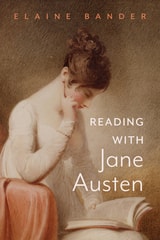
Reading with Jane Austen
Elaine Bander
Bucknell University Press, 2026
Jane Austen has more readers today than at any time in history. Many of Austen’s legions of fans, however, came to her novels after first seeing films or other adaptations made for twenty-first-century audiences. Austen herself conversely spent her literary career undermining romantic clichés and rethinking novel conventions. Confident that she and her contemporaries shared a common reading culture, Austen deliberately constructed her novels to set readerly expectations, only to disrupt or confound those expectations by challenging her readers’ assumptions and values. In Reading with Jane Austen, Elaine Bander carefully rereads the great author’s novels—beginning with her late work of juvenilia, “Catharine, or The Bower,” and ending with her final fragment, “Sanditon”—against the rich context of late Georgian literary and intellectual culture. In doing so, Bander invites us into the transformative experience that Austen intentionally designed for her earliest readers, adding new layers of appreciation for those who love her work.
Published by Bucknell University Press. Distributed worldwide by Rutgers University Press.
Elaine Bander speaking at the Atwater Library in Quebec (https://youtu.be/UeEjFOfp9cQ?si=Wv2hsLxkGK157WZI)
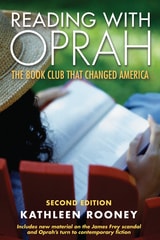
Reading with Oprah
The Book Club that Changed AmericaKathleen Rooney
University of Arkansas Press, 2008
Adored by its fans, deplored by its critics, Oprah’s Book Club has been at the center of arguments about cultural authority and literary taste since it began in 1996. Reading with Oprah explores the club’s revolutionary fusion of books, television, and commerce and tells the engaging and in-depth story of the OBC phenomenon.
Kathleen Rooney combines extensive research with a dynamic voice to reveal the club’s far-reaching cultural impact and its role as crucible for the clash between “high” and “low” literary taste. Comprehensive and up-to-date, the book covers the club from its inception in 1996, through the Jonathan Franzen contretemps, the surprising suspension in 2002, and, after the club’s return in 2003, the progression from “great books” to memoir. New material includes an extensive look at the James Frey scandal and Oprah’s turn to contemporary fiction, including The Road and Middlesex.
Through close examination of Winfrey’s picks and personal interviews with book club authors and readers, Rooney demonstrates how the club that Barbara Kingsolver calls “one of the best possible uses of a television set” has, according to Wally Lamb, “gotten people of all ages to read, to read more, and to read widely.”
First edition published in 2005.
Reading with the Transcendentalists
Ten Works that Made a MovementPhilip F. Gura
University of Massachusetts Press, 2026
Exploring the books and reading practices behind the creation of Transcendentalist philosophy and community
Transcendentalism emerged in early 19th century New England as a uniquely American philosophical, spiritual, and literary movement. Its first generation of thinkers—including Ralph Waldo Emerson, Theodore Parker, and Margaret Fuller—created a worldview that stressed the inherent goodness of the “self-reliant” individual and the presence of the divine in nature. These intellectuals gathered in informal symposia devoted to what Emerson called “creative reading,” a practice that stresses the transformative potential of the written word that was central to the movement’s emergence, growth, and spread. But what were these thinkers reading and how did it influence the development of Transcendentalism?
In Reading with the Transcendentalists, renowned literary scholar Philip F. Gura focuses on 10 American, British, and European books that were essential to the movement’s thoughts, writings, and activities. Many of the authors of these books—James Marsh, Madame de Staël, Samson Reed, George Ripley, Thomas Carlyle, Albert Brisbane, and George Sand—stood outside of Transcendentalism yet profoundly influenced it. Others such as Emerson, Parker, and Fuller were the movement’s central architects, whose writings in turn inspired the next generation, including Henry David Thoreau and Caroline Healey Dall. Each of these books challenged prevailing religious, philosophical, and social conventions in ways that resonated deeply with burgeoning Transcendentalist ideals.
Blending intellectual biography with book history, Gura crafts a captivating cultural history that reconstructs the dynamic social networks of the early Transcendentalists, in which ideas from the written word circulated, evolved, and acquired new meanings. The result is an rich portrait of reading as a creative and communal act, and an exploration of how books ignite curiosity, sustain friendship, and catalyze intellectual transformation. Through a carefully developed narrative structure that is filled not only with books and reading but with headline-worthy scandals, disputes, and falling outs and realignments, Gura traces the historical arc of a transnational intellectual movement that helped lay the foundation for the idea of “America.”
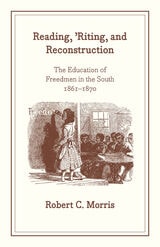
Reading, 'Riting, and Reconstruction
The Education of Freedmen in the South, 1861-1870Robert C. Morris
University of Chicago Press, 1981
This study of education for freedmen following Emancipation is the definitive treatment of the subject. Employing a wide range of sources, Robert C. Morris examines the organizations that staffed and managed black schools in the South, with particular attention paid to the activities of the Freedman’s Bureau. He looks as well at those who came to teach, a diverse group—white, black, Northern, Southern—and at the curricula and textbooks they used. While giving special emphasis to the Freedmen’s Bureau school program, Morris places the freedmen’s educational movement fully in its nineteenth-century context, relating it both to the antislavery crusade that preceded it and to the conservative era of race relations that followed.

Reading, Gender and Identity in Seventeenth-Century England
Hannah Jeans
University of London Press, 2025
This ambitious and interdisciplinary book redraws the history of early modern Englishwomen’s reading, exploring the connections between gender, reading habits, and genre throughout the seventeenth century. Reading, Gender and Identity in Seventeenth-Century England challenges accepted historiographical narratives about reading that have privileged male experience and the impact of the Civil War; the book highlights the multiplicity and complexity of women’s reading practices, focusing on how women used reading in constructing their gender identity. Reading was a gendered act in the early modern period; across genres, women were depicted negotiating a range of gendered behavioral norms. From religious texts, romances, and cookbooks, to news, household records, and scientific and medical treatises, Jeans draws on archival sources across a wide range of writing types to offer a more complete picture of women’s reading experiences, ultimately questioning the accepted notion of the woman reader itself.