Results by title
50 books match the query 'Realism' and 11 start with r
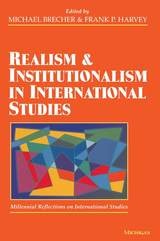
Realism and Institutionalism in International Studies
Michael Brecher and Frank P. Harvey, editors
University of Michigan Press, 2009
Realism and Institutionalism in International Studies represents a unique collection of original essays by foremost scholars in the field of International Studies. Six essays advocate, critique, or revise Realism, the theoretical paradigm that explains international politics by emphasizing security competition and war among states. The remaining four essays address Institutionalism, the paradigm that offers explanations for the formation, maintenance, variation, and significance of international institutions.
The authors reflect on the strengths and weaknesses of these approaches and suggest research agendas for the future. Together, this volume provides an accessible and wide-ranging survey of the issues concerning two major paradigms in International Studies. This volume will be of interest to scholars and students alike and will undoubtedly determine the shape of future research.

Realism and Naturalism in Nineteenth-Century American Literature, Revised Edition
Donald Pizer
Southern Illinois University Press, 1984
The 1966 edition of this book has become a standard work. In this new, revised edition, Pizer has dropped three chapters and has refined and extended the work by adding six: “American Literary Naturalism: An Approach Through Form,” “American Literary Naturalism: The Example of Dreiser,” “The Problem of Philosophy in the Naturalistic Novel,” “Hamlin Garland’s 1891 Main-Travelled Roads: Local Color as Art,” “Jack London: The Problem of Form,” and “Dreiser’s ‘Nigger Jeff’: The Development of an Aesthetic.”
The book contains definitions of realism and naturalism based on representative novels of the period ranging from Howells’ Rise of Silas Lapham to Crane’s Red Badge of Courage; analyses of the literary criticism of the age, stressing that of Howells, Garland, and Norris; and close readings of specific works by major figures of the period.
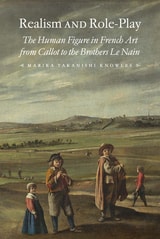
Realism and Role-Play
The Human Figure in French Art from Callot to the Brothers Le NainMarika Takanishi Knowles
University of Delaware Press, 2011
Published by University of Delaware Press. Distributed worldwide by Rutgers University Press.
Realism and the American Dramatic Tradition
William W. Demastes
University of Alabama Press, 1996
This book reconsiders realism on the American stage by addressing the great variety and richness of the plays that form the American theatre canon.
Any review of 20th-century American theatre invariably leads to the term realism. Yet despite the strong tradition of theatrical realism on the American stage, the term is frequently misidentified, and the practices to which it refers are often attacked as monolithically tyrannical, restricting the potential of the American national theatre.This book reconsiders realism on the American stage by addressing the great variety and richness of the plays that form the American theatre canon. By reconsidering the form and revisiting many of the plays that contributed to the realist tradition, the authors provide the opportunity to apprise strengths often overlooked by previous critics. The volume traces the development of American dramatic realism from James A. Herne, the "American Ibsen," to currently active contemporaries such as Sam Shepard, David Mamet, and Marsha Norman. This frank assessment, in sixteen original essays, reopens a critical dialog too long closed.
Essays include:
American Dramatic Realisms, Viable Frames of Thought
The Struggle for the Real--Interpretive Conflict, Dramatic Method, and the Paradox of Realism
The Legacy of James A. Herne: American Realities and Realisms
Whose Realism? Rachel Crothers's Power Struggle in the American Theatre
The Provincetown Players' Experiments with Realism
Servant of Three Masters: Realism, Idealism, and "Hokum" in American High Comedy
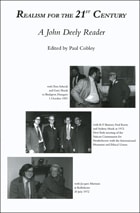
Realism for the 21st Century
A John Deely ReaderJohn Deely
University of Scranton Press, 2009
Realism for the 21st Century is a collection of thirty essays from John Deely—a major figure in contemporary semiotics and an authority on scholastic realism and the works of Charles Sanders Peirce. The volume tracks Deely’s development as a pragmatic realist, featuring his early essays on our relation to the world after Darwinism; crucial articles on logic, semiotics, and objectivity; overviews of philosophy after modernity; and a new essay on “purely objective reality.”
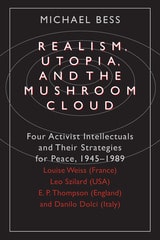
Realism, Utopia, and the Mushroom Cloud
Four Activist Intellectuals and their Strategies for Peace, 1945-1989--Louise Weiss (France), Leo Szilard (USA), E. P. Thompson (England), Danilo Dolci (Italy)Michael Bess
University of Chicago Press, 1993
Nagasaki, and continued preparations for nuclear war illustrate the modern
world's propensity for mass destruction. . . . Yet there have been
important signs of resistance to this trend. These have included not only
the emergence of mass-based peace and disarmament movements but activist
intellectuals grappling with the growing problem posed by mass violence
among nation-states. . . . Bess examines the lives and ideas of four of
these intellectuals: Leo Szilard of Hungary and (later) the United States,
E. P. Thompson of England, Danilo Dolci of Italy, and Louise Weiss of
France. . . . Realism, Utopia, and the Mushroom Cloud is a powerful,
important scholarly work, casting new light upon some of the great issues
of modern times. Readers will learn much from it."—Lawrence S.
Wittner, Peace and Change
"Bess seeks to understand the way in which the creation of the atomic bomb
has changed the social and political situation of humankind. Are we to be
held hostage by military forces or can we transform our situation? He
describes the lives of four very different activists, each with different
views on what causes conflict and how best to address conflict. . . .
Overall, this book offers an interesting perspective on life after the
atomic bomb. . . . In asking ourselves what the possibilities of our future
are, we can turn to these lives for some guidance. . . . This book is
informative, provocative, and encourages one to consider carefully how s/he
chooses to live."—Erin McKenna, Utopian Studies
"These four lives, researched and skillfully presented by historian Michael
Bess, make fascinating stories in themselves. They also serve as useful
vehicles for examining major cross-currents of Cold War resistance. . . .
From Weiss the cynical pragmatist to Szilard the high-level fixer to
hompson the social reformer to Dolce the spiritual street organizer,
Michael Bess has woven an illuminating tapestry of human efforts to cope
with life under the mushroom cloud."—Samuel H. Day Jr., The
Progressive
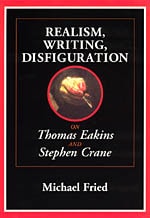
Realism, Writing, Disfiguration
On Thomas Eakins and Stephen CraneMichael Fried
University of Chicago Press, 1987
"An extraordinary achievement of scholarship and critical analysis. It is a book distinguished not only for its brilliance but for its courage, its grace and wit, its readiness to test its arguments in tough-minded ways, and its capacity to meet the challenge superbly. . . . This is a landmark in American cultural and intellectual studies."—Sacvan Bercovitch, Harvard University
Reconstructing Realpolitik
Frank W. Wayman and Paul F. Diehl, Editors
University of Michigan Press, 1994
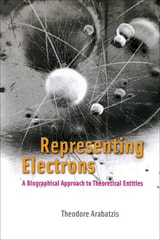
Representing Electrons
A Biographical Approach to Theoretical EntitiesTheodore Arabatzis
University of Chicago Press, 2005
Using the electron—or rather its representation—as a historical actor, Theodore Arabatzis illustrates the emergence and gradual consolidation of its representation in physics, its career throughout old quantum theory, and its appropriation and reinterpretation by chemists. As Arabatzis develops this novel biographical approach, he portrays scientific representations as partly autonomous agents with lives of their own. Furthermore, he argues that the considerable variance in the representation of the electron does not undermine its stable identity or existence.
Raising philosophical issues of contentious debate in the history and philosophy of science—namely, scientific realism and meaning change—Arabatzis addresses the history of the electron across disciplines, integrating historical narrative with philosophical analysis in a book that will be a touchstone for historians and philosophers of science and scientists alike.
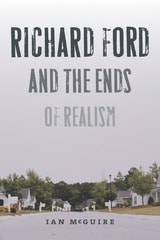
Richard Ford and the Ends of Realism
Ian McGuire
University of Iowa Press, 2015
McGuire also uses this idea of pragmatic realism to mount a larger defense of contemporary realist writing and uses Ford’s example to argue that realism itself remains a useful and necessary critical category. Contemporary realism, rather than being merely conventional or reactionary, as some of its critics have called it, can offer its proponents an aesthetically and philosophically sophisticated way of engaging with and contesting the particularities of contemporary, even postmodern, experience.
In offering this new reading of Richard Ford’s fiction, as well as a fresh understanding of the realist impulse in contemporary American fiction, both become richer, more resonant, and more immediate—reaching both backward into the past and forward to involve themselves in important contemporary debates about history, postmodernity, and moral relativism.
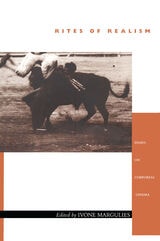
Rites of Realism
Essays on Corporeal CinemaIvone Margulies, ed.
Duke University Press, 2003
By providing close readings of classic and contemporary works, Rites of Realism signals the need to return to a focus on films as the main innovators of realist representation. The collection is inspired by André Bazin's theories on film's inherent heterogeneity and unique ability to register contingency (the singular, one-time event). This volume features two new translations: of Bazin's seminal essay "Death Every Afternoon" and Serge Daney's essay reinterpreting Bazin's defense of the long shot as a way to set the stage for a clash or risky confrontation between man and animal. These pieces evince key concerns—particularly the link between cinematic realism and contingency—that the other essays explore further.
Among the topics addressed are the provocative mimesis of Luis Buñuel's Land Without Bread; the adaptation of trial documents in Carl Dreyer's Passion of Joan of Arc; the use of the tableaux vivant by Wim Wenders and Peter Greenaway; and Pier Paolo Pasolini's strategies of analogy in his transposition of The Gospel According to St. Matthew from Palestine to southern Italy. Essays consider the work of filmmakers including Michelangelo Antonioni, Maya Deren, Mike Leigh, Cesare Zavattini, Zhang Yuan, and Abbas Kiarostami.
Contributors: Paul Arthur, André Bazin, Mark A. Cohen, Serge Daney, Mary Ann Doane, James F. Lastra, Ivone Margulies, Abé Mark Normes, Brigitte Peucker, Richard Porton, Philip Rosen, Catherine Russell, James Schamus, Noa Steimatsky, Xiaobing Tang