70 books match the query 'Reason' and 12 start with r
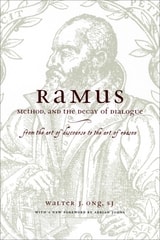
cover of Ramus, Method, and the Decay of Dialogue: From the Art of Discourse to the Art of Reason

Ramus, Method, and the Decay of Dialogue

From the Art of Discourse to the Art of Reason

Walter J. Ong, S.J.

University of Chicago Press, 2004

Renaissance logician, philosopher, humanist, and teacher, Peter Ramus (1515-72) is best known for his attack on Aristotelian logic, his radical pedagogical theories, and his new interpretation for the canon of rhetoric. His work, published in Latin and translated into many languages, has influenced the study of Renaissance literature, rhetoric, education, logic, and—more recently—media studies.

Considered the most important work of Walter Ong's career, Ramus, Method, and the Decay of Dialogue is an elegant review of the history of Ramist scholarship and Ramus's quarrels with Aristotle. A key influence on Marshall McLuhan, with whom Ong enjoys the status of honorary guru among technophiles, this challenging study remains the most detailed account of Ramus's method ever published. Out of print for more than a decade, this book—with a new foreword by Adrian Johns—is a canonical text for enthusiasts of media, Renaissance literature, and intellectual history.
[more]
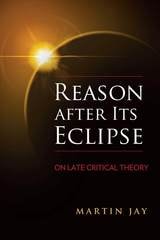
cover of Reason after Its Eclipse: On Late Critical Theory

Reason after Its Eclipse

On Late Critical Theory

Martin Jay

University of Wisconsin Press, 2017

Martin Jay tackles a question as old as Plato and still pressing today: what is reason, and what roles does and should it have in human endeavor? Applying the tools of intellectual history, he examines the overlapping, but not fully compatible, meanings that have accrued to the term "reason" over two millennia, homing in on moments of crisis, critique, and defense of reason.

After surveying Western ideas of reason from the ancient Greeks through Kant, Hegel, and Marx, Jay engages at length with the ways leading theorists of the Frankfurt School—Horkheimer, Marcuse, Adorno, and most extensively Habermas—sought to salvage a viable concept of reason after its apparent eclipse. They despaired, in particular, over the decay in the modern world of reason into mere instrumental rationality. When reason becomes a technical tool of calculation separated from the values and norms central to daily life, then choices become grounded not in careful thought but in emotion and will—a mode of thinking embraced by fascist movements in the twentieth century.

Is there a more robust idea of reason that can be defended as at once a philosophical concept, a ground of critique, and a norm for human emancipation? Jay explores at length the ommunicative rationality advocated by Habermas and considers the range of arguments, both pro and con, that have greeted his work.
[more]
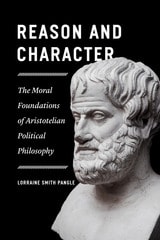
cover of Reason and Character: The Moral Foundations of Aristotelian Political Philosophy

Reason and Character

The Moral Foundations of Aristotelian Political Philosophy

Lorraine Smith Pangle

University of Chicago Press, 2020

A close and selective commentary on Aristotle’s Nicomachean Ethics, offering a novel interpretation of Aristotle’s teachings on the relation between reason and moral virtue.

What does it mean to live a good life or a happy life, and what part does reason play in the quest for fulfillment? Lorraine Smith Pangle shows how Aristotle’s arguments for virtue as the core of happiness and for reason as the guide to virtue emerge in response to Socrates’s paradoxical claim that virtue is knowledge and vice is ignorance.

Against Socrates, Aristotle does justice to the effectual truth of moral responsibility—that our characters do indeed depend on our own voluntary actions. But he also incorporates Socratic insights into the close interconnection of passion and judgment and the way passions and bad habits work not to overcome knowledge that remains intact but to corrupt the knowledge one thinks one has. Reason and Character presents fresh interpretations of Aristotle’s teaching on the character of moral judgment and moral choice, on the way reason finds the mean—especially in justice—and on the relation between practical and theoretical wisdom.
[more]
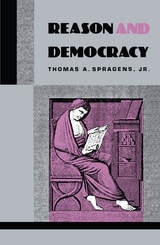
cover of Reason and Democracy

Reason and Democracy

Thomas A. Spragens Jr.

Duke University Press, 1990

Reason and Democracy breaks new ground in providing a plausible philosophical basis for the communitarian view of a healthy democracy as the rational pursuit of common purposes by free and equal citizens. Thomas A. Spragens Jr. argues that the most persistent paradigms of Western political rationality originated in classical philosophy, took their modern expression in the philosophies of Kant and Mill, and terminated in Max Weber’s pairing of purely technical rationality with arbitrary ends.
Drawing on recent work in the philosophy of science and the philosophy of language, combined with appropriate analogies in political thought and action, Spragens maintains that it is possible to discern the outlines of a philosophically cogent and morally beneficial concept of rational practice on the part of a political community. This possibility, he contends, provides a philosophical basis for liberal democratic politics that is superior to utilitarian and deontological accounts.
[more]
cover of Reason and Evidence in Husserl's Phenomenology

Reason and Evidence in Husserl's Phenomenology

David Michael Kleinberg-Levin

Northwestern University Press, 1970
In Reason and Evidence in Husserl's Phenomenology David Michael Kleinberg-Levin examines Husserl’s concept of necessary, a priori, and absolutely certain indubitable evidence, which he terms apodictic, and his related concept of complete evidence, which he terms adequate. To do so it explicates some of the more general relevant features of phenomenology as a whole.

 
[more]
cover of Reason and Morality

Reason and Morality

Alan Gewirth

University of Chicago Press, 1982

"Most modern philosophers attempt to solve the problem of morality from within the epistemological assumptions that define the dominant cultural perspective of our age. Alan Gewirth's Reason and Morality is a major work in this ongoing enterprise. Gewirth develops, with patience and skill, what he calls a 'modified naturalism' in which morality is derived by logic alone from the concept of action. . . . I think that the publication of Reason and Morality is a major event in the history of moral philosophy. It develops with great power a new and exciting position in ethical naturalism. No one, regardless of philosophical stance, can read this work without an enlargement of mind. It illuminates morality and agency for all."—E. M. Adams, The Review of Metaphysics

"This is a fascinating study of an apparently intractable problem. Gewirth has provided plenty of material for further discussion, and his theory deserves serious consideration. He is always aware of possible rejoinders and argues in a rigorous manner, showing a firm grasp of the current state of moral and political philosophy."—Mind
[more]
cover of Reason and Wonder: Why Science and Faith Need Each Other

Reason and Wonder

Why Science and Faith Need Each Other

Eric Priest

Templeton Press, 2016

Often science and religion are seen as completely separate enti­ties. Science exists in the realm of fact, whereas religion exists in the realm of faith. Conversations about genes, psychology, or even the meaning of life occur in silos. But as Eric Priest, Keith Ward, David Myers, N. T. Wright, and others show, these conversations are so much richer when both science and faith are incorporated.
This is exactly what Reason and Wonder does. Eric Priest has brought together twelve of the leading thinkers in science and theology to discuss everything from the origins of the universe to evolution and evil. At the heart of each essay is an understanding that the best science—and the best theology— are both undergirded by an appeal to reason as well as a deep sense of wonder.
Each of these great scientific and theological thinkers offers a chapter on their area of expertise, and the book closes with a stimulating set of questions for group discussion or personal reflection.
  • Contributors and their topics include:
  • Eric Priest: Towards an integration of science and religion
  • Keith Ward: God, science and the New Atheism
  • Eleonore Stump: Natural law, reductionism and the Creator
  • David Wilkinson: The origin and end of the universe: A challenge for Christianity
  • Jennifer Wiseman: Universe of wonder, universe of life
  • Kenneth R. Miller: Evolution, faith and science
  • Michael J. Murray and Jeff Schloss: Evolution and evil
  • Pauline Rudd: Is there more to life than genes?
  • David G. Myers: Psychological science meets Christian faith
  • John Wyatt: Being a person: Towards an integration of neuroscientific and Christian perspectives
  • John Swinton: From projection to connection: Conversa­tions between science, spirituality and health
  • Mark Harris: Do the miracles of Jesus contradict science?
  • N. T. Wright: Can a scientist trust the New Testament? 
[more]
cover of Reason in Law, Tenth Edition

Reason in Law, Tenth Edition

Lief H. Carter, Thomas F. Burke and Jessica Silbey

University of Chicago Press, 2026

An indispensable introduction to legal reasoning, updated for today’s political and legal environment.

Since it was first published nearly five decades ago, Reason in Law has become the starting point for understanding legal reasoning, a critical component of the rule of law. The editors show how judges can integrate all the elements of a case to persuasively explain their rulings—and, even more importantly, why they sometimes fail to do so. Drawing on cases old and new, Reason in Law enables readers to become sophisticated “judges of judging.”

Now in its tenth edition, Reason in Law includes a new chapter on the increasingly contentious and politically consequential field of administrative law and addresses recent developments in the American legal landscape, including growing conservatism in the federal judiciary and the flood of lawsuits brought against the second Trump administration. It also analyzes new cases on the First Amendment rights of high schoolers, transgender civil rights, the responsibilities universities have for student safety, Donald Trump’s sweeping claims of executive power, and historic Supreme Court decisions expanding the rights of gun owners and allowing states to criminalize abortion. As always, Reason in Law connects legal theory with empirical research on the American judicial system, showing how trustworthy legal reasoning helps preserve social peace and the rule of law.
[more]
cover of Reason in Law: Eighth Edition

Reason in Law

Eighth Edition

Lief H. Carter and Thomas F. Burke

University of Chicago Press, 2009
Over the years, Reason in Law has established itself as the leading textbook for courses in legal reasoning, a critical aspect of the rule of law. This eighth edition brings the book’s analyses and examples fully up to date, adding new cases while retaining old ones whose lessons remain potent. It takes full account of the dramatic changes--and challenges--to legal reasoning that emerged from the Bush administration’s attempts to fight terrorism and also explores recent conflicts over same-sex marriage, gun control, hate crimes, and climate change.  The result is an indispensable introduction to an issue that lies at the heart of the workings of the law.
[more]
cover of Reason in Law: Ninth Edition

Reason in Law

Ninth Edition

Lief H. Carter and Thomas F. Burke

University of Chicago Press, 2016
Over the nearly four decades it has been in print, Reason in Law has established itself as the place to start for understanding legal reasoning, a critical component of the rule of law. This ninth edition brings the book’s analyses and examples up to date, adding new cases while retaining old ones whose lessons remain potent. It examines several recent controversial Supreme Court decisions, including rulings on the constitutionality and proper interpretation of the Affordable Care Act and Justice Scalia’s powerful dissent in Maryland v. King. Also new to this edition are cases on same-sex marriage, the Voting Rights Act, and the legalization of marijuana. A new appendix explains the historical evolution of legal reasoning and the rule of law in civic life. The result is an indispensable introduction to the workings of the law. 
[more]
cover of Reason, Revelation, and Metaphysics

Reason, Revelation, and Metaphysics

Montague Brown

Catholic University of America Press, 2021
Any realist metaphysics must include an integrated account of the transcendentals and the analogy of being, for an adequate metaphysics must be about everything, and all things share in some key metaphysical characteristic—being, unity, truth, goodness, and beauty. However, they do not share in them in exactly the same way. Therefore, there is need to explain the transcendental characteristics in an analogical way. By using the phrase “transcendental analogies,” Reason, Revelation and Metaphysics claims that there are analogies of unity, truth, goodness, and beauty, which are related to, but irreducible to, the analogy of being. As this book is a systematic study of the topic, theoretical reason has primacy in the project and metaphysics is given pride of place. But reason is practical and aesthetic as well; that is, our consciences urge us to seek what is good, and we are delighted by what is beautiful. Although goodness and beauty are not reducible to truth, they must be included in any adequate metaphysical account, for metaphysics looks to explain everything. Although metaphysics is traditionally thought to be a philosophical project involving ontology and natural theology, Montague Brown argues that an adequate metaphysics must ultimately be theological, including within its scope the truths of revelation. Philosophical reason’s examination of the transcendental analogies raises questions that it cannot answer. We experience a world of many beings, truths, goods, and beauties. Recognizing that these many instances have something in common, we affirm a transcendent instance of each (traditionally called God). However, although we know that a transcendent instance exists, we do not know its nature: therefore, we cannot say how it is related to the other instances. If we try to apply this transcendent instance as the prime analogate to shed light on the other analogates, we must fail, for the abstractness and universality of the transcendent instance can add nothing to our understanding of the particular instances. Wanting to know how the many exist and are related, philosophical reason finds no way forward and recognizes its need for help. It is the thesis of this book that reason finds this help only in the revelation of the God’s covenantal relation with the world. The first principle of all things—most perfectly revealed in Jesus Christ, perfect God and perfect man—is really and freely related to us. Only by accepting this revealed prime analogate can the transcendental analogies bear fruit in our ongoing quest for understanding.
[more]
cover of Rhyme and Reason in Reading and Spelling

Rhyme and Reason in Reading and Spelling

Lynette Bradley

University of Michigan Press, 1985

Nursery rhymes have been told to children for centuries. Many people think that they are just meant to make children smile. However, preschool children's awareness of rhyme and alliteration has an important influence on their success in learning to read and to spell. In Rhyme and Reason in Reading and Spelling, the authors explore this causal hypothesis using a new research design of combining longitudinal methods with intervention, and they provide strong evidence to show that there is a positive relationship between recognizing similar sounds, as found in nursery rhymes, and learning to read and to spell. The authors also investigate the relationship of this skill to children's learning difficulties. This is the first volume in the International Academy for Research in Learning Disabilities Monograph series.
[more]