Results by title
88 books match the query 'Religion and politics' and 13 start with r
Rage and Carnage in the Name of God
Religious Violence in NigeriaAbiodun Alao
Duke University Press, 2022
Reed Smoot Hearings
The Investigation of a Mormon Senator and the Transformation of an American ReligionMichael Harold Paulos
Utah State University Press, 2022
The work adds new insights into the role religion and the secular played in the shaping of US political institutions and national policies. Chapters also look at the history of anti-polygamy laws, the persistence of post-1890 plural marriage, the continuation of anti-Mormon sentiment, the intimacies and challenges of religious privatization, the dynamic of federal power on religious reform, and the more intimate role individuals played in effecting these institutional and national developments.
The Smoot hearings stand as an important case study that highlights the paradoxical history of religious liberty in America and the principles of exclusion and coercion that history is predicated on. Framed within a liberal Protestant sensibility, these principles of secular progress mapped out the relationship of religion and the nation-state for the new modern century. The Reed Smoot Hearings will be of significant interest to students and scholars of Mormon, western, American, and religious history.
Publication supported, in part, by Gonzaba Medical Group.
Contributors: Gary James Bergera, John Brumbaugh, Kenneth L. Cannon II, Byron W. Daynes, Kathryn M. Daynes, Kathryn Smoot Egan, D. Michael Quinn
Refuge in the Lord
Lawrence J. McAndrews
Catholic University of America Press, 2015
Religion and Political Tolerance in America
Advances in the State of the ArtPaul Djupe
Temple University Press, 2015
The essays in Religion and Political Tolerance in America seek to understand how these elements interrelate. The editor and contributors to this important volume present new and innovative research that wrestles with the fundamental question of the place of religion in democratic society. They address topics ranging from religious contributions to social identity to the political tolerance that religious elites (clergy) hold and advocate to others, and how religion shapes responses to intolerance.
The conclusion, by Ted Jelen, emphasizes that religion’s take on political tolerance is nuanced and that they are not incompatible; religion can sometimes enhance the tolerance of ordinary citizens.

Religion and Politics in East Africa
The Period since IndependenceHölger Bernt Hansen
Ohio University Press, 1994
Religious activities have been of continuing importance in the rise of protest against postcolonial governments in Eastern Africa. Governments have attempted to “manage“ religious affairs in both Muslim and Christian areas. Religious denominations have acted as advocates of human rights and in opposition to one-party-state regimes. Islamic fundamentalism changed with the ending of the Cold War.
The book is divided into four parts: The Challenge of Islam; Christianity, Sectarianism, and Politics in Uganda; Christians and Muslim in Kenyan Politics; and Cross-cultural Complications. An introductory essay by Michael Twaddle provides and overview of the changing character of politico-religious conflict in Eastern Africa. Holger Bernt Hansen summarizes the presentation with a discussion of dilemmas and challenges in the study of religion and politics.
Religion and the Cold War
A Global PerspectivePhilip E. Muehlenbeck
Vanderbilt University Press, 2012
Students and scholars will find in this volume a level of comprehensiveness rarely achieved in Cold War studies. Each chapter reveals that the power and influence of ideas are just as important as military might in the struggles between superpowersand that few ideas, then as now, carry as much force as religious ideology. As Muehlenbeck and his contributors demonstrate, no area of the world, and no religious tenet, was safe from the manipulations of a powerful set of players focused solely on their own sphere of influence.
Religion, Empire, and Torture
The Case of Achaemenian Persia, with a Postscript on Abu GhraibBruce Lincoln
University of Chicago Press, 2007
Lincoln identifies three core components of an imperial theology that have transhistorical and contemporary relevance: dualistic ethics, a theory of divine election, and a sense of salvific mission. Beyond this, he asks, how did the Achaemenians understand their place in the cosmos and their moral status in relation to others? Why did they feel called to intervene in the struggle between good and evil? What was their sense of historic purpose, especially their desire to restore paradise lost? And how did this lead them to deal with enemies and critics as imperial power ran its course? Lincoln shows how these religious ideas shaped Achaemenian practice and brought the Persians unprecedented wealth, power, and territory, but also produced unmanageable contradictions, as in a gruesome case of torture discussed in the book’s final chapter. Close study of that episode leads Lincoln back to the present with a postscript that provides a searing and utterly novel perspective on the photographs from Abu Ghraib.
Religion, Secularism, and Political Belonging
Leerom Medovoi and Elizabeth Bentley, editors
Duke University Press, 2021
Contributors. Markus Balkenhol, Elizabeth Bentley, Kambiz GhaneaBassiri, David N. Gibbs, Ori Goldberg, Marcia Klotz, Zeynep Kurtulus Korkman, Leerom Medovoi, Eva Midden, Mohanad Mustafa, Mu-chou Poo, Shaul Setter, John Vignaux Smith, Pooyan Tamimi Arab, Ernst van den Hemel, Albert Welter, Francis Ching-Wah Yip, Raef Zreik

Religious Imaginations
How Narratives of Faith are Shaping Today’s WorldEdited by James Walters
Gingko, 2018
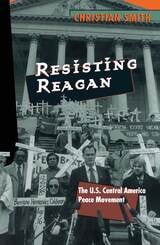
Resisting Reagan
The U.S. Central America Peace MovementChristian Smith
University of Chicago Press, 1996
Focusing on the movement's three most important national campaigns—Witness for Peace, Sanctuary, and the Pledge of Resistance—this book demonstrates the centrality of morality as a political motivator, highlights the importance of political opportunities in movement outcomes, and examines the social structuring of insurgent consciousness. Based on extensive surveys, interviews, and research, Resisting Reagan makes significant contributions to our understanding of the formation of individual activist identities, of national movement dynamics, and of religious resources for political activism.
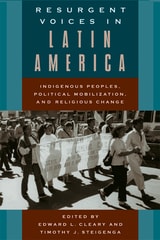
Resurgent Voices in Latin America
Indigenous Peoples, Political Mobilization, and Religious ChangeCleary, Edward L.
Rutgers University Press, 2004
After more than 500 years of marginalization, Latin America’s forty million Indians have recently made major strides in gaining political recognition and civil rights. In this book, social scientists explore the important role of religion in indigenous activism, showing the ways that religion has strengthened indigenous identity and contributed to the struggle for indigenous rights in the region.
Drawing on case studies from Bolivia, Peru, Guatemala, Ecuador, Paraguay, and Mexico, the contributors explore four key questions. How have traditional religions interacted with Christianity to produce new practices and beliefs? What resources, motivations, and ideological legitimacies do religious institutions provide for indigenous social movements? How effective are these movements in achieving their goals? Finally, as new religious groups continue to compete for adherents in the region, how will individuals’ religious choices affect political outcomes?
Resurgent Voices in Latin America offers new insight into the dynamics of indigenous social movements and into the complex and changing world of Latin American religions. The essays show that religious beliefs, practices, and institutions have both affected and been affected by political activism.
Revival and Reconciliation
The Anglican Church and the Politics of RwandaPhillip A. Cantrell II
University of Wisconsin Press, 2022
Drawing from new archival materials as well as on-the-ground field research, Revival and Reconciliation is a Rwanda-centered account of the country's ecclesiastical and national historiography. Cantrell calls attention to the harms the postgenocide church risks doing should it continue to support false narratives about Rwanda's colonial and postcolonial past—with dangerous consequences for the future.
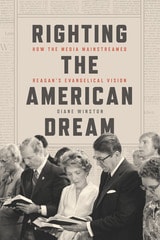
Righting the American Dream
How the Media Mainstreamed Reagan's Evangelical VisionDiane Winston
University of Chicago Press, 2023
After two years in the White House, an aging and increasingly unpopular Ronald Reagan looked like a one-term president, but in 1983 something changed. Reagan spoke of his embattled agenda as a spiritual rather than a political project and cast his vision for limited government and market economics as the natural outworking of religious conviction. The news media broadcast this message with enthusiasm, and white evangelicals rallied to the president’s cause. With their support, Reagan won reelection and continued to dismantle the welfare state, unraveling a political consensus that stood for half a century.
In Righting the American Dream, Diane Winston reveals how support for Reagan emerged from a new religious vision of American identity circulating in the popular press. Through four key events—the “evil empire” speech, AIDS outbreak, invasion of Grenada, and rise in American poverty rates—Winston shows that many journalists uncritically adopted Reagan’s religious rhetoric and ultimately mainstreamed otherwise unpopular evangelical ideas about individual responsibility. The result is a provocative new account of how Reagan together with the press turned America to the right and initiated a social revolution that continues today.