58 books match the query 'Representative government and representation' and 6 start with r
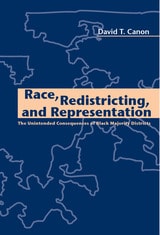
cover of Race, Redistricting, and Representation: The Unintended Consequences of Black Majority Districts

Race, Redistricting, and Representation

The Unintended Consequences of Black Majority Districts

David T. Canon

University of Chicago Press, 1999

Since the creation of minority-dominated congressional districts eight years ago, the Supreme Court has condemned the move as akin to "political apartheid," while many African-American leaders argue that such districts are required for authentic representation.

In the most comprehensive treatment of the subject to date, David Canon shows that the unintended consequences of black majority districts actually contradict the common wisdom that whites will not be adequately represented in these areas. Not only do black candidates need white votes to win, but this crucial "swing" vote often decides the race. And, once elected, even the black members who appeal primarily to black voters usually do a better job than white members of walking the racial tightrope, balancing the needs of their diverse constituents.

Ultimately, Canon contends, minority districting is good for the country as a whole. These districts not only give African Americans a greater voice in the political process, they promote a politics of commonality—a biracial politics—rather than a politics of difference.
[more]
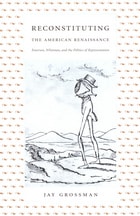
cover of Reconstituting the American Renaissance: Emerson, Whitman, and the Politics of Representation

Reconstituting the American Renaissance

Emerson, Whitman, and the Politics of Representation

Jay Grossman

Duke University Press, 2003

Challenging the standard periodization of American literary history, Reconstituting the American Renaissance reinterprets the works of Ralph Waldo Emerson and Walt Whitman and the relationship of these two authors to each other. Jay Grossman argues that issues of political representation—involving vexed questions of who shall speak and for whom—lie at the heart of American political and literary discourse from the revolutionary era through the Civil War. By taking the mid-nineteenth-century period, traditionally understood as marking the advent of literary writing in the United States, and restoring to it the ways in which Emerson and Whitman engaged with eighteenth-century controversies, rhetorics, and languages about political representation, Grossman departs significantly from arguments that have traditionally separated American writing in the eighteenth and nineteenth centuries.

Reconstituting the American Renaissance describes how Emerson and Whitman came into the period of their greatest productivity with different conceptions of the functions and political efficacy of the word in the world. It challenges Emerson’s position as Whitman’s necessary precursor and offers a cultural history that emphasizes the two writers’ differences in social class, cultural experience, and political perspective. In their writings between 1830 and 1855, the book finds contrasting conceptions of the relations between the “representative man” and the constituencies to whom, and for whom, he speaks. Reconstituting the American Renaissance opens up the canonical relationship between Emerson and Whitman and multiplies the historical and discursive contexts for understanding their published and unpublished works.
[more]
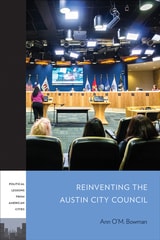
cover of Reinventing the Austin City Council

Reinventing the Austin City Council

Ann O'M. Bowman

Temple University Press, 2020

Until recently, Austin, the progressive, politically liberal capital of Texas, elected its city council using a not-so-progressive system. Candidates competed citywide for seats, and voters could cast ballots for as many candidates as there were seats up for election. However, this approach disadvantages the representation of geographically-concentrated minority groups, thereby—among other things—preventing the benefits of growth from reaching all of the city’s communities. 

Reinventing the Austin City Council explores the puzzle that was Austin’s reluctance to alter its at-large system and establish a geographically-based, single-member district system. Ann Bowman chronicles the repeated attempts to change the system, the eventual decision to do so, and the consequences of that change. In the process, she explores the many twists and turns that occurred in Austin as it struggled to design a fair system of representation. Reinventing the Austin City Council assesses the impact of the new district system since its inception in 2014. 

Austin’s experience ultimately offers a political lesson for creating institutional change.
[more]
cover of Representation Rights and the Burger Years

Representation Rights and the Burger Years

Nancy Maveety

University of Michigan Press, 1991
In Representation Rights and the Burger Years, political scientist Nancy Maveety tackles the constitutional meaning of "fair and effective" representation rights and evaluates the specific contributions that the Supreme Court made to this definition during the Burger era.
 
The Court of Chief Justice Warren Burger has been described as one that made no distinctive jurisprudential contributions.  It has been dismissed as a court overshadowed by both its predecessor and its successor.  By contrast, Maveety argues that the Burger Court in fact revolutionized constitutional understandings of political representation, expanding, in particular, the judicial scrutiny of political institutions.  Moving beyond the "one person, one vote" reapportionment initiated by the Warren Court, it opened the way for the articulation of group-based constitutional representation rights.
 
This group-based approach to representation questions broadened groups' constitutional claims to equal political influence.  Yet, as Maveety perceptively shows, this broader interpretation of "representable interests" was grounded in mainstream American conceptions of political representation.  The great value of Maveety's study is the presentation of a "typology of group representation," which explains and validates the Burger Court's work on representation rights.  This typology, drawn from American history, political theory, and political practice, offers a new approach for evaluating the precedental record of the Burger years and a sophisticated framework for understanding the interaction between constitutional law and politics.
[more]
cover of Representative Democracy: Principles and Genealogy

Representative Democracy

Principles and Genealogy

Nadia Urbinati

University of Chicago Press, 2006
It is usually held that representative government is not strictly democratic, since it does not allow the people themselves to directly make decisions. But here, taking as her guide Thomas Paine’s subversive view that “Athens, by representation, would have surpassed her own democracy,” Nadia Urbinati challenges this accepted wisdom, arguing that political representation deserves to be regarded as a fully legitimate mode of democratic decision making—and not just a pragmatic second choice when direct democracy is not possible.
As Urbinati shows, the idea that representation is incompatible with democracy stems from our modern concept of sovereignty, which identifies politics with a decision maker’s direct physical presence and the immediate act of the will. She goes on to contend that a democratic theory of representation can and should go beyond these identifications. Political representation, she demonstrates, is ultimately grounded in a continuum of influence and power created by political judgment, as well as the way presence through ideas and speech links society with representative institutions. Deftly integrating the ideas of such thinkers as Rousseau, Kant, Emmanuel Joseph Sieyès, Paine, and the Marquis de Condorcet with her own, Urbinati constructs a thought-provoking alternative vision of democracy.
[more]
cover of Republic of Signs: Liberal Theory and American Popular Culture

Republic of Signs

Liberal Theory and American Popular Culture

Anne Norton

University of Chicago Press, 1993

Norton examines the enactment of liberal ideas in popular culture; in the possessions of ordinary people and the habits of everyday life. She sees liberalism as the common sense of the American people: a set of conventions unconsciously adhered to, a set of principles silently taken for granted.

The author ranges over a wide expanse of popular activities (e.g. wrestling, roller derby, lotteries, shopping sprees, and dining out), as well as conventional political topics (e.g., the Constitution, presidency, news media, and centrality of law). Yet the argument is pointed and probling, never shallow or superficial. Fred and Wilma Flintstone are as vital to the republic as Franklin and Eleanor Roosevelt.

"In discussions that range from the Constitution and the presidency to money and shopping, voting, lotteries, and survey research, Norton discerns and imaginatively invents possibilities that exceed recognized actualities and already approved opportunities."—Richard E. Flathman, American Political Science Review

"[S]timulating and stylish exploration of political theory, language, culture, and shopping at the mall . . . popular culture at its best, informed by history and theory, serious in purpose, yet witty and modest in tone."—Bernard Mergen, American Studies International
[more]