Results by title
131 books match the query 'Republic of South Africa' and 3 start with r
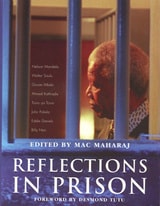
Reflections in Prison
Voices From the South African Liberation StruggleMac Maharaj
University of Massachusetts Press, 2002
Written by Mandela, Walter Sisulu, Ahmed Kathrada, Govan Mbeki, and four other leaders of the anti-apartheid movement, these essays provide a rare view of their thinking at a critical point in the liberation struggle, on the eve of the 1976 Soweto Uprising. The leaders describe their philosophies, strategies, and hopes. They debate such crucial issues as violent versus nonviolent forms of struggle, diversity and unity, the ideological challenge of the Black Consciousness movement, and how to accommodate different interpretations of African nationalism.
The book begins with a foreword by Desmond Tutu and a contextualizing introduction by Maharaj. Then come two essays by Mandela and one each by Sisulu, Kathrada, Mbeki, Billy Nair, John Pokela, Eddie Daniels and Andimba Toivo Ya Toivo. Each essay is preceded by a short biography of the author, a description of his life in prison, and a pencil sketch by a black South African artist.
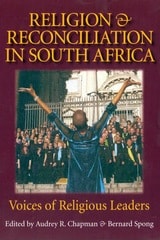
Religion & Reconciliation in South Africa
Voices of Religious LeadersBernard Spong
Templeton Press, 2003
Postapartheid South Africa's efforts to come to terms with its past, particularly its Truth and Reconciliation Commission's emphasis on forgiveness and reconciliation, is of special interest to many in the world community. The Truth and Reconciliation Commission (TRC), led by Archbishop Desmond Tutu, was mandated to go beyond truth-finding and to "promote national unity and reconciliation in a spirit of understanding which transcends the conflict and divisions of the past." In contrast with other truth commissions, the TRC was led by clerics rather than lawyers and judge, and the TRC's approach to reconciliation was shaped by and imbued with religious content. The TRC submitted its final report to the Mandela administration in October 1998.
Over the next two years, the Rev. Bernard Spong, former communications director of the South African Council of Churches, conducted a series of in-depth interviews about the TRC with thirty-three key religious figures. In this volume, they discuss and evaluate the following issues:
•How should we understand the concept of national or political reconciliation and its requirements?•What are the differences and similarities between religious and political approaches to reconciliation?
•Does national or political reconciliation require forgiveness between former victims and perpetrators?
•What is the appropriate role of religious representatives in a truth commission process? And is it recommended that other countries emulate the South African model?
•How do religious leaders assess the contributions and limitations of the TRC?
•What kind of initiatives are contemporary religious communities taking to promote reconciliation among their members and in the wider society?
The conversations presented in this volume, and the essays interpreting them, seek to illuminate issues and questions raised by the TRC model, including how to conceptualize reconciliation and the differences between political and religious approaches.
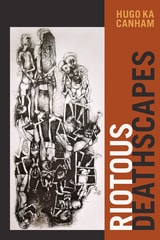
Riotous Deathscapes
Hugo ka Canham
Duke University Press, 2023