Results by title
81 books match the query 'Revolutions, Uprisings & Rebellions' and 7 start with r
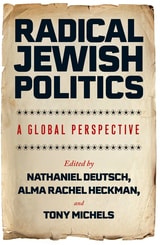
Radical Jewish Politics
A Global PerspectiveNathaniel Deutsch
Rutgers University Press, 2026
For the first time, this volume centers the rich but little known history of radical Jewish politics in the Middle East and North Africa and puts it into conversation with developments in the Americas, South Africa, Soviet Asia, and Europe. Jews were attracted to radical politics in the nineteenth and twentieth centuries to transform the societies they lived in but also out of a deep desire to belong. Somewhat paradoxically, then, radical politics held out the enticing possibility of normalization for Jews, even as it frequently resulted in their further alienation or persecution. In some cases, Jewish radicals sought recognition and autonomy as Jews; in others, Jews labored to be accepted as full-fledged citizens of their home countries; in still others, they tried to escape Jewishness altogether. Jewish experiences of modernity, colonialism, race, nationalism, emancipation, war, and migration, serve as the connective tissue that binds together radical Jewish politics from Baghdad to Buenos Aires.
[more]
Revolution Beyond the Event
The Afterlives of Radical PoliticsEdited by Charlotte Al-Khalili, Narges Ansari, Myriam Lamrani, and Kaya Uzel
University College London, 2023
A critical perspective on the lived realities of revolutionary afterlives.
Revolution Beyond the Event brings together leading international anthropologists and emerging scholars to examine revolutionary legacies from the MENA region, Latin America, and the Caribbean. It explores the idea that revolutions have varied afterlives that complicate the assumptions about their duration, pace, and progression, and argues that a renewed focus on the temporality of radical politics is essential to our understanding of revolution. Through a careful selection of case studies, the book provides a critical perspective on the lived realities of revolutionary afterlives, challenging the liberal humanist assumptions implicit in the modern idea of revolution and reappraising the political agency of people caught up in revolutionary situations across a variety of ethnographic contexts.
Revolution Beyond the Event brings together leading international anthropologists and emerging scholars to examine revolutionary legacies from the MENA region, Latin America, and the Caribbean. It explores the idea that revolutions have varied afterlives that complicate the assumptions about their duration, pace, and progression, and argues that a renewed focus on the temporality of radical politics is essential to our understanding of revolution. Through a careful selection of case studies, the book provides a critical perspective on the lived realities of revolutionary afterlives, challenging the liberal humanist assumptions implicit in the modern idea of revolution and reappraising the political agency of people caught up in revolutionary situations across a variety of ethnographic contexts.
[more]

Revolution and World Politics
The Rise and Fall of the Sixth Great PowerFred Halliday
Duke University Press, 1999
Revolutions, as much as international war or nationalism, have shaped the development of world politics. In cause, ideology, and consequence they have merited description as a “sixth great power” alongside the dominant nations. In Revolution and World Politics Fred Halliday reassesses the role of revolution from the French Revolution to the Iranian Revolution and the collapse of communism.
Halliday begins by tracing the origins and evolution of the modern concept of “revolution” and placing it in historical context. Arguing that revolution is central to any understanding of international relations, he examines the internationalist ideology of revolutionaries who are committed to promoting change elsewhere by exposing revolution. In contrast with the claims of revolutionaries and counterrevolutionaries alike, he sees revolutions both as part of an internationalist social conflict and as a challenge to the system of states. Chapters on the distinct foreign policies of revolutionary states are followed by discussions of war, counterrevolution, and postrevolutionary transformation. The study concludes with a reassessment of the place of revolution within international relations theory and in modern history, drawing out implications for their incidence and character in the twenty-first century.
Students and scholars of international relations, political science, sociology, and history will value this major contribution to understanding worldwide developments in government and society.
[more]
Revolution
Modern Uprisings in Ancient TimeMiriam Leonard
University of Chicago Press, 2025
A consideration of how modern revolutions have employed tropes of classical antiquity.
Despite its Latin etymology, “revolution” in its modern understanding arguably did not exist in antiquity, and revolution as we know it today is considered by many theorists to be a term born in modernity. While they certainly had times of momentous political upheaval, the Greeks and Romans tended to understand such events as part of a narrative of political continuity rather than novelty or rupture. Nevertheless, modern revolutions have repeatedly appropriated tropes of classical discourse, such as freedom, tyranny, tragedy, and fraternity.
With this book, Miriam Leonard offers a conceptual history of revolution, unraveling modernity’s yearning for the new and questioning why ancient concepts continue to play such an important role in political uprisings. Leonard looks at examples of appeals to antiquity during the French and Haitian Revolutions, in anticolonial struggles, and feminist and queer movements and considers works of theorists such as Karl Marx, Hannah Arendt, and Sigmund Freud that foreground an engagement with antiquity.
[more]
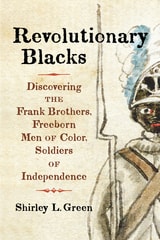
Revolutionary Blacks
Discovering the Frank Brothers, Freeborn Men of Color, Soldiers of IndependenceShirley L. Green
Westholme Publishing, 2026
William and Benjamin Frank joined the Second Rhode Island Regiment in the spring of 1777, following the tradition of military service established by their father, a veteran of the French and Indian War. The brothers became part of a cohort of free Black soldiers serving in an integrated Continental Army. The Second Rhode Island saw action along the Delaware River in the defense of Fort Mercer and the battle of Red Bank, before falling back with the rest of the army to Valley Forge. Following the brutal winter of 1777–1778 and the pivotal Battle of Monmouth, New Jersey, in June 1778, veteran soldiers of color from the Second Rhode Island, including the Frank brothers, were transferred to the newly segregated First Rhode Island. This regiment was composed of Black and Native American soldiers, including enslaved men who were promised their freedom in exchange for service. Allowing formerly enslaved men to serve was reluctantly authorized by George Washington to address manpower shortages, but in exchange, he introduced segregation into the army. The “Black Regiment,” as it became known returned to its home state, where it fought with distinction at the Battle of Rhode Island in August. While encamped near Providence in February 1780, Ben Frank deserted and ended up in British service. His brother William remained with his unit and served during the American victory at Yorktown, Virginia, where the Black Regiment once again demonstrated its effectiveness. William was honorably discharged and returned to Rhode Island, while Ben eventually relocated to Nova Scotia with other loyalists.
In Revolutionary Blacks: Discovering the Frank Brothers, Freeborn Men of Color, Soldiers of Independence historian Shirley L. Green takes the reader on a journey based on her family’s history, rooted in its oral tradition. Putting together the pieces of this puzzle through archival research, interviews, and DNA evidence, the author authenticates and expands the family’s oral history. In addition to providing context and substance to the Black experience during the war years, the author underscores the significant distinction between free Blacks in military service and those who had been enslaved, and how they responded in different ways to the harsh realities of racism. An original and important contribution to American history, Revolutionary Blacks presents a complex account of Black life during the Revolutionary Era and demonstrates that free men of color shared with white soldiers the desire to improve their condition in life and to maintain their families safely in postcolonial North America.
In Revolutionary Blacks: Discovering the Frank Brothers, Freeborn Men of Color, Soldiers of Independence historian Shirley L. Green takes the reader on a journey based on her family’s history, rooted in its oral tradition. Putting together the pieces of this puzzle through archival research, interviews, and DNA evidence, the author authenticates and expands the family’s oral history. In addition to providing context and substance to the Black experience during the war years, the author underscores the significant distinction between free Blacks in military service and those who had been enslaved, and how they responded in different ways to the harsh realities of racism. An original and important contribution to American history, Revolutionary Blacks presents a complex account of Black life during the Revolutionary Era and demonstrates that free men of color shared with white soldiers the desire to improve their condition in life and to maintain their families safely in postcolonial North America.
[more]
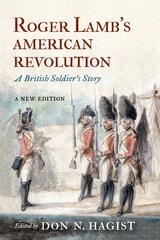
Roger Lamb's American Revolution
A British Soldier's StoryDon N. Hagist
Westholme Publishing, 2022
Featured in Ken Burns The American Revolution on PBS®
Of all the British soldiers who served in North America during the American Revolution, none wrote more about his experiences than Roger Lamb. He certainly had a lot to say: his service in two of the most important campaigns—the 1777 Saratoga campaign and the 1781 campaign through the Carolinas to Virginia—put him in the thick of some of the war’s most famous battles. Moreover, he was twice captured and twice escaped, making his way through hostile territory to rejoin the British army. Later in his life he wrote two books chronicling these experiences in great detail. Hundreds of British soldiers went through similar ordeals, sharing in the campaigns, the battles, the captivities, the escapes, but none recounted any aspect of these activities in the level of detail that Lamb did.
The first edition of this book, published in 2004, combined all of Roger Lamb’s first-hand recollections from his two books, An Original and Authentic Journal of Occurrences during the late American War, from its Commencement to the Year 1783 (Dublin, 1809) and Memoir of his Own Life (Dublin, 1811). Since that publication, two more important documents written by Lamb have come to light—an intelligence report written in 1782 recounting details of one of his escapes, and a “commonplace book” kept later in his life to record a vast range of memories, thoughts, and observations. Roger Lamb’s American Revolution: A British Soldier’s Story combines all of the material from these four sources pertaining to Lamb’s career as a soldier, from the time he joined the army to his departure from it, plus his recollections of childhood and post-military life. The result is the most comprehensive first-hand account by a British soldier in the American Revolution, an essential record for understanding the war in its totality.
[more]
Rural Unrest during the First Russian Revolution
Kursk Province, 1905-1906Burton Richard Miller
Central European University Press, 2013
The narrative of peasant unrest in Russia during 1905–1906 combines a chronology of incidents drawn from official documents, with close analysis of the villages associated with the disorders based upon detailed census materials compiled by local specialists. The analysis concentrates on a single province: Kursk Oblast, bordering the now independent Ukraine. In place of the general surveys of the revolution that dominate the literature, Miller focuses on local events and the rural populations that participated in them. Documents the degree to which the peasant community had been pushed onto the path of change by the end of the nineteenth century, how much the “peasantry” itself had become increasingly heterogeneous in outlook and occupation, and the rapidity with which these processes had begun to corrode the legitimacy of the older order. Miller concludes that unrest was concentrated mostly among peasant communities for whom the benefits the vital interactions between social unequals that had maintained a fragile social peace in the countryside had been radically eroded; he furthermore identifies the prominent role played by that spectrum of persons that retained their ties to their villages, but stood toward the margins of rural life.
[more]