Results by title
51 books match the query 'Rights' and 11 start with r
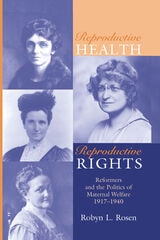
REPRODUCTIVE HEALTH, REPRODUCTIVE RIGHTS
REFORMERS & THE POLITICS OF MATERNAL WELFARE, 1917–1940Robyn L. Rosen
The Ohio State University Press, 2003
In the early twentieth century, shifting attitudes and new public health standards brought an unprecedented interest in and effort to regulate issues affecting reproduction and maternity. Maternal and infant health, nutrition, and medical care came under scrutiny, as did the issue of birth control. While the prior gained public support, the latter remained controversial. Though some reformers saw birth control as an important part of maternal welfare, others sought to separate it from more popular reforms. The careers of the four prominent but usually neglected reformers (Elizabeth Lowell Putnam, Ethel Sturges Dummer, Mary Ware Dennett, and Blanche Ames) examined in this book embody the struggle to define and resolve these tensions.
The study of these reformers offers a new perspective on more recognized leaders in the arena of reproductive health and rights, especially the U.S. Children's Bureau and Margaret Sanger. Putnam's elitism contextualizes the class politics of the Bureau, underscoring its sensitivity to the vulnerable and its innovative approach to public health. Dummer reminds us of roads not taken by policy makers in the Bureau, accentuating the differences between a child-centered and a woman-centered agenda. Dennett highlights the obstacles to women reformers in the formal political sphere, while Ames's penchant toward maternalism and compromise also led to difficulties. Together, they illustrate the complexities of formulating an effective approach to securing reproductive rights and health.
Race, Rights, and Rifles
The Origins of the NRA and Contemporary Gun CultureAlexandra Filindra
University of Chicago Press, 2023
An eye-opening examination of the ties between American gun culture and white male supremacy from the American Revolution to today.
One-third of American adults—approximately 86 million people—own firearms. This is not just for protection or hunting. Although many associate gun-centric ideology with individualist and libertarian traditions in American political culture, Race, Rights, and Rifles shows that it rests on an equally old but different foundation. Instead, Alexandra Filindra shows that American gun culture can be traced back to the American Revolution when republican notions of civic duty were fused with a belief in white male supremacy and a commitment to maintaining racial and gender hierarchies.
Drawing on wide-ranging historical and contemporary evidence, Race, Rights, and Rifles traces how this ideology emerged during the Revolution and became embedded in America’s institutions, from state militias to the National Rifle Association (NRA). Utilizing original survey data, Filindra reveals how many White Americans —including those outside of the NRA’s direct orbit—embrace these beliefs, and as a result, they are more likely than other Americans to value gun rights over voting rights, embrace antidemocratic norms, and justify political violence.
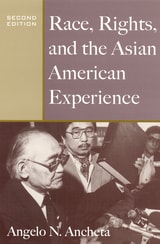
Race, Rights, and the Asian American Experience
Ancheta, Angelo N
Rutgers University Press, 2006
Ancheta examines legal and social theories of racial discrimination, ethnic differences in the Asian American population, nativism, citizenship, language, school desegregation, and affirmative action. In the revised edition of this influential book, Ancheta also covers post-9/11 anti-Asian sentiment and racial profiling. He analyzes recent legal cases involving political empowerment, language rights, human trafficking, immigrant rights, and affirmative action in higher education-many of which move the country farther away from the ideals of racial justice. On a more positive note, he reports on the progress Asian Americans have made in the corporate sector, politics, the military, entertainment, and academia.
A skillful mixture of legal theories, court cases, historical events, and personal insights, this revised edition brings fresh insights to U.S. civil rights from an Asian American perspective.

Race, Rights, and the Asian American Experience
Ancheta, Angelo N
Rutgers University Press, 1997
In Race, Rights, and the Asian American Experience, Angelo N. Ancheta demonstrates how United States civil rights laws have been framed by a black-white model of race that typically ignores the experiences of other groups, including Asian Americans. When racial discourse is limited to antagonisms between black and white, Asian Americans often find themselves in a racial limbo, marginalized or unrecognized as full participants.
Ancheta examines legal and social theories of racial discrimination, ethnic differences in the Asian American population, nativism, citizenship, language, school desegregation, and affirmative action. In the second edition of this influential book, Ancheta also covers post–9/11 anti-Asian sentiment and racial profiling. He analyzes recent legal cases involving political empowerment, language rights, human trafficking, immigrant rights, and affirmative action in higher education—many of which move the country farther away from the ideals of racial justice. On a more positive note, he reports on the progress Asian Americans have made in the corporate sector, politics, the military, entertainment, and academia.
A skillful mixture of legal theories, court cases, historical events, and personal insights, this second edition brings fresh insights to U.S. civil rights from an Asian American perspective.
Refusing Care
Forced Treatment and the Rights of the Mentally IllElyn R. Saks
University of Chicago Press, 2002
Focusing on overinterventionist approaches, Refusing Care explores when, if ever, the mentally ill should be treated against their will. Basing her analysis on case and empirical studies, Elyn R. Saks explores dilemmas raised by forced treatment in three contexts—civil commitment (forced hospitalization for noncriminals), medication, and seclusion and restraints. Saks argues that the best way to solve each of these dilemmas is, paradoxically, to be both more protective of individual autonomy and more paternalistic than current law calls for. For instance, while Saks advocates relaxing the standards for first commitment after a psychotic episode, she also would prohibit extreme mechanical restraints (such as tying someone spread-eagled to a bed). Finally, because of the often extreme prejudice against the mentally ill in American society, Saks proposes standards that, as much as possible, should apply equally to non-mentally ill and mentally ill people alike.
Mental health professionals, lawyers, disability rights activists, and anyone who wants to learn more about the way the mentally ill are treated—and ought to be treated—in the United States should read Refusing Care.
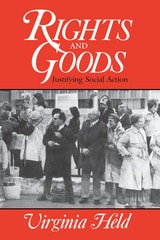
Rights and Goods
Justifying Social ActionVirginia Held
University of Chicago Press, 1989
Seeking a morality based on actual experience, Held offers a method of inquiry with which to deal with the specific moral problems encountered in daily life. She argues that the division between public and private morality is misleading and shows convincingly that moral judgment should be contextual. She maps out different approaches and positions for various types of issues, including membership in a state, legal decisions, political activities, economic transactions, interpersonal relations, diplomacy, journalism, and determining our obligation to future generations. Issues such as these provide the true test of moral theory, since its success is seen in the willingness of conscientious persons to commit themselves to it by acting on it in their daily lives.
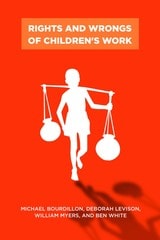
Rights and Wrongs of Children's Work
Bourdillon, Michael
Rutgers University Press, 2010
This groundbreaking book considers international policies governing children's work and the complexity of assessing the various effects of their work. The authors question current child labor policies and interventions, which, even though pursued with the best intentions, too often fail to protect children against harm or promote their access to education and other opportunities for decent futures. They argue for the need to re-think the assumptions that underlie current policies on the basis of empirical evidence, and they recommend new approaches to advance working children's well-being and guarantee their human rights.
Rights and Wrongs of Children's Work condemns the exploitation and abuse of child workers and supports the right of all children to the best quality, free education that society can afford. At the same time, the authors recognize the value, and sometimes the necessity, of work in growing up, and the reality that a "workless" childhood, without responsibilities, is not good preparation for adult life in any environment.
Rights in the Digital Era
All rights reserved. No part of this publication may be reproduced, stored in a retrieval system, or transmitted in any form or by any means without prior permission from the publisher.
Society of American Archivists, 2015
About Rights in the Digital Era:
MODULE 4Understanding Copyright Law
Heather Briston
Describes the main principles of copyright law and outlines strategies for addressing common issues, special topics, and digital projects.
MODULE 5
Balancing Access and Privacy in Manuscript Collections
Menzi L. Behrnd-Klodt
Introduces basic access and privacy laws, concepts, definitions, and professional ethical standards affecting manuscript materials and private and family papers.
MODULE 6
Balancing Access and Privacy in the Records of Organizations
Menzi L. Behrnd-Klodt
Introduces basic access and privacy laws, concepts, definitions, and professional ethical standards affecting the management of records created by organizations, businesses, agencies, and other entities.
MODULE 7
Managing Rights and Permissions
Aprille C. McKay
Provides practical guidance to help archivists transfer, clear, manage, and track rights information in analog and digital archives.
About Trends in Archives Practice:
This open-ended series by the Society of American Archivists features brief, authoritative treatments—written and edited by top-level professionals—that fill significant gaps in archival literature. The goal of this modular approach is to build agile, user-centered resources. Modules treat discrete topics relating to the practical management of archives and manuscript collections in the digital age. Select modules are clustered together by topic (as they are here) and are available in print or electronic format. Each module also is available separately in electronic format so that readers can mix and match modules that best satisfy their needs and interests. Stay on trend with Trends in Archives Practice!
Rights of Inclusion
Law and Identity in the Life Stories of Americans with DisabilitiesDavid M. Engel and Frank W. Munger
University of Chicago Press, 2003
Although all sixty interviewees had experienced discrimination, none had filed a formal protest or lawsuit. Nevertheless, civil rights played a crucial role in their lives. Rights improved their self-image, enhanced their career aspirations, and altered the perceptions and assumptions of their employers and coworkers-in effect producing more inclusive institutional arrangements. Focusing on these long-term life histories, Engel and Munger incisively show how rights and identity affect one another over time and how that interaction ultimately determines the success of laws such as the ADA.
Rights on Trial
How Workplace Discrimination Law Perpetuates InequalityEllen Berrey, Robert L. Nelson, and Laura Beth Nielsen
University of Chicago Press, 2017
On the surface, America’s commitment to equal opportunity in the workplace has never been clearer. Virtually every company has antidiscrimination policies in place, and there are laws designed to protect these rights across a range of marginalized groups. But, as Ellen Berrey, Robert L. Nelson, and Laura Beth Nielsen compellingly show, this progressive vision of the law falls far short in practice. When aggrieved individuals turn to the law, the adversarial character of litigation imposes considerable personal and financial costs that make plaintiffs feel like they’ve lost regardless of the outcome of the case. Employer defendants also are dissatisfied with the system, often feeling “held up” by what they see as frivolous cases. And even when the case is resolved in the plaintiff’s favor, the conditions that gave rise to the lawsuit rarely change. In fact, the contemporary approach to workplace discrimination law perversely comes to reinforce the very hierarchies that antidiscrimination laws were created to redress.
Based on rich interviews with plaintiffs, attorneys, and representatives of defendants and an original national dataset on case outcomes, Rights on Trial reveals the fundamental flaws of workplace discrimination law and offers practical recommendations for how we might better respond to persistent patterns of discrimination.

Rights or Self-Government?
Recovering the Meaning of Citizenship in an Age of RightsThomas E. Schneider
St. Augustine's Press, 2026