51 books match the query 'Risk' and 10 start with r
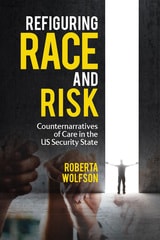
cover of Refiguring Race and Risk: Counternarratives of Care in the US Security State

Refiguring Race and Risk

Counternarratives of Care in the US Security State

Roberta Wolfson

The Ohio State University Press, 2024
In Refiguring Race and Risk, Roberta Wolfson turns to novels, memoirs, and other cultural works to debunk the false sense of national security rooted in positioning people of color as embodiments of risk. Considering output by Miné Okubo, Sanyika Shakur, Abraham Verghese, Khaled Hosseini, Helena María Viramontes, and others, Wolfson demonstrates how these authors disrupt racist security regimes and model alternative strategies for managing risk by crafting stories of collective care and community building. Chapters discuss, among other examples, how gang members defy the mass incarceration of Black and Latinx Americans by committing to self-education and self-advocacy; how an Asian immigrant doctor offers a corrective to the pandemic-era trend of allowing xenophobia to inform public health decisions by providing human-centered medical services to HIV-positive patients; and how Latinx migrant farmworkers battle ongoing precarity amid the increasing militarization of the US-Mexico border by bartering life-sustaining resources. In revealing how these works cultivate love as a mode of political resistance, Wolfson relabels people of color not as a source of risk but as critical actors in the push to improve national security.
[more]
cover of Reporting on Risk: How the Mass Media Portray Accidents, Diseases, Other Hazards

Reporting on Risk

How the Mass Media Portray Accidents, Diseases, Other Hazards

Eleanor Singer

Russell Sage Foundation, 1993

After acts of airline terrorism, air travel tends to drop dramatically—yet Americans routinely pursue the far riskier business of driving cards, where accidents resulting in death or injury are much more likely to occur. Reporting on Risk argues that this selective concern with danger is powerfully shaped by the media, whose coverage of potentially hazardous events is governed more by a need to excite the public than to inform it. Singer and Endreny survey a wide range of print and electronic media to provide an unprecedented look at how hundreds of different hazards are presented to the public—from toxic waste and food poisoning to cigarette smoking, from transportation accidents to famine, and from experimental surgery to communicable diseases. Their investigations raise thought-provoking questions about what the media tell us about modern risks, which hazards are covered and which ignored, and how the media determine when hazards should be considered risky. Are natural hazards reported differently than man-made hazards? Is greater emphasis placed on the potential benefits or the potential drawbacks of complex new technologies? Are journalists more concerned with reporting on unproven cures or informing the public about preventative measures? Do newspapers differ from magazines and television in their risk reporting practices? Reporting on Risk investigates how the media place blame for disasters, and looks at how the reporting of risks has changed in the past twenty-five years as such hazards as nuclear power, birth control methods, and industrial by-products have grown in national prominence. The authors demonstrate that the media often fail to report on risks until energized by the occurrence of some disastrous or dramatic event—the Union Carbide pesticide leak in Bhopal, the Challenger explosion, the outbreak of famine in Somalia, or the failed transplant of a baboon heart to "Baby Fae." Sustained attention to these hazards depends less on whether the underlying issues have been resolved than on whether they continue to unfold in newsworthy events. Reporting on Risk examines the accuracy and the amount of information we receive about our environment. It offers a critical perspective on how our perceptions of risk, as shaped by the media, may contribute to misguided individual and public choices for action and prevention in an increasingly complex world. The authors' probing assessment of how the media report a vast array of risks offers insights useful to journalists, policy analysts, risk specialists, legislators, and concerned citizens.
[more]
cover of Risk Revisited

Risk Revisited

Pat Caplan

Pluto Press, 2000
[more]
cover of Risk Topography: Systemic Risk and Macro Modeling

Risk Topography

Systemic Risk and Macro Modeling

Edited by Markus Brunnermeier and Arvind Krishnamurthy

University of Chicago Press, 2014

The recent financial crisis and the difficulty of using mainstream macroeconomic models to accurately monitor and assess systemic risk have stimulated new analyses of how we measure economic activity and the development of more sophisticated models in which the financial sector plays a greater role.

Markus Brunnermeier and Arvind Krishnamurthy have assembled contributions from leading academic researchers, central bankers, and other financial-market experts to explore the possibilities for advancing macroeconomic modeling in order to achieve more accurate economic measurement. Essays in this volume focus on the development of models capable of highlighting the vulnerabilities that leave the economy susceptible to adverse feedback loops and liquidity spirals. While these types of vulnerabilities have often been identified, they have not been consistently measured. In a financial world of increasing complexity and uncertainty, this volume is an invaluable resource for policymakers working to improve current measurement systems and for academics concerned with conceptualizing effective measurement.
[more]
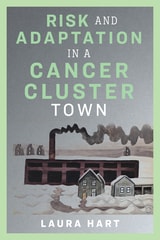
cover of Risk and Adaptation in a Cancer Cluster Town

Risk and Adaptation in a Cancer Cluster Town

Laura Hart

Rutgers University Press, 2023

In disease cluster communities across the country, environmental contamination from local industries is often suspected as a source of disease. But civic action is notoriously hampered by the slow response from government agencies to investigate the cause of disease and the complexities of risk assessment. 

In Risk and Adaptation in a Cancer Cluster Town, Laura Hart examines another understudied dimension of community inaction: the role of emotion and its relationship to community experiences of social belonging and inequality. Using a cancer cluster community in Northwest Ohio as a case study, Hart advances an approach to risk that grapples with the complexities of community belonging, disconnect, and disruption in the wake of suspected industrial pollution. Her research points to a fear driven not only by economic anxiety, but also by a fear of losing security within the community—a sort of pride that is not only about status, but connectedness. Hart reveals the importance of this social form of risk—the desire for belonging and the risk of not belonging—ultimately arguing that this is consequential to how people make judgements and respond to issues. Within this context where the imperative for self-protection is elusive, affected families experience psychosocial and practical conflicts as they adapt to cancer as a way of life. Considering a future where debates about risk and science will inevitably increase, Hart considers possibilities for the democratization of risk management and the need for transformative approaches to environmental justice.
[more]
cover of Risk and Insurance Management Manual for Libraries

Risk and Insurance Management Manual for Libraries

American Library Association, 2005

[more]
cover of Risk and Insurance Management Manual for Libraries, Updated

Risk and Insurance Management Manual for Libraries, Updated

Sally Alexander

American Library Association, 2021

[more]
cover of Risk and Risk Management in the Agricultural Economy

Risk and Risk Management in the Agricultural Economy

Edited by Tatyana Deryugina and Barry K. Goodwin

University of Chicago Press, 0

A wide-ranging examination of the risks agricultural producers face and how risk management policies respond to an uncertain economy.

Agricultural producers face greater risk and uncertainty than those in many other sectors of the economy. Sources of risk include weather shocks, disease, and volatile prices that can upend a season's returns. A wide array of federal policies, including crop and livestock insurance programs, are designed to help producers manage these risks, often at substantial cost to taxpayers. This volume examines how producers respond to and manage various risks across multiple dimensions. Contributors investigate the potential for "subsidy harvesting" in livestock insurance markets, the effects of climate change on insurance participation and crop choice, the relationship between the structure of insurance contracts and diversification incentives, and the role of conservation practices in risk mitigation. The research studies present new evidence on the design and consequences of agricultural risk management policies.

[more]
cover of Risk, Courage, and Women: Contemporary Voices in Prose and Poetry

Risk, Courage, and Women

Contemporary Voices in Prose and Poetry

Karen A. Waldron

University of North Texas Press, 2007
[more]
cover of Risk, Reproduction, and Narratives of Experience

Risk, Reproduction, and Narratives of Experience

Lauren Fordyce

Vanderbilt University Press, 2012

As Carole Browner explains in her foreword: "These chapters compellingly reveal that although we anthropologists tend to speak of biomedicine in hegemonic terms, in fact its penetration is quite variable and often ambivalently met. . . . Risk, Reproduction, and Narratives of Experience sheds new light on a troubling core aspect of medicalization processes, which simultaneously render pregnant women more docile subjects even as they are impelled to actively engage with biomedicalized prenatal care regimes. . . . We also see that a consummate means by which states seek to consolidate power in the reproductive realm is through expansion of the biomedical concept of risk. This critical observation emerges repeatedly in this collection."
[more]