Results by title
101 books match the query 'Rock' and 16 start with r

Race, Rock, and Elvis
Michael T. Bertrand
University of Illinois Press, 2000
Did Elvis Presley's brand of rock 'n' roll help revise racial attitudes in postwar America? Michael T. Bertrand delves into this question and many others to investigate popular music's revolutionary influence on black-white relations in the South.
Youthful fans of rhythm and blues, rock 'n' roll, and other black-inspired music often broke from their segregationist elders and ignored the color line. Not coincidentally, these same young white people--the southern branch of a national and commercialized youth culture--led a general relaxation of racist attitudes. Bertrand argues that African American music facilitated a new recognition of black people as fellow human beings. African American audiences welcomed Elvis with enthusiasm while racially mixed audiences flocked to music venues at a time when adults expected separate performances for black and white audiences. Bertrand also describes the critical role of radio and recordings in making African American culture available to white fans on an unprecedented scale. Over time, southern working-class youth used the new music to define and express new values and build their own identities.
Radio Free Boston
The Rise and Fall of WBCNCarter Alan
University Press of New England, 2013
Reichsrock
The International Web of White-Power and Neo-Nazi Hate MusicDyck, Kirsten
Rutgers University Press, 2016
Rhythm and Noise
An Aesthetics of RockTheodore Gracyk
Duke University Press, 1996
What’s in a name? “Rock” or “Rock ’n’ Roll?” Grayck argues that rock and roll is actually a performance style, one in a number of musical styles comprising rock. What distinguishes rock, Gracyk tells us, is how it is mediated by technology: The art is in the recording. The lesson is a heady one, entailing a tour through the history of rock music from Elvis Presley’s first recordings in 1954 to Kurt Cobain’s suicide in 1994. Gracyk takes us through key recordings, lets us hear what rock musicians and their critics have to say, shows us how other kinds of music compare, and gives us the philosophical background to make more than passing sense of the medium. His work takes up the common myths and stereotypes about rock, popular and academic, and focuses on the features of the music that electrify fans and consistently generate controversy. When Elvis came to town, did southern sheriffs say that rock was barbaric and addictive? Well so did Theodor Adorno, in his way, and Allan Bloom, in his, and Gracyk takes aim at this charge as it echoes through the era of recorded music. He looks at what rock has to do with romanticism and, even more, with commercialism. And he questions the orthodoxy of making grand distinctions between “serious” and “popular” art.
Keenly attuned to the nuances of music and of all the ways that we can think about it, this exhilarating book tunes us in, as no other has, to the complex role of rock in American culture.
Right to Rock
The Black Rock Coalition and the Cultural Politics of RaceMaureen Mahon
Duke University Press, 2004

Rimbaud and Jim Morrison
The Rebel as PoetWallace Fowlie
Duke University Press, 1994
In 1968 Jim Morrison, founder and lead singer of the rock band the Doors, wrote to Wallace Fowlie, a scholar of French literature and a professor at Duke University. Morrison thanked Fowlie for producing an English translation of the complete poems of Rimbaud. He needed the translation, he said, because, "I don’t read French that easily. . . . I am a rock singer and your book travels around with me." Fourteen years later, when Fowlie first heard the music of the Doors, he recognized the influence of Rimbaud in Morrison’s lyrics.
In Rimbaud and Jim Morrison Fowlie, a master of the form of the memoir, reconstructs the lives of the two youthful poets from a personal perspective. In their twinned stories he discovers an uncanny symmetry, a pattern far richer than the simple truth that both led lives full of adventure and both made poetry of their thirst for the liberation of the self. The result is an engaging account of the connections between an exceptional French symbolist who gave up writing poetry at the age of twenty, died young, and whose poems are still avidly read to this day, and an American rock musician whose brief career ignited an entire generation and has continued to fascinate millions around the world in the twenty years since his death in Paris. In this dual portrait, Fowlie gives us a glimpse of the affinities and resemblances between European literary traditions and American rock music and youth culture in the late twentieth century.
A personal meditation on two unusual, yet emblematic, cultural figures, this book also stands as a summary of a noted scholar’s lifelong reflections on creative artists.
Roadrunner
A Song by Jonathan Richman and the Modern LoversJoshua Clover
Duke University Press, 2021
Rock 'n' Roll Movies
Sterritt, David
Rutgers University Press, 2018
Rock Eras
Interpretations of Music and Society, 1954-1984Jim Curtis
University of Wisconsin Press, 1987
Paper is temporarily out of stock, Cloth (0-87972-368-8) is available at the paper price until further notice.
Rock Over the Edge
Transformations in Popular Music CultureRoger Beebe, Denise Fulbrook, and Ben Saunders, eds.
Duke University Press, 2002
Bridging the disciplines of musicology and cultural studies, the collection has two primary goals: to seek out a language for talking about music culture and to look at the relationship of music to culture in general. The editors’ introduction provides a backward glance at recent rock criticism and also looks to the future of the rapidly expanding discipline of popular music studies. Taking seriously the implications of critical theory for the study of non-literary aesthetic endeavors, the volume also addresses such issues as the affective power of popular music and the psychic construction of fandom.
Rock Over the Edge will appeal to scholars and students in popular music studies and American Studies as well as general readers interested in popular music.
Contributors. Ian Balfour, Roger Beebe, Michael Coyle, Robert Fink, Denise Fulbrook, Tony Grajeda, Lawrence Grossberg, Trent Hill, Josh Kun, Jason Middleton, Lisa Ann Parks, Ben Saunders, John J. Sheinbaum, Gayle Wald, Warren Zanes
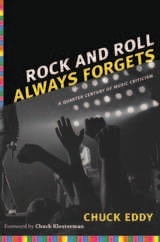
Rock and Roll Always Forgets
A Quarter Century of Music CriticismChuck Eddy
Duke University Press, 2011
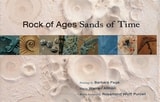
Rock of Ages, Sands of Time
Paintings by Barbara Page, Text by Warren AllmonBarbara Page and Warren D. Allmon
University of Chicago Press, 2001
These are just a few scenes from the magnificent drama that unfolds in glorious full color and three-dimensional texture in Rock of Ages, Sands of Time. Each of Barbara Page's 544 contiguous painted panels represents a million years of the history of life on earth, with fossil plants and animals depicted at the same scale and in association with each other just as they might be found by a paleontologist in the field. A muted rainbow of background colors evoke the rocks in which the fossils were found—the Texas Red Beds, for instance, or the yellow Solnhofen limestone—and keystone events are shown metaphorically, with fat rolls of paint marking major extinctions or continental drift.
To fully experience the awesome impact of an eon's worth of time spread across 500 feet of bas-relief panels, you'd have to visit the Museum of the Earth in Ithaca, New York, where Page's specially commissioned work will be installed when the museum opens in 2002. But this book is the next best thing. Not only does it contain crisp color reproductions of each painting, but it also includes an accessible essay from paleontologist Warren Allmon giving the scientific context behind the art.
For fossil lovers of all ages, and anyone interested in the merging of art and science, Rock of Ages, Sands of Time will be the find of a lifetime.
Rock of Ages
Subcultural Religious Identity and Public Opinion among Young EvangelicalsJeremiah J. Castle
Temple University Press, 2019
Evangelicals and Republicans have been powerful—and active—allies in American politics since the 1970s. But as public opinions have changed, are young evangelicals’ political identities and attitudes on key issues changing too? And if so, why? In Rock of Ages, Jeremiah Castle answers these questions to understand their important implications for American politics and society.
Castle develops his own theory of public opinion among young evangelicals to predict and explain their political attitudes and voting behavior. Relying on both survey data and his own interviews with evangelical college students, he shows that while some young evangelicals may be more liberal in their attitudes on some issues, most are just as firmly Republican, conservative, and pro-life on abortion as the previous generation.
Rock of Ages considers not only what makes young evangelicals different from the previous generation, but also what that means for both the church and American politics.
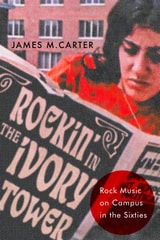
Rockin' in the Ivory Tower
Rock Music on Campus in the SixtiesJames M. Carter
Rutgers University Press, 2023
Histories of American rock music and the 1960s counterculture typically focus on the same few places: Woodstock, Monterey, Altamont. Yet there was also a very active college circuit that brought edgy acts like the Jefferson Airplane and the Velvet Underground to different metropolitan regions and smaller towns all over the country. These campus concerts were often programmed, promoted, and reviewed by students themselves, and their diverse tastes challenged narrow definitions of rock music.
Rockin’ in the Ivory Tower takes a close look at two smaller universities, Drew in New Jersey and Stony Brook on Long Island, to see how the culture of rock music played an integral role in student life in the late 1960s. Analyzing campus archives and college newspapers, historian James Carter traces connections between rock fandom and the civil rights protests, free speech activism, radical ideas, lifestyle transformations, and anti-war movements that revolutionized universities in the 1960s. Furthermore, he finds that these progressive students refused to segregate genres like folk, R&B, hard rock, and pop. Rockin’ in the Ivory Tower gives readers a front-row seat to a dynamic time for the music industry, countercultural politics, and youth culture.
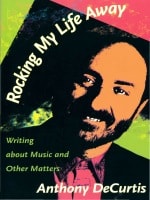
Rocking My Life Away
Writing about Music and Other MattersAnthony DeCurtis
Duke University Press, 1998
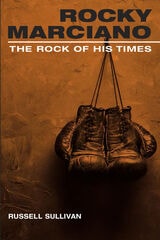
Rocky Marciano
The Rock of His TimesRussell Sullivan
University of Illinois Press, 2002
In this captivating and complex portrait of an American sports legend, Russell Sullivan confirms Rocky Marciano's place as a symbol and cultural icon of his era. As much as he embodied the wholesome, rags-to-riches patriotism of a true American hero, he also reflected the racial and ethnic tensions festering behind the country's benevolent facade.
Spirited, fast-paced, and rich in detail, Rocky Marciano is the first book to place the boxer in the context of his times. Capturing his athletic accomplishments against the colorful backdrop of the 1950s fight scene, Sullivan examines how Marciano's career reflected the glamour and scandal of boxing as well as tenor of his times.