110 books match the query 'Romanticism' and 21 start with r
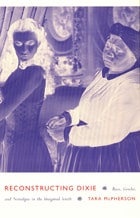
cover of Reconstructing Dixie: Race, Gender, and Nostalgia in the Imagined South

Reconstructing Dixie

Race, Gender, and Nostalgia in the Imagined South

Tara McPherson

Duke University Press, 2003

The South has long played a central role in America’s national imagination—the site of the trauma of slavery and of a vast nostalgia industry, alternatively the nation’s moral other and its moral center. Reconstructing Dixie explores how ideas about the South function within American culture. Narratives of the region often cohere around such tropes as southern hospitality and the southern (white) lady. Tara McPherson argues that these discursive constructions tend to conceal and disavow hard historical truths, particularly regarding race relations and the ways racial inequities underwrite southern femininity. Advocating conceptions of the South less mythologized and more tethered to complex realities, McPherson seeks to bring into view that which is repeatedly obscured—the South’s history of both racial injustice and cross-racial alliance.

Illuminating crucial connections between understandings of race, gender, and place on the one hand and narrative and images on the other, McPherson reads a number of representations of the South produced from the 1930s to the present. These are drawn from fiction, film, television, southern studies scholarship, popular journalism, music, tourist sites, the internet, and autobiography. She examines modes of affect or ways of "feeling southern" to reveal how these feelings, along with the narratives and images she discusses, sanction particular racial logics. A wide-ranging cultural studies critique, Reconstructing Dixie calls for vibrant new ways of thinking about the South and for a revamped and reinvigorated southern studies.

Reconstructing Dixie will appeal to scholars in American, southern, and cultural studies, and to those in African American, media, and women’s studies.
[more]
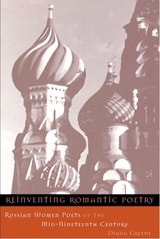
cover of Reinventing Romantic Poetry: Russian Women Poets of the Mid-Nineteenth Century

Reinventing Romantic Poetry

Russian Women Poets of the Mid-Nineteenth Century

Diana Greene

University of Wisconsin Press, 2003

Reinventing Romantic Poetry offers a new look at the Russian literary scene in the nineteenth century. While celebrated poets such as Aleksandr Pushkin worked within a male-centered Romantic aesthetic—the poet as a bard or sexual conqueror; nature as a mother or mistress; the poet’s muse as an idealized woman—Russian women attempting to write Romantic poetry found they had to reinvent poetic conventions of the day to express themselves as women and as poets. Comparing the poetry of fourteen men and fourteen women from this period, Diana Greene revives and redefines the women’s writings and offers a thoughtful examination of the sexual politics of reception and literary reputation.
The fourteen women considered wrote poetry in every genre, from visions to verse tales, from love lyrics to metaphysical poetry, as well as prose works and plays. Greene delves into the reasons why their writing was dismissed, focusing in particular on the work of Evdokiia Rostopchina, Nadezhda Khvoshchinskaia, and Karolina Pavlova. Greene also considers class as a factor in literary reputation, comparing canonical male poets with the work of other men whose work, like the women’s, was deemed inferior at the time. The book also features an appendix of significant poems by Russian women discussed in the text. Some, found in archival notebooks, are published here for the first time, and others are reprinted for the first time since the mid-nineteenth century.
[more]
cover of Representing the Troubles in Irish Short Fiction

Representing the Troubles in Irish Short Fiction

Michael L. Storey

Catholic University of America Press, 2004
Representing the Troubles in Irish Short Fiction offers a comprehensive examination of Irish short stories written over the last eighty years that have treated the Troubles, Ireland's intractable conflict that arose out of its relationship to England.
[more]
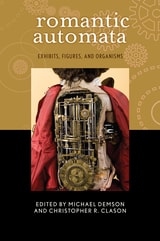
cover of Romantic Automata: Exhibitions, Figures, Organisms

Romantic Automata

Exhibitions, Figures, Organisms

Michael Demson

Bucknell University Press, 2020

For most of the eighteenth century, automata were deemed a celebration of human ingenuity, feats of science and reason. Among the Romantics, however, they prompted a contradictory apprehension about mechanization and contrivance: such science and engineering threatened the spiritual nature of life, the source of compassion in human society. A deep dread of puppets and the machinery that propels them consequently surfaced in late eighteenth and early nineteenth century literature. Romantic Automata is a collection of essays examining the rise of this cultural suspicion of mechanical imitations of life.

Recent scholarship in post-humanism, post-colonialism, disability studies, post-modern feminism, eco-criticism, and radical Orientalism has significantly affected the critical discourse on this topic. In engaging with the work and thought of Coleridge, Poe, Hoffmann, Mary Shelley, and other Romantic luminaries, the contributors to this collection open new methodological approaches to understanding human interaction with technology that strives to simulate, supplement, or supplant organic life.


Published by Bucknell University Press. Distributed worldwide by Rutgers University Press. 
[more]
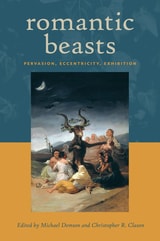
cover of Romantic Beasts: Pervasion, Eccentricity, Exhibition

Romantic Beasts

Pervasion, Eccentricity, Exhibition

Michael Demson

Bucknell University Press, 2025

By staging human-animal encounters, Romantic literature and art repeatedly questioned how "human" animals could be and how "animal" humans in fact are. Romantic-era authors and artists often depicted perplexing animal intrusions upon humans. Sometimes the intruders were mystifying or terrifying, like Coleridge’s albatross or Poe’s raven; sometimes they were mundane, as in “The Swallow” by Smith or “To a Mouse” by Burns—regardless, encounters with animal-others occasioned Romantic musings. This collection builds on existing scholarship while deploying new methodological approaches from gender studies, posthumanism, postcolonialism, disability studies, and digital studies to deepen our understanding of why animal-human encounters were so prevalent in the creative work and cultural discourse of the Romantic period, including the rhetoric of social movements like transatlantic abolitionism. Taken together, the chapters demonstrate the range and complexity of Romantic representations of human-animal interactions and conceptualizations of animality, nonhuman life, and not-wholly-human life.
 
Published by Bucknell University Press. Distributed worldwide by Rutgers University Press.
[more]
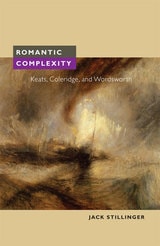
cover of Romantic Complexity: Keats, Coleridge, and Wordsworth

Romantic Complexity

Keats, Coleridge, and Wordsworth

Jack Stillinger

University of Illinois Press, 2005

In Romantic Complexity, Jack Stillinger examines three of the most admired poets of English Romanticism--Keats, Coleridge, and Wordsworth--with a focus on the complexity that results from the multiple authorship, the multiple textual representation, and the multiple reading and interpretation of their best works.

Specific topics include the joint authorship of Wordsworth and Coleridge in the Lyrical Ballads, an experiment of 1798 that established the most essential characteristics of modern poetry; Coleridge's creation of eighteen or more different versions of The Ancient Mariner and how this textual multiplicity affects interpretation; the historical collaboration between Keats and his readers to produce fifty-nine separate but entirely legitimate readings of The Eve of St. Agnes; and a number of practical and theoretical matters bearing on the relationships among these writers and their influences on one another.

Stillinger shows his deep understanding of the poets' lives, works, and the history of their reception, in chapters rich with intriguing questions and answers sure to engage students and teachers of the world's greatest poetry.
[more]
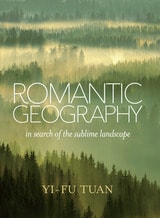
cover of Romantic Geography: In Search of the Sublime Landscape

Romantic Geography

In Search of the Sublime Landscape

Yi-Fu Tuan

University of Wisconsin Press, 2013

Yi-Fu Tuan established a global reputation for deepening the field of geography by examining its moral, universal, philosophical, and poetic potentials and implications. In Romantic Geography, he considers the human tendency to find salvation in geographies that cater not so much to survival needs (or even to good, comfortable living) as to the passionate and romantic aspirations of their nature.

[more]
cover of Romantic Globalism: British Literature and Modern World Order, 1750–1830

Romantic Globalism

British Literature and Modern World Order, 1750–1830

Evan Gottlieb

The Ohio State University Press, 2014

Romantic Globalism: British Literature and Modern World Order, 1750–1830 explores how British literature of the late eighteenth century and Romantic era both reflects and inflects the increasingly global world in which it was produced and consumed. Building on recent work in globalization studies, cosmopolitanism, and critical theory, Evan Gottlieb investigates the ways in which, following the economic and historiographical writings of the Scottish Enlightenment, a number of influential Romantic-era authors began representing, mediating, and even critiquing their experiences of globalization in poetry, fiction, and drama.
 
Although modern media tend to represent globalization as an essentially contemporary phenomenon, many scholars now agree that its fundamental dynamics—especially its characteristic annulment of spatial and temporal differences—have been present for several centuries. Moreover, the last decades of the eighteenth century and the first of the nineteenth century saw the convergence of a number of world-changing socio-political developments in the Western world. Romantic Globalism is significant because it is the first extended scholarly study that brings together these lines of inquiry. In so doing, Romantic Globalism not only charts a new course of study for British Romanticism but also suggests how the Romantics’ visions of globality might still be valuable to us today.
[more]
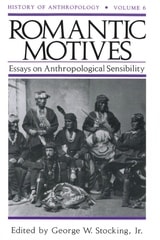
cover of Romantic Motives: Essays on Anthropological Sensibility

Romantic Motives

Essays on Anthropological Sensibility

Edited by George W. Stocking, Jr.

University of Wisconsin Press, 1996
Romantic Motives explores a topic that has been underemphasized in the historiography of anthropology. Tracking the Romantic strains in the the writings of Rousseau, Herder, Cushing, Sapir, Benedict, Redfield, Mead, Lévi-Strauss, and others, these essays show Romanticism as a permanent and recurrent tendency within the anthropological tradition.
[more]
cover of Romantic Poetry: Recent Revisionary Criticism

Romantic Poetry

Recent Revisionary Criticism

Kroeber, Karl

Rutgers University Press, 1993

This anthology fills the need for a comprehensive, up-to-date collection of the most important contemporary writings on the English romantic poets. During the 1980s, many theoretical innovations in literary study swept academic criticism. Many of these approaches--from deconstructive, new historicist, and feminist perspectives--used romantic texts as primary examples and altered radically the ways in which we read. Other major changes have occurred in textual studies, dramatically transforming the works of these poets. The world of English romantic poetry has certainly changed, and Romantic Poetry keeps pace with those changes. Karl Kroeber and Gene W. Ruoff have organized the book by poet--Blake, Wordsworth, Coleridge, Byron, Shelly, and Keats--and have included essays representative of key critical approaches to each poet's work. In addition to their excellent general introduction, the editors have provided brief, helpful forewords to each essay, showing how it reflects current approaches to its subject. The book also has an extensive bibliography sure to serve as an important research aid. Students on all levels will find this book invaluable.
[more]
cover of Romantic Things: A Tree, a Rock, a Cloud

Romantic Things

A Tree, a Rock, a Cloud

Mary Jacobus

University of Chicago Press, 2012
Our thoughts are shaped as much by what things make of us as by what we make of them. Lyric poetry is especially concerned with things and their relationship to thought, sense, and understanding. In Romantic Things, Mary Jacobus explores the world of objects and phenomena in nature as expressed in Romantic poetry alongside the theme of sentience and sensory deprivation in literature and art.
 
Jacobus discusses objects and attributes that test our perceptions and preoccupy both Romantic poetry and modern philosophy. John Clare, John Constable, Rainer Maria Rilke, W. G. Sebald, and Gerhard Richter make appearances around the central figure of William Wordsworth as Jacobus explores trees, rocks, clouds, breath, sleep, deafness, and blindness in their work. While she thinks through these things, she is assisted by the writings of Maurice Merleau-Ponty, Jacques Derrida, and Jean-Luc Nancy. Helping us think more deeply about things that are at once visible and invisible, seen and unseen, felt and unfeeling, Romantic Things opens our eyes to what has been previously overlooked in lyric and Romantic poetry.
[more]
cover of Romantic Vision, Ethical Context: Novalis and Artistic Autonomy

Romantic Vision, Ethical Context

Novalis and Artistic Autonomy

Geza Molnar

University of Minnesota Press, 1987

Exploring the full range of Novalis's (the pen name of the German poet and philosopher Friedrich von Hardenberg) work, von Molnar shows how he dealt, in theory and practice, with a central issue in Romanticism-the emerging concept of the autonomous self and its relation.
[more]
cover of Romantic Women Writers: Voices and Countervoices

Romantic Women Writers

Voices and Countervoices

Paula R. Feldman and Theresa M. Kelley

Brandeis University Press, 1995
Essays forging a new definition of Romanticism that includes the wide range of women's artistic expression.
[more]
cover of Romanticism Against the Tide of Modernity

Romanticism Against the Tide of Modernity

Michael Löwy and Robert Sayre

Duke University Press, 2001

Romanticism is a worldview that finds expression over a whole range of cultural fields—not only in literature and art but in philosophy, theology, political theory, and social movements. In Romanticism Against the Tide of Modernity Michael Löwy and Robert Sayre formulate a theory that defines romanticism as a cultural protest against modern bourgeois industrial civilization and work to reveal the unity that underlies the extraordinary diversity of romanticism from the eighteenth to the twenty-first century.
After critiquing previous conceptions of romanticism and discussing its first European manifestations, Löwy and Sayre propose a typology of the sociopolitical positions held by romantic writers-from “restitutionist” to various revolutionary/utopian forms. In subsequent chapters, they give extended treatment to writers as diverse as Coleridge and Ruskin, Charles Peguy, Ernst Bloch and Christa Wolf. Among other topics, they discuss the complex relationship between Marxism and romanticism before closing with a reflection on more contemporary manifestations of romanticism (for example, surrealism, the events of May 1968, and the ecological movement) as well as its future.
Students and scholars of literature, humanities, social sciences, and cultural studies will be interested in this elegant and thoroughly original book.
[more]
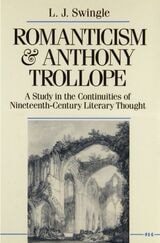
cover of Romanticism and Anthony Trollope: A Study in the Continuities of Nineteenth-Century Literary Thought

Romanticism and Anthony Trollope

A Study in the Continuities of Nineteenth-Century Literary Thought

L. J. Swingle

University of Michigan Press, 1990
Most people who study Romanticism suppose the Victorian novelist Anthony Trollope has little or nothing to do with Romantic literary thought, except perhaps opposition to it. Most people who study Trollope agree. Romanticism and Anthony Trollope argues that these suppositions are mistaken, reflecting erroneous ideas about Romanticism or about Trollope—or perhaps about both.L. J. Swingle invites reexamination of popular assumptions about the nature of nineteenth-century literary art, generally, and, especially, reconsideration of the idea that Romanticism and what is called Victorian Realism are fundamentally antithetical. Romantic writers and Trollope share basic assumptions about how human beings think; and, as a result, they also share uneasy notions about the substantiality of human relationships, particularly marriage. Swingle shows that our understanding of Trollope is clarified and enriched when we think about his work in relation to Romantic literary art; and, as well, it shows that we gain a better understanding of Romanticism by thinking about it in connection withTrollope. At a time when the resurrection of Trollope’s writings is increasingly common and popular enthusiasm for his work is high, this book will be especially welcomed. Romanticists, students of fiction, literary historians, and people working in nineteenth-century cultural studies will find its insights important and provocative, leading not only to a revaluation of Trollope’s work but to a rethinking of our stereotypes of Romanticism.
[more]
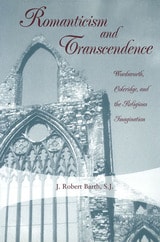
cover of Romanticism and Transcendence: Wordsworth, Coleridge, and the Religious Imagination

Romanticism and Transcendence

Wordsworth, Coleridge, and the Religious Imagination

J. Robert Barth, S.J.

University of Missouri Press, 2003
Grounded in the thought of Samuel Taylor Coleridge, Romanticism and Transcendence explores the religious dimensions of imagination in the Romantic tradition, both theoretically and in the poetry of Wordsworth and Coleridge. J. Robert Barth suggests that we may look to Coleridge for the theoretical grounding of the view of religious imagination proposed in this book, but that it is in Wordsworth above all that we see this imagination at work.
Barth first argues that the Romantic imagination—with its profound symbolic import—of its very nature has religious implications, and notes parallels between Coleridge’s view of the imagination and that of Ignatius Loyola in his Spiritual Exercises. He then turns to the role of religious experience in Wordsworth, using The Prelude as a privileged source. Next, after comparing the conception of humanity and God in Wordsworth and Coleridge, Barth considers the role of religious experience and imagery in two of Coleridge’s central poetic texts, The Rime of the Ancient Mariner and Christabel. Finally, Barth examines the continuing role of the Romantic idea of the religious imagination today, in literature and all the arts, linking it with the thought of theologian Karl Rahner and literary critic George Steiner.
Romanticism and Transcendence brings together literary theory, poetry, and religious experience, areas that are interrelated but are often not seen in relationship. By exploring levels of Wordsworth’s and Coleridge’s poetry that are often ignored, Barth provides insight into how and why the imagination was so important to their work. He also demonstrates how rich with religious value and meaning poetry and the arts can be.
The interdisciplinary nature of this important new study will make it useful not only to Wordsworth and Coleridge scholars and other Romantic specialists, but also to anyone concerned with the intellectual history of the nineteenth century and to theologians in general.
[more]
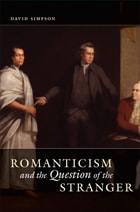
cover of Romanticism and the Question of the Stranger

Romanticism and the Question of the Stranger

David Simpson

University of Chicago Press, 2012
In our post-9/11 world, the figure of the stranger—the foreigner, the enemy, the unknown visitor—carries a particular urgency, and the force of language used to describe those who are “different” has become particularly strong. But arguments about the stranger are not unique to our time. In Romanticism and the Question of the Stranger, David Simpson locates the figure of the stranger and the rhetoric of strangeness in romanticism and places them in a tradition that extends from antiquity to today.
 
Simpson shows that debates about strangers loomed large in the French Republic of the 1790s, resulting in heated discourse that weighed who was to be welcomed and who was to be proscribed as dangerous. Placing this debate in the context of classical, biblical, and other later writings, he identifies a persistent difficulty in controlling the play between the despised and the desired. He examines the stranger as found in the works of Coleridge, Austen, Scott, and Southey, as well as in depictions of the betrayals of hospitality in the literature of slavery and exploration—as in Mungo Park's Travels and Stedman's Narrative—and portrayals of strange women in de Staël, Rousseau, and Burney. Contributing to a rich strain of thinking about the stranger that includes interventions by Ricoeur and Derrida, Romanticism and the Question of the Stranger reveals the complex history of encounters with alien figures and our continued struggles with romantic concerns about the unknown.
[more]
cover of Romanticism, Nationalism, and the Revolt against Theory

Romanticism, Nationalism, and the Revolt against Theory

David Simpson

University of Chicago Press, 1993

Why has Anglo-American culture for so long regarded "theory" with intense suspicion? In this important contribution to the history of critical theory, David Simpson argues that a nationalist myth underlies contemporary attacks on theory. Theory's antagonists, Simpson shows, invoke the same criteria of common sense and national solidarity as did the British intellectuals who rebelled against "theory" and "method" during the French Revolution.

Simpson demonstrates the close association between "theory" and "method" and shows that by the mid-eighteenth century, "method" had acquired distinctly subversive associations in England. Attributed increasingly to the French and the Germans, "method" paradoxically evoked images both of inhuman rationality and unbridled sentimentality; in either incarnation, it was seen as a threat to what was claimed to be authentically British. Simpson develops these paradigms in relation to feminism, the gendering of Anglo-American culture, and the emergence of literature and literary criticism as antitheoretical discourses. He then looks at the Romantic poets' response to this confining ideology of the cultural role of literature. Finally, Simpson considers postmodern theory's claims for the radical energy of nonrational or antirationalist positions.

This is an essential book not only for students of the Romantic period and intellectual historians concerned with the idea of "method," but for anyone interested in the historical background of today's debates over the excesses and possibilities of "theory."
[more]
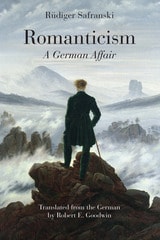
cover of Romanticism: A German Affair

Romanticism

A German Affair

Rüdiger Safranski Translated from the German by Robert E. Goodwin

Northwestern University Press, 2014

The renowned scholar Rüdiger Safranski’s Romanticism: A German Affair both offers an accessible overview of Romanticism and, more critically, traces its lasting influence, for better and for ill, on German culture. Safranski begins with the eighteenthcentury Sturm und Drang movement, which would sow the seeds for Romanticism in Germany. While Romanticism was a broad artistic, literary, and intellectual movement, German thinkers were especially concerned with its strong philosophical-metaphysical and religious dimension. Safranski follows this spirit in its afterlife in the work of Heinrich Heine, Richard Wagner, Friedrich Nietzsche, Thomas Mann, and through the later artistic upheavals of the twentieth century. He concludes by carefully considering Romanticism’s possible influence in the rise of National Socialism and the student revolt of 1968.

Romanticism: A German Affair is essential reading for anyone interested in the power of art, culture, and ideas in the life of a nation.
[more]
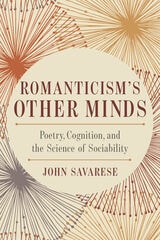
cover of Romanticism’s Other Minds: Poetry, Cognition, and the Science of Sociability

Romanticism’s Other Minds

Poetry, Cognition, and the Science of Sociability

John Savarese

The Ohio State University Press, 2020
In Romanticism’s Other Minds: Poetry, Cognition, and the Science of Sociability, John Savarese reassesses early relationships between Romantic poetry and the sciences, uncovering a prehistory of cognitive approaches to literature and demonstrating earlier engagement of cognitive approaches than has heretofore been examined at length. Eighteenth- and early nineteenth-century writers framed poetry as a window into the mind’s original, underlying structures of thought and feeling. While that Romantic argument helped forge a well-known relationship between poetry and introspective or private consciousness, Savarese argues that it also made poetry the staging ground for a more surprising set of debates about the naturally social mind. From James Macpherson’s forgeries of ancient Scottish poetry to Wordsworth’s and Coleridge’s Lyrical Ballads, poets mined traditional literatures and recent scientific conjectures to produce alternate histories of cognition, histories that variously emphasized the impersonal, the intersubjective, and the collective. By bringing together poetics, philosophy of mind, and the physiology of embodied experience—and with major studies of James Macpherson, Anna Letitia Barbauld, William Wordsworth, and Walter Scott—Romanticism’s Other Minds recovers the interdisciplinary conversations at the heart of Romantic-era literary theory.
[more]
cover of Ruin and Restitution: Reinterpreting Romanticism in Spain

Ruin and Restitution

Reinterpreting Romanticism in Spain

Philip W. Silver

Vanderbilt University Press, 1997

In this highly suggestive work, Philip Silver confronts and corrects the entire critical tradition on Spanish romanticism and suggests a new "restitutional" theory of that period in Spanish cultural and political history.
[more]