Results by title
857 books match the query 'Schools' and 36 start with r
RSF
The Russell Sage Foundation Journal of the Social Sciences: Higher Education EffectivenessSteven G. Brint
Russell Sage Foundation, 2016
Beginning with the editors’ authoritative introduction, the contributors assess the effectiveness of U.S. higher education at the national, state, campus, and classroom levels. Several focus on the effects of the steep decline in state funding in recent years, which has contributed to rising tuition at most state universities. Steven Hemelt and David Marcotte find that the financial burdens of attendance, even at public institutions, is a significant and growing impediment for students from low-income families. John Witte, Barbara Wolfe, and Sara Dahill-Brown analyze 36 years of enrollment trends at the University of Wisconsin, Madison, and find increased enrollment of upper-income students, suggesting widening inequality of access.
James Rosenbaum and his coauthors examine the effectiveness of “college for all” policies and find that on a wide range of economic and job satisfaction measures, holders of sub-baccalaureate credentials outperform those who start but do not complete four-year colleges. Two papers – by Kevin Dougherty and coauthors and Michael Kurlaender and coauthors – find that the use of new regulatory mechanisms such as performance funding and rating systems are plagued by unintended consequences that can provide misleading measures of institutional effectiveness. Lynn Reimer and co-authors examine the effectiveness of the “promising practices” in STEM education (science, technology, engineering, and mathematics) promoted by the National Academy of Sciences, and find that they can increase completion rates among low-income, first-generation, and under-represented students.
Expanding college access and effectiveness is a key way to promote economic mobility. The important findings in this issue illuminate the strengths and weaknesses of the U.S. system of higher education and suggest new avenues for improving student outcomes.
RSF
The Russell Sage Foundation Journal of the Social Sciences: The Fiftieth Anniversary of the Kerner Commission ReportSusan T. Gooden
Russell Sage Foundation, 2018
Articles in the issue examine the extent to which the recommendations in the Kerner Report contributed to policy changes and improvements in the social and economic well-being of urban residents . In their introduction, Gooden and Myers analyze changes in socioeconomic inequality between whites and blacks over the last five decades. They find that while the black poverty rate has declined and black educational attainment has increased, disparities still remain. Additionally, the income gap and disparities in unemployment between blacks and whites remain virtually unchanged. Rick Loessberg and John Koskinen similarly note the persistence of these disparities, but also show that some of the Kerner Report’s recommendations were adopted at local levels and have provided the foundation for increased racial diversity in media, law enforcement reforms, and public housing desegregation.
Other contributors study the urban areas that were sites of the riots. Reynolds Farley shows that in Detroit, residential segregation has declined and interracial marriage has increased over the last fifty years. However, on key economic measures such as income and wealth, African Americans have fallen even further behind whites than they were in 1967 due to dramatic changes in Detroit’s labor market. In their study of wealth inequality in Los Angeles, Melany De La Cruz-Viesca and coauthors show that much of the wealth gap between blacks and whites is due to disparities in home ownership, a subject neglected in the Kerner Report. Marcus Casey and Bradley Hardy study the evolution of African American neighborhoods since the Kerner Report and find that neighborhoods directly affected by riots in the 1960s still remain among the most economically disadvantaged today.
The Kerner Report endures as a classic touchstone in the nation’s search for a path toward equality. Together, the articles in this special issue demonstrate the long-term influence of the report and show where further progress is needed to close the racial divide.
Race and Class Matters at an Elite College
Elizabeth Aries
Temple University Press, 2008
In Race and Class Matters at an Elite College, Elizabeth Aries provides a rare glimpse into the challenges faced by black and white college students from widely different class backgrounds as they come to live together as freshmen. Based on an intensive study Aries conducted with 58 students at Amherst College during the 2005-2006 academic year, this book offers a uniquely personal look at the day-to-day thoughts and feelings of students as they experience racial and economic diversity firsthand, some for the first time.
Through online questionnaires and face-to-face interviews, Aries followed four groups of students throughout their first year of college: affluent whites, affluent blacks, less financially advantaged whites from families with more limited education, and less financially advantaged blacks from the same background. Drawing heavily on the voices of these freshmen, Aries chronicles what they learned from racial and class diversity—and what colleges might do to help their students learn more.
Race at the Top
Asian Americans and Whites in Pursuit of the American Dream in Suburban SchoolsNatasha Warikoo
University of Chicago Press, 2022
The American suburb conjures an image of picturesque privilege: manicured lawns, quiet streets, and—most important to parents—high-quality schools. These elite enclaves are also historically white, allowing many white Americans to safeguard their privileges by using public schools to help their children enter top colleges. That’s changing, however, as Asian American professionals increasingly move into wealthy suburban areas to give their kids that same leg up for their college applications and future careers.
As Natasha Warikoo shows in Race at the Top, white and Asian parents alike will do anything to help their children get to the top of the achievement pile. She takes us into the affluent suburban East Coast school she calls “Woodcrest High,” with a student body about one-half white and one-third Asian American. As increasing numbers of Woodcrest’s Asian American students earn star-pupil status, many whites feel displaced from the top of the academic hierarchy, and their frustrations grow. To maintain their children’s edge, some white parents complain to the school that schoolwork has become too rigorous. They also emphasize excellence in extracurriculars like sports and theater, which maintains their children’s advantage.
Warikoo reveals how, even when they are bested, white families in Woodcrest work to change the rules in their favor so they can remain the winners of the meritocracy game. Along the way, Warikoo explores urgent issues of racial and economic inequality that play out in affluent suburban American high schools. Caught in a race for power and privilege at the very top of society, what families in towns like Woodcrest fail to see is that everyone in their race is getting a medal—the children who actually lose are those living beyond their town’s boundaries.
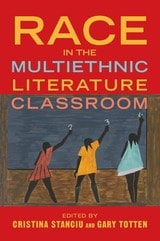
Race in the Multiethnic Literature Classroom
Edited by Cristina Stanciu and Gary Totten
University of Illinois Press, 2024
The contemporary rethinking and relearning of history and racism has sparked creative approaches for teaching the histories and representations of marginalized communities. Cristina Stanciu and Gary Totten edit a collection that illuminates these ideas for a variety of fields, areas of education, and institutional contexts.
The authors draw on their own racial and ethnic backgrounds to examine race and racism in the context of addressing necessary and often difficult classroom conversations about race, histories of exclusion, and racism. Case studies, reflections, and personal experiences provide guidance for addressing race and racism in the classroom. In-depth analysis looks at attacks on teaching Critical Race Theory and other practices for studying marginalized histories and voices. Throughout, the contributors shine a light on how a critical framework focused on race advances an understanding of contemporary and historical US multiethnic literatures for students around the world and in all fields of study.
Contributors: Kristen Brown, Nancy Carranza, Luis Cortes, Marilyn Edelstein, Naomi Edwards, Joanne Lipson Freed, Yadira Gamez, Lauren J. Gantz, Jennifer Ho, Shermaine M. Jones, Norell Martinez, Sarah Minslow, Crystal R. Pérez, Kevin Pyon, Emily Ruth Rutter, Ariel Santos, and C. Anneke Snyder
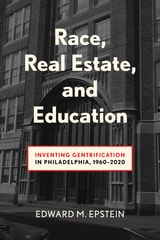
Race, Real Estate and Education
Inventing Gentrification in Philadelphia, 1960-2020Edward M. Epstein
Temple University Press, 2025
Epstein outlines the citywide context for the plan to create “University City” in West Philadelphia. He recounts the attempts to correct the segregation, overcrowding, and authoritarian management that plagued Philadelphia’s public schools. As the West Philadelphia Corporation, the proxy for the universities and hospitals, initiated gentrification efforts, the local community resisted and protested, causing the project to fail. The effort was revived with spectacular success, however, with the launch of the well-funded Penn Alexander School in 2001.
Race, Real Estate, and Education shows how the pursuit of urbanist ideals sometimes deepens neighborhood injustice. Epstein’s exploration of whether Philadelphia’s overall approach was beneficial or misguided presents a cautionary tale.
In the series Urban Life, Landscape, and Policy
Racial Melancholia, Racial Dissociation
On the Social and Psychic Lives of Asian AmericansDavid L. Eng and Shinhee Han
Duke University Press, 2018
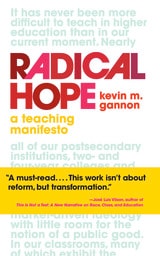
Radical Hope
A Teaching ManifestoKevin M. Gannon
West Virginia University Press, 2020
Higher education has seen better days. Harsh budget cuts, the precarious nature of employment in college teaching, and political hostility to the entire enterprise of education have made for an increasingly fraught landscape. Radical Hope is an ambitious response to this state of affairs, at once political and practical—the work of an activist, teacher, and public intellectual grappling with some of the most pressing topics at the intersection of higher education and social justice.
Kevin Gannon asks that the contemporary university’s manifold problems be approached as opportunities for critical engagement, arguing that, when done effectively, teaching is by definition emancipatory and hopeful. Considering individual pedagogical practice, the students who are the primary audience and beneficiaries of teaching, and the institutions and systems within which teaching occurs, Radical Hope surveys the field, tackling everything from impostor syndrome to cell phones in class to allegations of a campus “free speech crisis.” Throughout, Gannon translates ideals into tangible strategies and practices (including key takeaways at the conclusion of each chapter), with the goal of reclaiming teachers’ essential role in the discourse of higher education.

Radical Transparency
Perspectives on Graduate Education in Writing StudiesJustin H. Cook
Utah State University Press, 2027
Radical Transparency brings together candid, powerful accounts of what it means to live, work, and labor as a graduate student in writing studies in today’s academy. At a moment when higher education is defined by precarity, burnout, widening inequities, and political uncertainty, this collection names, without sanitizing, the emotional, embodied, and institutional realities that shape graduate education.
Blending scholarly analysis with personal narrative, the chapters document graduate student experiences across writing studies, rhetoric and composition, and related fields. Contributors take up issues often rendered invisible in official program materials and institutional discourse, including disability and access, queer and crip temporalities, financial and labor precarity, mentoring breakdowns, emotional labor, care work, grief, and the hidden curricula that govern graduate life. Together, these chapters reveal how graduate students navigate systems that demand resilience while frequently withholding transparency, support, and care. Organized around three intersecting threads—navigating precarity, building networks of care, and reimagining academic work—Radical Transparency also introduces an emotional-labor tagging system that allows readers to trace recurring forms of labor and affective demand as they surface in different institutional contexts.
Whether read cover to cover or approached nonlinearly, the text invites readers to see connections accumulate—and patterns emerge. Radical Transparency is for graduate students who suspect they’re not broken. It is for faculty and administrators willing to sit with discomfort, accountability, and complicity. And it is for anyone who believes that transparency without action is insufficient and that telling the truth, collectively and aloud, is a form of resistance.
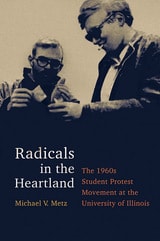
Radicals in the Heartland
The 1960s Student Protest Movement at the University of IllinoisMichael V. Metz
University of Illinois Press, 2019
Positioning the events in the context of their time, Michael V. Metz delves into the lives and actions of activists at the center of the drama. A participant himself, Metz draws on interviews, archives, and newspaper records to show a movement born in demands for free speech, inspired by a movement for civil rights, and driven to the edge by a seemingly never-ending war. If the sudden burst of irrational violence baffled parents, administrators, and legislators, it seemed inevitable to students after years of official intransigence and disregard. Metz portrays campus protesters not as angry, militant extremists but as youthful citizens deeply engaged with grave moral issues, embodying the idealism, naiveté, and courage of a minority of a generation.
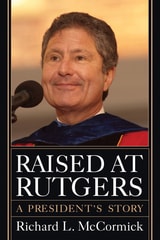
Raised at Rutgers
A President's StoryMcCormick, Richard L
Rutgers University Press, 2014
With understandable pride, McCormick recalls and relates Rutgers’s academic achievements during his presidency, including a renewed focus on undergraduate education and a significant increase in funding for research. Most dramatically, he chronicles the University’s protracted efforts to reclaim Robert Wood Johnson Medical School (and ultimately to acquire most of UMDNJ), a goal that was finally realized with crucial help from Governor Chris Christie and former governor Tom Kean.
Among the most honest accounts ever written of a college presidency, Raised at Rutgers takes the reader inside one of the best, and liveliest, public universities in America and highlights many of the most critical issues facing higher education today.
Reach Everyone, Teach Everyone
Universal Design for Learning in Higher EducationThomas J. Tobin
West Virginia University Press, 2018
Advocates for the rights of people with disabilities have worked hard to make universal design in the built environment “just part of what we do.” We no longer see curb cuts, for instance, as accommodations for people with disabilities, but perceive their usefulness every time we ride our bikes or push our strollers through crosswalks.
This is also a perfect model for Universal Design for Learning (UDL), a framework grounded in the neuroscience of why, what, and how people learn. Tobin and Behling show that, although it is often associated with students with disabilities, UDL can be profitably broadened toward a larger ease-of-use and general diversity framework. Captioned instructional videos, for example, benefit learners with hearing impairments but also the student who worries about waking her young children at night or those studying on a noisy team bus.
Reach Everyone, Teach Everyone is aimed at faculty members, faculty-service staff, disability support providers, student-service staff, campus leaders, and graduate students who want to strengthen the engagement, interaction, and performance of all college students. It includes resources for readers who want to become UDL experts and advocates: real-world case studies, active-learning techniques, UDL coaching skills, micro- and macro-level UDL-adoption guidance, and use-them-now resources.
Reaching All Writers
A Pedagogical Guide for Evolving College Writing ClassroomsJoanne Baird Giordano
Utah State University Press, 2023
Using threshold concepts and transfer as a foundation, the authors provide an invaluable resource for multiple contexts: instructors working off the tenure track and/or at multiple institutions; two-year college programs without a writing program administrator; and writing program graduate teaching assistant training courses. Each chapter includes an overview of a threshold concept, disciplinary background readings, practical teaching strategies, assignment and learning activity ideas, assessment principles, examples from student and instructor perspectives, and questions for reflection and discussion.
Reaching All Writers describes effective teaching practices to help all college writing instructors, regardless of their institutional contexts, make changes that support equitable and inclusive learning opportunities—with a focus on teaching students whose backgrounds and learning experiences are different from those with more educational or economic privilege. Both new and experienced teachers adapting first-year college writing courses will find the book’s blend of practical strategies and disciplinary knowledge a useful companion for facilitating new classroom and program needs or designing new teaching assistant training courses.
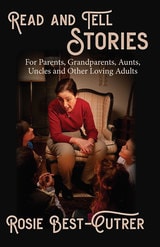
Read and Tell Stories
For parents, grandparents, aunts, uncles, and other loving adultsRosie Cutrer
Parkhurst Brothers, Inc., 2020

Readings in Primary Art Education
Edited by Steve Herne, Sue Cox, and Robert Watts
Intellect Books, 2009
Readings in Primary Art Education focuses on the challenges of and approaches to teaching art to primary-school students. Drawn from articles originally published in the International Journal of Art and Design, this volume gathers the work of the best scholars in the field and provides a critical framework for developing methods of teaching art to young students. Capturing the key issues and debates that are shaping both curricula and practice, Readings in Primary Art Education is an essential starting point for anyone involved in art education. This collection of essays will be a welcome addition to art and design education and will be of interest to those active in primary art and design education, including practicing teachers and scholars.
Reasons and Feelings
Writing for the Humanities NowSarah Mesle
University of Chicago Press, 2025
Humanities experts today are embattled. In a world of crises undermining higher education at every turn, what can still motivate humanists to write? Galvanizing, imaginative, and unrepentantly nerdy, Sarah Mesle’s Reasons and Feeling offers practical writing and publishing advice alongside a forcefully affirmative account of why humanities writing matters.
Mesle proposes that writing can help envision sustainable community, but only when we recognize that humanist authority comes from both our reasons and our feelings. Alongside everyday compositional advice—including strategies for addressing different audiences, pitching publications, and managing writing anxiety—readers will find an account of how such craft practices connect to both their intellectual commitments and their historical conditions. Mesle shows how university-trained writers at all levels benefit from embracing a broader range of styles and affects. Doing so helps them harness their writing’s community-building potential and makes them better able to value their own expertise, whether they write for the classroom, in public venues, or for the specialized scholarly communities that share their niche, weird, or beloved, objects of study.
Reasons and Feelings draws on Mesle’s expertise as a professor of writing and her work as an editor helping academics shift between writing for scholarly venues and journalistic ones. In a voice that’s honest, warm, accessible, and bracingly funny, Reasons and Feelings gives humanists a path toward bolder fantasies of the worlds their writing can make.
Reclaiming Indigenous Research in Higher Education
Minthorn, Robin Starr
Rutgers University Press, 2018
Recently, Native scholars have started to reclaim research through the development of their own research methodologies and paradigms that are based in tribal knowledge systems and values, and that allow inherent Indigenous knowledge and lived experiences to strengthen the research. Reclaiming Indigenous Research in Higher Education highlights the current scholarship emerging from these scholars of higher education. From understanding how Native American students make their way through school, to tracking tribal college and university transfer students, this book allows Native scholars to take center stage, and shines the light squarely on those least represented among us.
Recommended Principles to Guide Academy-Industry Relationships
American Association of University Professors
University of Illinois Press, 2014
• Preserving the integrity of research and public respect for higher education
• Eliminating and managing individual and institutional financial conflicts of interest
• Maintaining unbiased hiring and recruitment policies
• Establishing grievance procedures and due process rights for faculty, graduate students, and academic professionals
• Mastering the complications of negotiations over patents and copyright
• Assuring the ethics of research involving human subjects.
In a time of dynamic change Recommended Principles to Guide Academy-Industry Relationships offers an indispensable and authoritative guide to sustaining integrity and tradition while achieving great things in twenty-first century academia.
Redefining Success in America
A New Theory of Happiness and Human DevelopmentMichael Kaufman
University of Chicago Press, 2019
Returning to the legendary Harvard Student Study of undergraduates from the 1960s and interviewing participants almost fifty years later, Kaufman shows that formative experiences in family, school, and community largely shape a future adult’s worldview and well-being by late adolescence, and that fundamental change in adulthood, when it occurs, is shaped by adult family experiences, not by ever-greater competitive success. Published research on general samples shows that these patterns, and the book’s findings generally, are broadly applicable to demographically varied populations in the United States.
Leveraging biography-length clinical interviews and quantitative evidence unmatched even by earlier landmark studies of human development, Redefining Success in America redefines the conversation about the nature and origins of happiness, and about how adults develop. This longitudinal study pioneers a new paradigm in happiness research, developmental science, and personality psychology that will appeal to scholars and students in the social sciences, psychotherapy professionals, and serious readers navigating the competitive journey.
Refiguring Prose Style
Possibilities For Writing Pedagogyedited by T. R. Johnson & Thomas Pace
Utah State University Press, 2005
For about two decades, say Johnson and Pace, the discussion of how to address prose style in teaching college writing has been stuck, with style standing in as a proxy for other stakes in the theory wars.
The traditional argument is evidently still quite persuasive to some—that teaching style is mostly a matter of teaching generic conventions through repetition and practice. Such a position usually presumes the traditional view of composition as essentially a service course, one without content of its own. On the other side, the shortcomings of this argument have been much discussed—that it neglects invention, revision, context, meaning, even truth; that it is not congruent with research; that it ignores 100 years of scholarship establishing composition's intellectual territory beyond "service."
The discussion is stuck there, and all sides have been giving it a rest in recent scholarship. Yet style remains of vital practical interest to the field, because everyone has to teach it one way or another.
A consequence of the impasse is that a theory of style itself has not been well articulated. Johnson and Pace suggest that moving the field toward a better consensus will require establishing style as a clearer subject of inquiry.
Accordingly, this collection takes up a comprehensive study of the subject. Part I explores the recent history of composition studies, the ways it has figured and all but effaced the whole question of prose style. Part II takes to heart Elbow's suggestion that composition and literature, particularly as conceptualized in the context of creative writing courses, have something to learn from each other. Part III sketches practical classroom procedures for heightening students' abilities to engage style, and part IV explores new theoretical frameworks for defining this vital and much neglected territory.
The hope of the essays here—focusing as they do on historical, aesthetic, practical, and theoretical issues—is to awaken composition studies to the possibilities of style, and, in turn, to rejuvenate a great many classrooms.
Reflections on the Pandemic
COVID and Social Crises in the Year Everything ChangedTeresa Politano
Rutgers University Press, 2024
Contributors include: Patricia Akhimie, Marc Aronson, Ulla D. Berg, Stephanie Bonne, Stephanie Boyer, Kimberly Camp, Jordan Casteel, Kelly-Jane Cotter, Mark Doty, David Dreyfus, Adrienne E. Eaton, Katherine C. Epstein, Leah Falk, Paul G. Falkowski, Rigoberto González, James Goodman, David Greenberg, Angelique Haugerud, Grace Lynne Haynes, Leslieann Hobayan, Jonathan Holloway, James W. Hughes, Naomi Jackson, Amy Jordan, Vikki Katz, Mackenzie Kean, Robert E. Kopp, Christian Lighty, Stephen Masaryk, Louis P. Masur, Revathi V. Machan, Yalidy Matos, Belinda McKeon, Susan L. Miller, Yehoshua November, Joyce Carol Oates, Mary E. O’Dowd, Katherine Ognyanova, David Orr, Gregory Pardlo, Steve Pikiell, Teresa Politano, en Purkert, Nick Romanenko, Evie Shockley, Caridad Svich, and Didier William.
Reformed American Dreams
Welfare Mothers, Higher Education, and ActivismSheila M. Katz
Rutgers University Press, 2019
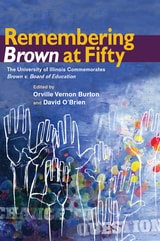
Remembering Brown at Fifty
The University of Illinois Commemorates Brown v. Board of EducationEdited by Orville Vernon Burton and David O'Brien
University of Illinois Press, 2009
Inspired by the University of Illinois's celebration of the Brown v. Board of Education decision's fiftieth anniversary, this collection addresses the significance of Brown in the contributors' lives or work in education and civil rights. Several authors describe their personal roles in the Brown case or similar cases, while others examine and illustrate events, performances, and exhibitions that were part of the anniversary commemoration. The book not only explores the repercussions of the Brown decision, but also stands as a historic document in its own right, preserving the reactions of many prominent intellectuals, artists, and activists fifty years after the decision.
Contributors are Kal Alston, Margaret L. Andersen, Kathryn H. Anthony, Nathaniel C. Banks, Bernice McNair Barnett, Christopher Benson, Ed Blankenheim, Julian Bond, Orville Vernon Burton, Jason Chambers, Constance Curry, Joseph A. De Laine Jr., Mary L. Dudziak, Joe R. Feagin, John Hope Franklin, Ophelia De Laine Gona, Lani Guinier, Darlene Clark Hine, Freeman A. Hrabowski III, John Jennings, Ralph Lemon, George Lipsitz, Jim Loewen, Laughlin McDonald, David O'Brien, James C. Onderdonk, Sekou Sundiata, Christopher Teal, Nicholas Watkins, Carrie Mae Weems, Juan Williams, and Joy Ann Williamson.
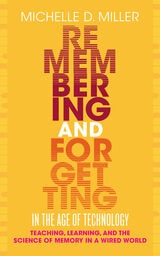
Remembering and Forgetting in the Age of Technology
Teaching, Learning, and the Science of Memory in a Wired WorldMichelle D Miller
West Virginia University Press, 2022
Human minds are made of memories, and today those memories have competition. Biological memory capacities are being supplanted, or at least supplemented, by digital ones, as we rely on recording—phone cameras, digital video, speech-to-text—to capture information we’ll need in the future and then rely on those stored recordings to know what happened in the past. Search engines have taken over not only traditional reference materials but also the knowledge base that used to be encoded in our own brains. Google remembers, so we don’t have to. And when we don’t have to, we no longer can. Or can we?
Remembering and Forgetting in the Age of Technology offers concise, nontechnical explanations of major principles of memory and attention—concepts that all teachers should know and that can inform how technology is used in their classes. Teachers will come away with a new appreciation of the importance of memory for learning, useful ideas for handling and discussing technology with their students, and an understanding of how memory is changing in our technology-saturated world.

Remembering the University of Chicago
Teachers, Scientists, and ScholarsEdited by Edward Shils
University of Chicago Press, 1991
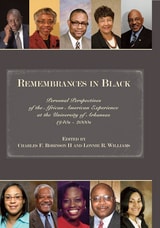
Remembrances in Black
Personal Perspectives of the African American Experience at the University of Arkansas, 1940s–2000sCharles F. Robinson II
University of Arkansas Press, 2015
Response to Reform
Composition and the Professionalization of TeachingMargaret J. Marshall
Southern Illinois University Press, 2003
Response to Reform: Composition and the Professionalization of Teaching critiques the politics of labor and gender biases inherent in the composition workplace that prevent literacy teachers from attaining professional status and respect. Scrutinizing the relationship between scholarship and teaching, Margaret J. Marshall calls for a reconceptualization of what it means to prepare for and enter the field of composition instruction.
Interrogating the approach the education system takes to certify teachers without actually “professionalizing” their careers, Marshall contends that these programs rely on outdated rhetorics of labor that only widen the gap between teaching and other professional jobs. Such attempts to re-educate literacy teachers exploit and marginalize their work, and thus prevent them from claiming the status of academic professionals. In providing an overview of the history of and language used to literacy instruction, she also points out that while women are overrepresented in composition instruction, they are underrepresented in tenure track and administrative positions.
To correct and combat these inequities, Marshall advocates an alternate alignment of power structures and rhetorical choices. In a wide-ranging survey that sheds new light on the composition workplace as well as higher education at large, Response to Reform: Composition and the Professionalization of Teaching boldly asks us to do away with the reductive language we inherit from the past that characterize teaching and professionalization, as well as our customary responses to public criticism of education. The result is a new articulation of composition as a meritorious profession.
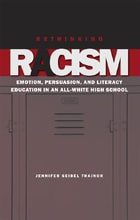
Rethinking Racism
Emotion, Persuasion, and Literacy Education in an All-White High SchoolJennifer Seibel Trainor
Southern Illinois University Press, 2008
In Rethinking Racism: Emotion, Persuasion, and Literacy Education in an All-White High School, Jennifer Seibel Trainor proposes a new understanding of the roots of racism, one that is based on attention to the role of emotion and the dynamics of persuasion. This one-year ethnographic study argues against previous assumptions about racism, demonstrating instead how rhetoric and emotion, as well as the processes and culture of schools, are involved in the formation of racist beliefs.
Telling the story of a year spent in an all-white high school, Trainor suggests that contrary to prevailing opinion, racism often does not stem from ignorance, a lack of exposure to other cultures, or the desire to protect white privilege. Rather, the causes of racism are frequently found in the realms of emotion and language, as opposed to rational calculations of privilege or political ideologies. Trainor maintains that racist assertions often originate not from prejudiced attitudes or beliefs but from metaphorical connections between racist ideas and nonracist values. These values are reinforced, even promoted by schooling via "emotioned rules" in place in classrooms: in tacit, unexamined lessons, rituals, and practices that exert a powerful—though largely unacknowledged—persuasive force on student feelings and beliefs about race.
Through in-depth analysis of established anti-racist pedagogies, student behavior, and racial discourses, Trainor illustrates the manner in which racist ideas are subtly upheld through social and literacy education in the classroom—and are thus embedded in the infrastructures of schools themselves. It is the emotional and rhetorical framework of the classroom that lends racism its compelling power in the minds of students, even as teachers endeavor to address the issue of cultural discrimination. This effort is continually hindered by an incomplete understanding of the function of emotions in relation to antiracist persuasion and cannot be remedied until the root of the problem is addressed.
Rethinking Racism calls for a fresh approach to understanding racism and its causes, offering crucial insight into the formative role of schooling in the perpetuation of discriminatory beliefs. In addition, this highly readable narrative draws from white students' own stories about the meanings of race in their learning and their lives. It thus provides new ways of thinking about how researchers and teachers rep- resent whiteness. Blending narrative with more traditional forms of ethnographic analysis, Rethinking Racism uncovers the ways in which constructions of racism originate in literacy research and in our classrooms—and how these constructions themselves can limit the rhetorical positions students enact.
Rewriting
How To Do Things With TextsJoseph Harris
Utah State University Press, 2006
"Like all writers, intellectuals need to say something new and say it well. But unlike many other writers, what intellectuals have to say is bound up with the books we are reading . . . and the ideas of the people we are talking with."
What are the moves that an academic writer makes? How does writing as an intellectual change the way we work from sources? In Rewriting, a textbook for the undergraduate classroom, Joseph Harris draws the college writing student away from static ideas of thesis, support, and structure, and toward a more mature and dynamic understanding. Harris wants college writers to think of intellectual writing as an adaptive and social activity, and he offers them a clear set of strategies—a set of moves—for participating in it.
Rhetorical Education In America
Cheryl Jean Glenn
University of Alabama Press, 2009
A timely collection of essays by prominent scholars in the field—on the past, present, and future of rhetoric instruction.
From Isocrates and Aristotle to the present, rhetorical education has consistently been regarded as the linchpin of a participatory democracy, a tool to foster civic action and social responsibility. Yet, questions of who should receive rhetorical education, in what form, and for what purpose, continue to vex teachers and scholars.
The essays in this volume converge to explore the purposes, problems, and possibilities of rhetorical education in America on both the undergraduate and graduate levels and inside and outside the academy. William Denman examines the ancient model of the "citizen-orator" and its value to democratic life. Thomas Miller argues that English departments have embraced a literary-research paradigm and sacrificed the teaching of rhetorical skills for public participation. Susan Kates explores how rhetoric is taught at nontraditional institutions, such as Berea College in Kentucky, where Appalachian dialect is espoused. Nan Johnson looks outside the academy at the parlor movement among women in antebellum America. Michael Halloran examines the rhetorical education provided by historical landmarks, where visitors are encouraged to share a common public discourse. Laura Gurak presents the challenges posed to traditional notions of literacy by the computer, the promises and dangers of internet technology, and the necessity of a critical cyber-literacy for future rhetorical curricula.
Collectively, the essays coalesce around timely political and cross-disciplinary issues. Rhetorical Education in America serves to orient scholars and teachers in rhetoric, regardless of their disciplinary home, and help to set an agenda for future classroom practice and curriculum design.
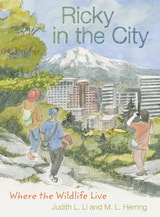
Ricky in the City
Where the Wildlife LiveJudith L. Li
Oregon State University Press, 2019
The kids find insects and reptiles moving about garden patches and bioswales, song birds and squirrels in neighborhood tree canopies, falcons and eagles crossing spacious river floodplains. As they record and map how wildlife and people are connected in these city spaces, they become community scientists, contributing to actual regional databases. After they see the young trees Marcus planted in his neighborhood, the feeders Jenny tends for hummingbirds, and the fascinating wildlife underpasses built in the wetlands, Ricky and Ellie realize there are many ways people actively care for the city’s wildlife.
In this fourth and final story of their award-winning children’s series, M. L. Herring’s vivid pen and watercolor illustrations complement the engaging storytelling of Judith Li. Readers will delight in the journal pages and maps “hand drawn” by Ricky and Ellie at the end of each chapter, while the “Dear Reader” section offers further tips for budding citizen scientists.
Ricky's Atlas
Mapping a Land on FireLi
Oregon State University Press, 2016
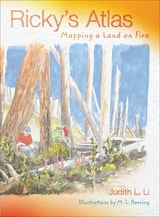
In this sequel to Ellie’s Log: Exploring the Forest Where the Great Tree Fell, Ricky Zamora brings his love of map-making and his boundless curiosity to the arid landscapes east of the Cascades Mountains. He arrives during a wild thunderstorm, and watches his family and their neighbors scramble to deal with a wildfire sparked by lightning. Joined by his friend Ellie, he sees how plants, animals, and people adjust to life with wildfires.
While hiking across a natural prairie, climbing up a fire tower, and studying historical photos and maps, Ricky and Ellie learn about the role of fire in shaping the landscape of the semi-arid plateau east of the mountains. They experience the scary days of wildfire in progress, explore a gritty site after a wildfire, and discover how some plants and animals depend on fire to survive.
Color pen-and-ink drawings accompany the text and vividly illustrate plants, animals, and events encountered in this exciting summer adventure. With his friend Ellie, Ricky creates a brightly colored diary of the fire, with maps, timelines, and sketches of what they see in this fire-prone land. Ricky’s notebook about his summer visit to his uncle’s ranch becomes an atlas of fire ecology, weather patterns, and life in the rain shadow.
Upper elementary kids will enjoy the mixture of amazing adventures with actual historical, physical, and ecological data about the region. Woven into the story are the small pleasures of ranch life, intriguing histories of Native Americans and early settlers, and almost unbelievable views of ancient fossils. Ricky and Ellie’s explorations, accompanied by their hand-written notes, introduce readers to a very special landscape and history east of the mountains.
Roads Less Traveled and Other Perspectives on Nationally Competitive Scholarships
Suzanne McCray
University of Arkansas Press, 2017
For many, the applications present an unfamiliar territory, so students seek out informed advisors who can help them navigate the terrain. This volume of essays is a great way for anyone advising students through an application to become an expert. Roads Less Traveled and Other Perspectives on Nationally Competitive Scholarships provides critical information from scholarship foundations about the best ways to guide students—from considering a career path, to completing the application, to preparing for an interview. Experienced advisors also share helpful tips on practical topics like writing letters of endorsement or assisting those who want to study abroad, and they provide programmatic advice on how to broaden the pool of applicants, address those with financial needs, and make all who apply feel the process has value beyond winning. Roads Less Traveled and Other Perspectives on Nationally Competitive Scholarships is a must for anyone advising students on scholarships.
Rutgers Meets Japan
A Trans-Pacific Network of the Late Nineteenth CenturyHaruko Wakabayashi
Rutgers University Press, 2026
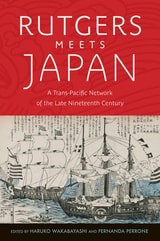
Griffis and Kusakabe were only a small piece of a vast transnational network of leading modernizers of Japan in the 1860s and 70s. The Japanese students in New Brunswick were young and innovative men of samurai and aristocratic lineage, who were sent by reform-minded leaders of Japan, which was undergoing a dramatic transformation. They came to New Brunswick seeking Western knowledge that was much needed for the modernization of a newly forming nation. New Brunswick became the hub of a network of Japanese nationals that extended to the major cities of New York, Philadelphia, and Boston, and from there to the smaller towns of New England. Once in New Brunswick, these Japanese students were embraced by Protestant ministers, educators, and missionaries—both men and women—whose network encompassed Rutgers College and the neighboring New Brunswick Theological Seminary, and which stretched to Dutch Reformed parishes throughout the Eastern seaboard, and westward as far as the Dutch enclave of Holland, Michigan. Meanwhile, the American teachers and missionaries who left for Japan became part of a network of reformist leaders and Japanese returnees that extended to schools, colleges, and missions in Japan, and formed the foundations of Japan’s modern educational system. Through contributions from scholars and archivists in the U.S., Canada, and Japan, Rutgers Meets Japan aims to reconstruct the early Rutgers-Japan connections and examine the role and impact of this transnational network on Japan and the U.S. in the late nineteenth century.
Rutgers Then and Now
Two Centuries of Campus Development: A Historic and Photographic OdysseyJames W. Hughes
Rutgers University Press, 2025
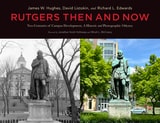
Rutgers, Then and Now tells this story, proceeding through ten sequential development phases of College Avenue and Piscataway campus expansions—each with its own buildings and physical layouts—that took place over the course of 250 years. It delivers stunning photographic and historic documentation of the growth of the university, showing “what it was and appeared originally” versus “what it is and looks like today.” Among other in-depth analyses, the book compares the diminutive geographic scale of today’s historical College Avenue Campus—once the entirety of Rutgers—to the much larger-sized (in acreage) Busch Campus. Replete with more than 500 images, the book also considers the Rutgers campuses that might have been, examining plans that were changed or abandoned. Shedding light on the sacrifices and gifts that transformed a small college into a vital hub for research and beloved home for students, it explores how Rutgers grew to become a world-class university.
Rutgers since 1945
A History of the State University of New JerseyPaul G. E. Clemens with an essay by Carla Yanni
Rutgers University Press, 2015