Results by title
64 books match the query 'Self in literature' and 3 start with r
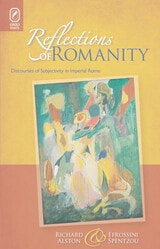
Reflections of Romanity
Discourses of Subjectivity in Imperial RomeRichard Alston
The Ohio State University Press, 2011
Reflections of Romanity: Discourses of Subjectivity in Imperial Rome, by Richard Alston and Efrossini Spentzou, challenges and provokes debate about how we understand the Roman world, and ourselves, by engagement with the early imperial literature of the mid-first to early second-century CE. Alston and Spentzou explore Roman subjectivity to illuminate a society whose fragmentation presented considerable challenges to contemporary thinkers. These members of the elite and intellectual classes faced complex ideological choices in relation to how they could define themselves in relation to imperial society.
Reflections of Romanity draws on present-day reflections on selfhood while at the same time uncovering processes of self-analysis, notably by tracing individuals’ reactions to moments of crisis or uncertainty. Thus it sets up a dialogue between the ancient texts it discusses, including the epics of Lucan and Statius, the letters of the Younger Pliny, Silius Italicus’ Punica, and Tacitus’ historical writings, and works of the modern period. Given the importance of classical thinking about the self in modern thought, this book addresses both a classical and a philosophical/literary critical audience.
[more]
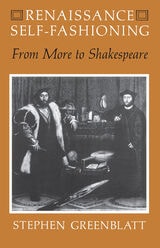
Renaissance Self-Fashioning
From More to ShakespeareStephen Greenblatt
University of Chicago Press, 1983
Renaissance Self-Fashioning is a study of sixteenth-century life and literature that spawned a new era of scholarly inquiry. Stephen Greenblatt examines the structure of selfhood as evidenced in major literary figures of the English Renaissance—More, Tyndale, Wyatt, Spenser, Marlowe, and Shakespeare—and finds that in the early modern period new questions surrounding the nature of identity heavily influenced the literature of the era. Now a classic text in literary studies, Renaissance Self-Fashioning continues to be of interest to students of the Renaissance, English literature, and the new historicist tradition, and this new edition includes a preface by the author on the book's creation and influence.
"No one who has read [Greenblatt's] accounts of More, Tyndale, Wyatt, and others can fail to be moved, as well as enlightened, by an interpretive mode which is as humane and sympathetic as it is analytical. These portraits are poignantly, subtly, and minutely rendered in a beautifully lucid prose alive in every sentence to the ambivalences and complexities of its subjects."—Harry Berger Jr., University of California, Santa Cruz
"No one who has read [Greenblatt's] accounts of More, Tyndale, Wyatt, and others can fail to be moved, as well as enlightened, by an interpretive mode which is as humane and sympathetic as it is analytical. These portraits are poignantly, subtly, and minutely rendered in a beautifully lucid prose alive in every sentence to the ambivalences and complexities of its subjects."—Harry Berger Jr., University of California, Santa Cruz
[more]
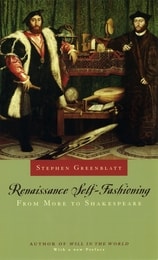
Renaissance Self-Fashioning
From More to ShakespeareStephen Greenblatt
University of Chicago Press, 2005
Renaissance Self-Fashioning is a study of sixteenth-century life and literature that spawned a new era of scholarly inquiry. Stephen Greenblatt examines the structure of selfhood as evidenced in major literary figures of the English Renaissance—More, Tyndale, Wyatt, Spenser, Marlowe, and Shakespeare—and finds that in the early modern period new questions surrounding the nature of identity heavily influenced the literature of the era. Now a classic text in literary studies, Renaissance Self-Fashioning continues to be of interest to students of the Renaissance, English literature, and the new historicist tradition, and this new edition includes a preface by the author on the book's creation and influence.
"No one who has read [Greenblatt's] accounts of More, Tyndale, Wyatt, and others can fail to be moved, as well as enlightened, by an interpretive mode which is as humane and sympathetic as it is analytical. These portraits are poignantly, subtly, and minutely rendered in a beautifully lucid prose alive in every sentence to the ambivalences and complexities of its subjects."—Harry Berger Jr., University of California, Santa Cruz
"No one who has read [Greenblatt's] accounts of More, Tyndale, Wyatt, and others can fail to be moved, as well as enlightened, by an interpretive mode which is as humane and sympathetic as it is analytical. These portraits are poignantly, subtly, and minutely rendered in a beautifully lucid prose alive in every sentence to the ambivalences and complexities of its subjects."—Harry Berger Jr., University of California, Santa Cruz
[more]