Results by title
66 books match the query 'Sex differences' and 5 start with r
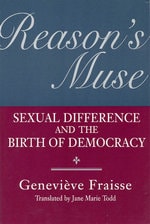
Reason's Muse
Sexual Difference and the Birth of DemocracyGeneviève Fraisse
University of Chicago Press, 1994
Through an analysis of literary, religious, legal, philosophical, and medical texts, Fraisse links a range of positions on women's proper role in society to specific historical and rhetorical circumstances. She shows how the Revolution marked a sharp break in the way women were represented in language, as traditional bantering about the "war of the sexes" gave way to serious discussions of the political and social meanings of sexual difference. Following this discussion on three different planes—the economical, the political, and the biological—Fraisse looks at the exclusion of women against the backdrop of democracy's inevitable lie: the affirmation of an equality so abstract it was impossible to concretely apply.
This study of the place of sexual equality in the founding moment of democracy offers insight into a persistent question: whether female emancipation is to be found through the achievement of equality with men or in the celebration of female difference.

Red Deer
Behavior and Ecology of Two SexesT. H. Clutton-Brock, F. E. Guinness, and S. D. Albon
University of Chicago Press, 1982

Resisting Regionalism
Gender And Naturalism In American Fiction, 1885-1915Donna Campbell
Ohio University Press, 1997
When James Lane Allen defined the “Feminine Principle” and the “Masculine Principle” in American fiction for the Atlantic Monthly in 1897, he in effect described local color fiction and naturalism, two branches of realism often regarded as bearing little relationship to each other. In this award-winning study of both movements, Resisting Regionalism explores the effect the cultural dominance of women’s local color fiction in the 1890’s had on young male naturalist writers, who rebelled against the local colorists and their “teacup tragedies.”
An immensely popular genre, local color fiction reached its peak in the 1880s in such literary journals as Harper’s Monthly, Scribner’s, the Atlantic Monthly, and the Century. These short stories exhibited local “characters,” depicted marginal groups and vanishing folkways, and addressed issues of absence, loss, limitation, and the past. Despite such prickly themes, according to Donna Campbell, local color fiction “fulfilled some specific needs of the public – for nostalgia, for a retreat into mildly exotic locales, for a semblance of order preserved in ritual.”
By the turn of the century, however, local color fiction was fading from the scene, supplanted by writers of adventure fiction and historical romances, with whom local colorists increasingly merged, and opposed by the naturalists. In examining this historic shift, Resisting Regionalism shows that far from being distanced from local color fiction, nationalism emerged in part as a dissenting response to its popularity and to the era’s concerns about the dominance of feminine influence in American literature. The new generation of authors, including Crane, Norris, London, Frederic, Wharton, resisted the cultural myths and narrative strategies common to local colorists Sarah Orne Jewett, Rose Terry Cooke, Mary E. Wilkins Freeman, and Constance Fenimore Woolson. Yet, as Campbell underscores in her analysis of Stephan Crane’s The Monster, the naturalists could, and did, integrate local color conventions with the grotesque and horrifying to powerful effect.
In clear, accessible prose, Resisting Regionalism provides fresh readings of naturalistic works in the context of the dispute between local color and naturalism. In the process, this book shows the debt naturalism owes to local color fiction and illuminates a neglected but significant literary era.

Robert Frost and Feminine Literary Tradition
Karen L. Kilcup
University of Michigan Press, 1998
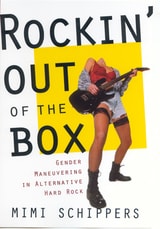
Rockin' Out Of The Box
Gender Maneuvering in Alternative Hard RockSchippers, Mimi
Rutgers University Press, 2002
Given the long history of feminism and its contested place in popular culture, important, practical questions arise: What effect, if any, have feminist ideas and practices had on the lives of young men and women who grew up with them? How do these individuals negotiate the realities of gender in their daily lives?
In Rockin’ Out of the Box, Mimi Schippers, employing the crucial feminist insight that gender is a constantly shifting performance and not an essential quality related to sex, explores the gender roles, assumptions, and transgressions of the men and women involved in the alternative hard rock scene. The author focuses on this sizable section of rock music both because it is widely inclusive of men and women and because it explicitly adopted feminism as its point of departure from mainstream music. Schippers uses the innovative term gender maneuvering to explain her observations that gender and sexuality are negotiated and always changing features of social relations. This process, she demonstrates, operates as a cultural practice and as an individual strategy of resistance to socially prescribed gender roles.
Schippers, who spent more than two years frequenting alternative hard rock clubs and concerts in Chicago, conducted extensive interviews with fans as well as musicians, including Ian MacKaye of Fugazi, Eddie Vedder of Pearl Jam, Kim Thayil of Soundgarden, Donita Sparks and Jennifer Finch of L7, Kat Bjelland and Lori Barbero of Babes in Toyland, Rose of Poster Children, Louise Post and Nina Gordon of Veruca Salt, and Liz Davis and Valerie Agnew of 7 Year Bitch. As it documents the development of a rock music genre that has so far received little academic attention, this book also demonstrates how this musical culture contributes to our understanding of the daily practices of gender relations among young people.